
What is the best supplement for dogs?
Published
By Prasanna M, founder, Growlrr Foods Pvt Ltd · ORCID 0009-0003-6812-347X
Every figure below is quoted from a product label, a company's own website, or a cited paper. Label photographs are our own.
Disclosure. Growlrr sells a nutrient-correction sachet for home-cooked dog and cat bowls. That is a commercial interest in this subject, and it is why every figure here is tied to a product label, a company's own website, or a peer-reviewed paper you can check without trusting us. Nothing on this page is veterinary advice: if your animal is stiff, limping or unwell, the right first step is a vet, not a product.
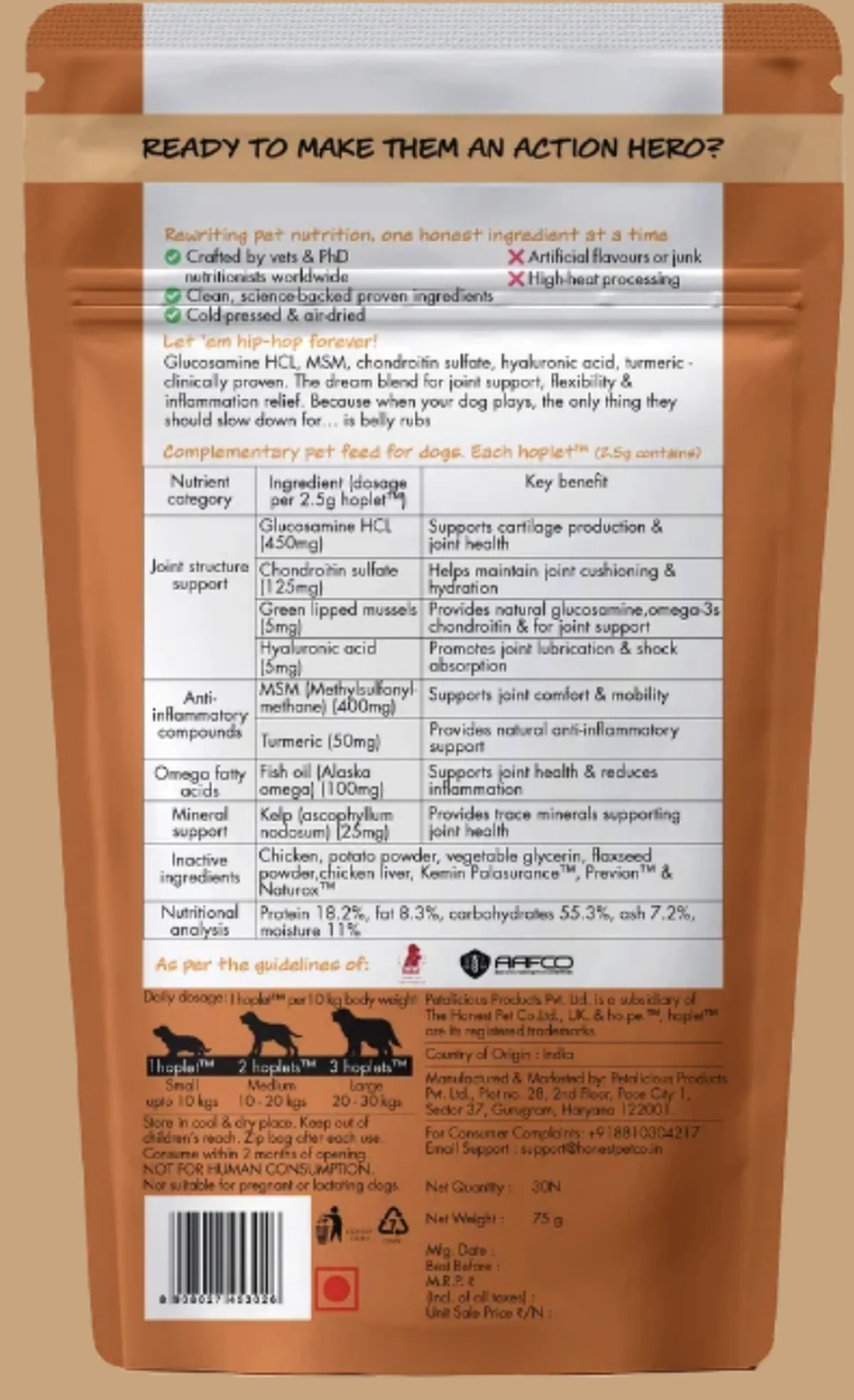
The case in point: a brand that sells "Zero-Asterisk Nutrition" has removed the one asterisk that mattered. The ho.pe. Hip + Joint Chicken Hoplet™ lists green-lipped mussel at 5 mg per chew. Feed a 30 kg retriever the label's three chews and it gets 15 mg a day. The randomised dog trials of green-lipped mussel used 600–1,470 mg a day for a dog that size. That is 40 to 98 times the label serving — between 120 and 290 chews a day. The name is on the front of the pack. The dose is not. Everything below is that one division, shown.
Dog joint supplement label: what is actually in a hip and joint chew
We did not take anyone's word for this. The numbers below are from the brand's own product page and from its 1mg listing, read on 14 September 2026; two other models, asked independently, pulled the same figures.
Per 2.5 g Hoplet (chicken): glucosamine HCl 450 mg · MSM 400 mg · chondroitin sulfate 125 mg · fish oil 100 mg · turmeric 50 mg (on the 1mg listing; absent from the brand page) · kelp 25 mg · green-lipped mussel 5 mg · hyaluronic acid 5 mg. Inactive: hydrolysed chicken, potato powder, vegetable glycerin, flaxseed powder, coconut oil, and three Kemin systems — Palasurance™, Previon™, Naturox™ (industrial palatant, preservation and antioxidant blends). Feeding guide: 1 Hoplet under 10 kg · 2 for 10–20 kg · 3 for 20–30 kg · 4 over 30 kg. Price: ₹899 for 30.
Nothing on that label is hidden. That is the point: the arithmetic is available to anyone who turns the pack over.
Green-lipped mussel dose for dogs: what the trials used
Wondering how this applies to your own pet? Build their bowl — two minutes, and it gives the exact grams for their weight.
Green-lipped mussel (Perna canaliculus) is a genuinely studied ingredient for canine osteoarthritis. Here are the doses in the studies that are actually cited when someone says "backed by research":
| Study | Design | GLM form | Dose | For a 30 kg dog |
|---|---|---|---|---|
| Hielm-Björkman et al. 2009, eCAM | randomised, double-blind, placebo + carprofen controls; GLM beat placebo on vet mobility index and pain score (less than carprofen) | powder capsules | 20–49 mg/kg/day | 600–1,470 mg/day |
| Cave et al. 2024, NZ Vet J | pilot RCT, working farm dogs | full-fat extract | 180–220 mg/day ("low dose") | 180–220 mg/day |
| Kampa et al. 2023, Front Vet Sci | randomised, double-blind, placebo + carprofen | lipid extract (PCSO-524 / EAB-277) | 5 mg/kg/day | 150 mg/day |
| Rialland et al. 2013, Can J Vet Res | prospective, diet-based | GLM-enriched complete diet, 60 days | whole diet enriched | (grams, not milligrams) |
Two things to notice. The lowest figure in any of those trials is 150 mg a day — and that is for a concentrated lipid extract, not powder. And the powder trial, the one closest to what a chew would contain, used the highest doses of all.
The dose maths: label serving vs trial dose
- Label: 5 mg per chew × 3 chews (the guide for 20–30 kg) = 15 mg/day.
- Powder trial range for 30 kg: 600–1,470 mg/day → 40× to 98× the label serving → 120 to 294 Hoplets a day.
- Even the lowest extract dose ever trialled, 150 mg/day → 10× → 30 Hoplets a day.
At ₹899 for 30, the powder-trial dose costs between ₹3,600 and ₹8,800 a day — and delivers 300–735 g of potato powder, glycerin and hydrolysed chicken alongside it, which is several days' worth of calories for a dog whose joints are the one thing you do not want to load.
No one will do that. The guide says three. At three, the green-lipped mussel is a rounding error: 1–2.5 % of the trial dose. The ingredient is on the front of the pack because the name sells; it is at 5 mg because 5 mg is what fits after the chew has been built.
“Zero asterisks”: the asterisk was the dose
The brand's homepage says, in its own words: "Zero-Asterisk Nutrition… No asterisks leading to disclaimers. No 'results may vary' hidden in tiny text… what you see is what you get." Its footer adds that the industry "hides behind disclaimers, puns and fine print."
Take that at face value, because it is the most useful sentence on the site. The asterisk is not a trick the industry plays on you. The asterisk is where the dose lives. It is the small print that says at this serving, this ingredient is 1–2.5 % of the amount the studies used. Remove the asterisk and you have not removed the caveat; you have removed the reader's only chance of seeing it. "What you see is what you get" is true here in the least helpful way: you see the name, you get 5 mg.
So the honest version of this label would carry exactly one asterisk, on the mussel, and it would read: studies used 40–100 times this amount. A brand that prints that is honest. A brand that prints "no asterisks" instead has made the absence of the caveat the product. The word on the front of the pack and the number on the back are doing opposite jobs, and the front is winning because the front is what gets read.
Glucosamine and chondroitin for dogs: dosed, but does it work?
This is where a hit-piece would stop, and where we should not. Not every line on this label is dusted:
- Glucosamine 450 mg × 3 = 1,350 mg/day ≈ 45 mg/kg. That is a real dose — above the 30 mg/kg Kampa et al. used. The catch is different: in that trial, glucosamine + chondroitin at 30 mg/kg did no better than placebo over six weeks, while the marine lipid extracts matched the NSAID. So the glucosamine is dosed honestly; the evidence for glucosamine is the weak link.
- Chondroitin 375 mg/day ≈ 12.5 mg/kg — in the same range as that trial's tablet. Dosed, same caveat.
- MSM 1,200 mg/day — no trial dose to compare against; a common inclusion, an uncommon subject of controlled studies.
- Fish oil 300 mg/day — for context, the omega-3 doses that move osteoarthritis scores in dogs run to grams, not hundreds of milligrams; this is a flavour-level inclusion.
- Hyaluronic acid 5 mg, kelp 25 mg — label ornaments. Same 5 mg logic as the mussel.
So the fair verdict is precise: the two ingredients this product leads with — "New Zealand green-lipped mussel" — are the two it contains the least of. The ones it actually carries in trial-scale amounts are the ones the best recent trial found inert.
Why a 2.5 g chew cannot carry a therapeutic dose
A 2.5 g chew is mostly binder, carrier and palatant — it has to hold together, taste of chicken, and last on a shelf. Once the format takes 1.5–2 g and glucosamine and MSM take most of the rest, adding 600 mg of mussel would mean roughly one and a half times the active load in the same chew. It is not impossible; it is a different product, and not the one on the shelf. The all-in-one list and the all-in-one format are in direct contradiction, and the list wins because the list is what gets read.
“Complementary pet feed”: what the pack says that the site does not
Everything above came from the brand's website. The pack is franker. On the back-of-pack render on ho.pe.'s own product page (read 14 September 2026), the ingredient table is headed, in full: "Complementary pet feed for dogs. Each hoplet™ (2.5 g) contains…" Complementary is the regulatory word for a product that is neither a complete food nor a treatment — a topper, legally. The front of the site says "India's cleanest, most effective pet supplement"; the back of the pack says complementary feed.
Complementary is not a modest word; it is a defined one. In the EU rulebook this pack borrows its vocabulary from, a complete feed is one "sufficient for a daily ration" on its own, and a complementary feed is one that "by reason of its composition, is sufficient for a daily ration only if used in combination with other feed" (Regulation (EC) 767/2009, Art. 3). Under AAFCO — the guidelines the pack itself cites — a product that is not complete must say so on the label: "intended for intermittent or supplemental feeding only." And a veterinary medicine, unlike either, must demonstrate efficacy at its labelled dose before it may claim to treat anything. So the word tells a regulator three things at once: this is not a food, this need not meet a nutrient profile, and this is not a medicine. In India there is no standard for complementary pet food at all — the one Indian standard, IS 11968, is voluntary and covers complete food only — so the word carries no domestic obligation whatsoever.
Now ask what it tells a pet parent. It appears once, as the header of the ingredient table on the back of the pack, in the smallest type on the panel. Complementary to what? The pack does not say — not to a diet, not to a treatment, not to a vet's plan. A reader who knows the term learns that the product makes no claim to completeness or efficacy; a reader who does not, which is nearly everyone, sees a word that sounds like complimentary and moves on to hip + joint, clinically proven and results in 4 weeks on the front. Both readings are available from the same pack. Only one of them is what the pack is for.
The word is not confined to supplements, and the clearest example on our desk is a cat pouch. On Amazon India (read 14 September 2026), Bellotta Tuna Topping Shrimp in Jelly — ₹880 for sixteen 85 g pouches, ₹55 each — is listed as "Wet Food for Cats and Kittens" under a splash card reading "WHOLE FOOD NUTRITION FOR COMPLETE CAT WELLNESS." The pouch front carries a 1+ badge and the roundels Taurine · Vitamins & Minerals · No preservatives added. Turn the pouch over (our photograph, May 2026): directly under the product name, in the small type beside the tear-strip, it says "Complementary for Adult Cat." Guaranteed analysis: protein min 12 %, fat min 1.0 %, moisture max 84 %; 47 kcal per 100 g. A 4 kg cat needs roughly 200–240 kcal a day — five pouches, ₹275, and still on a product that has told the regulator it is not a diet. Complete cat wellness on the listing; complementary on the pouch; the same tuna in the same jelly. (The listing's own ingredient panel — water, tuna, chicken, wheat gluten, modified tapioca starch — does not match the pouch's — water, tuna, shrimp, flavouring, gel powder, taurine, FOS, vitamins and minerals — and sits beside a graphic reading "No chicken or poultry by-products"; we take that as a panel copied from another variant and note it only as a mismatch between listing and pack.)
For contrast, the pouch photographed next to it, True Hunt from RMD Petcare, Bengaluru, says in ordinary type: "Complete and balanced wet food for cats, formulated to meet AAFCO & FEDIAF nutritional guidelines" — protein 12.5 %, fat 3 %, taurine 0.2 %, 72 kcal per 100 g, ₹98. That is what the word complete looks like when a label is willing to carry the obligation that comes with it.
Below the table is a line the site never shows: "Nutritional analysis: protein 18.2 %, fat 8.3 %, carbohydrates 55.3 %, ash 7.2 %, moisture 11 %." More than half of a hip-and-joint chew, by its own analysis, is carbohydrate — the potato powder, glycerin and flaxseed that hold it together — fed one per 10 kg of dog per day to animals whose joints are the reason for buying it. (What extra weight does to a dog's joints is in the trials above.)
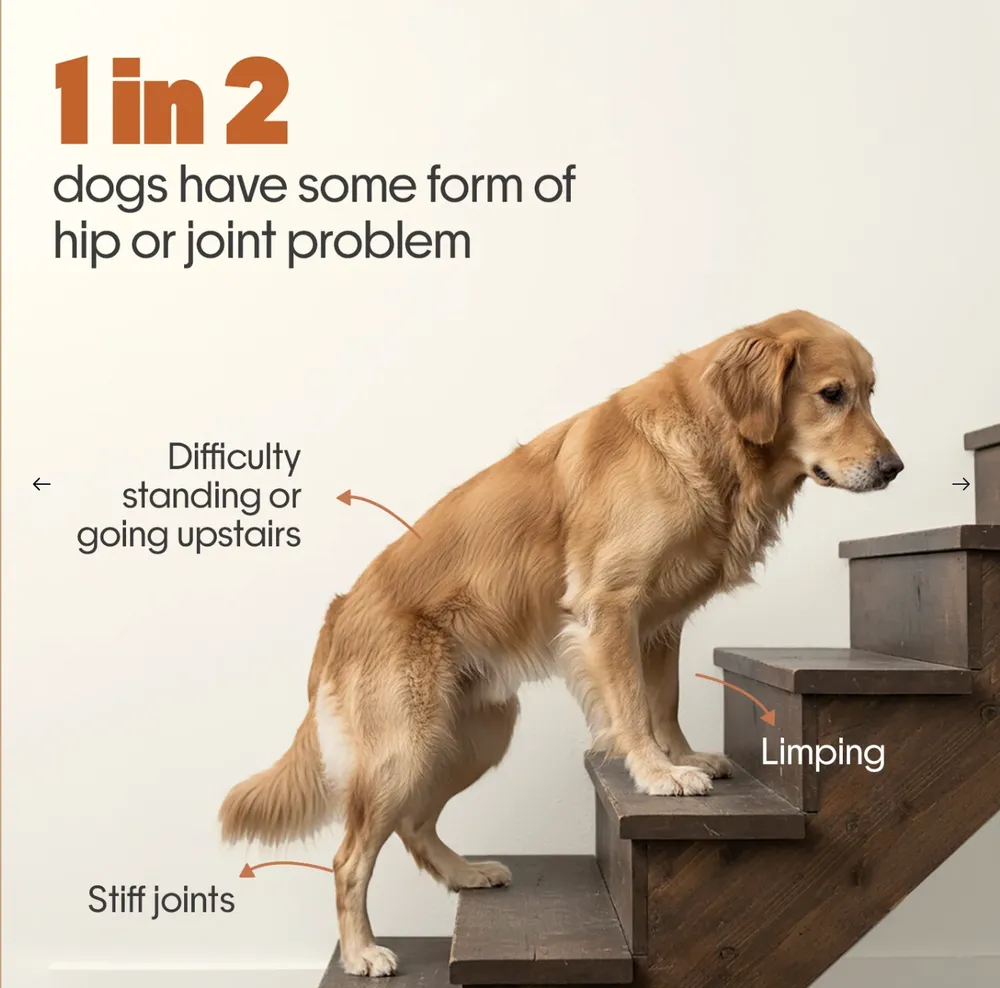
Two more lines from the same pack and page, quoted so the reader can weigh them against the milligrams: on the pack, "Glucosamine HCL, MSM, chondroitin sulfate, hyaluronic acid, turmeric — clinically proven"; on the site, "Results in 4 weeks", "1 in 2 dogs have some form of hip or joint problem", and a testimonial from a member of the brand's expert panel, a US DVM: "As a vet, I'd only recommend scientifically proven products with efficacy at its core for my patients — therefore, I trust and recommend hoplets from ho.pe." We do not doubt the sincerity. We have printed the doses. Scientifically proven refers to the ingredients; the product is a complementary feed with 5 mg of the one it leads with, and the reader can hold both sentences side by side.
Are joint chews bad for dogs? Why doing nothing beats doing this
If the mussel dose were merely too small, this would be a story about wasted money. It is not. Three things happen to a real dog while the pack sits in the kitchen:
1. Stolen time. A seven-to-nine-year-old retriever with stiff hips has osteoarthritis that is progressing now. The owner reads "Hip + Joint", watches the dog eat the chew eagerly, and reasonably believes the condition is being managed. So the vet visit that would have produced a weight plan, an anti-inflammatory, or one of the newer monoclonal-antibody treatments is deferred — six months, a year. The chew does not merely fail to help; it occupies the slot where help would have gone. The cartilage does not wait.
2. Calories on the joint. The single intervention with the clearest evidence in canine osteoarthritis is not a supplement at all. Marshall et al. (2010) took obese arthritic dogs and did nothing but reduce their weight — and lameness improved, measured on a force plate, not by owner impression. A 2.5 g chew of hydrolysed chicken, potato powder, glycerin and coconut oil, three or four a day, every day, is a small daily deposit in exactly the wrong account. Each extra kilogram on the dog is several kilograms of extra load through the hip on every stride.
3. Reassurance in the wrong direction. The product's real effect is on the human: the ritual, the tick-box, the feeling of having acted. That feeling is what the ₹899 buys. A product that made an owner more alert to the dog's decline would be worth paying for. This one makes them less.
What to give a dog instead of a joint supplement
The same money, spent on things that contain gram-scale amounts of something, rather than milligram-scale amounts of everything:
- A vet visit and a weight target. For a stiff older dog this is the intervention with the strongest evidence and the one the chew displaces. It also costs about one pack.
- Bone broth, made at home. Marrow bones and chicken feet, simmered slowly, give gelatin and collagen in grams — the glycine and proline that joint cartilage is made of, in a form dogs drink willingly — plus hydration, which older dogs with joint pain often under-do. No binder, no palatant, no potato. This is food, not medicine: we make no claim that broth treats arthritis. We do claim that ₹200 of bones deliver more of the actual material than ₹899 of chews, and the dog gets something real at the end of it.
- For the gut version: a fermented milk, made at home. The Pre + Probiotic Hoplet (same ₹899/30, same potato-and-glycerin base) contains one bacterial strain — the label reads "Enterococcus defaecium", 2 billion CFU — with 50 mg each of three prebiotics and 125 mg of hing. A cup of kefir is a living community of dozens of bacterial and yeast species in a milk matrix, for the price of the milk. In a hot, humid kitchen, skip the live grains and use a freeze-dried starter kept in the fridge; back-batch it. Introduce slowly — some dogs do not tolerate dairy, and that matters more than any strain count.
None of these is a cure and none of them should be sold as one. They are cheap, real, and gram-scale, and they leave the ₹899 for the vet.
“Vet approved” dog supplements: what the advisory board actually signed
The site names a US DVM, a UK animal nutritionist and an Indian pet nutritionist, and says "1,000+ research publications support our ingredients." Both things can be true and neither answers the question. Publications exist on green-lipped mussel at 20–49 mg/kg. An advisor asked "is 5 mg safe, is the mechanism plausible, does the label comply?" can say yes three times, honestly. Nobody was asked "does 15 mg a day do what the 1,000 publications did?" — because the answer is on this page.

Where the supplement playbook came from: human wellness
None of it is a pet-industry invention. The human supplement business spent twenty years building the template: the amber bottle, the "proprietary blend", seventy-five superfoods per scoop at whispers each, and the move from curing to optimising so you can never tell whether it worked and are nervous to stop. The pet version is the same template with a retriever in the photo, plus one structural improvement for the seller: the customer cannot read the back of the pack, and cannot tell you the hip still hurts.
How to check any dog supplement in one minute
- Find the milligrams per serving of the headline ingredient. If it is not printed, that is your answer.
- Find one dog trial of that ingredient and note its mg per kg per day.
- Multiply by your dog's weight. Divide by the serving.
If the answer is "three", buy it. If the answer is "a hundred and twenty", you are buying hope by the milligram.
The best supplement for dogs is the bowl, then the residual
Every label above uses complementary as a way out and never says what it complements. We do the opposite, and it is the only thing that makes the word honest: name the food first.
The bowl is defined before the sachet is. It is the best bowl an ordinary person can put together any day at a local grocery: a mix of chicken, mutton, common farmed fish like tilapia, and eggs — with curd and vegetables for dogs — and no liver, no heart, no bone, no exotic marine fish, nothing that needs a specialist supplier or a nerve. That bowl is cooked, weighed and measured against the NRC 2006 requirement for the animal's size, nutrient by nutrient. What it leaves short is a known list, and the sachet adds back precisely that — dosed by the animal's weight, checked in the validation runs, with the arithmetic on Zenodo where anyone can run it. Complementary to that bowl: named, ordinary, repeatable, printed.
So the order of operations is the reverse of the shelf. A food-based deficiency is best fixed with food. Feed the real bowl; correct only the residual the real bowl leaves; put nothing in the correction that the residual does not call for. The sachet is not a supplement in the shelf sense — it is a correction to a measured gap in a defined diet. Not a claim to be better. A claim to be checkable, which after the division above is the whole point.
Sources. Google Search Quality Rater Guidelines (public PDF; YMYL definition, E-E-A-T, Trust as the most important member; 2024–2025 revisions on exaggerated or misleading expertise claims). Bellotta: Amazon.in listing B09HHC35VZ (DogsNCats), splash cards and title, read 14 Sep 2026; pouch back photographed May 2026 (own photograph) — "Complementary for Adult Cat", guaranteed analysis, 47 kcal/100 g, MRP ₹55, imported by Sai International Pet Products, Ghaziabad; manufactured by i-Tail Corporation, Thailand. True Hunt: pouch back, same photograph — "Complete and balanced… AAFCO & FEDIAF", RMD Petcare Technologies, Bengaluru, MRP ₹98. Definitions: Regulation (EC) No 767/2009, Art. 3(2)(h)–(i) (complete / complementary feed); AAFCO Model Regulations for Pet Food, PF7 (nutritional adequacy statement — "intermittent or supplemental feeding only"); IS 11968 (BIS, complete pet food, voluntary). Pack render (back of pack) on the brand's Hip + Joint product page, honestpetco.in, read 14 Sep 2026 — "Complementary pet feed for dogs"; nutritional analysis protein 18.2 / fat 8.3 / carbohydrates 55.3 / ash 7.2 / moisture 11 %; "clinically proven"; daily dosage 1 hoplet per 10 kg; manufactured & marketed by Petolicious Products Pvt Ltd, Gurugram. Site copy: honestpetco.in homepage hero and footer ("Zero-Asterisk Nutrition"), read 14 Sep 2026. Product labels: honestpetco.in, Hip + Joint Chicken Hoplet™ for Dogs and Pre + Probiotic Chicken Hoplet™ for Dogs product pages; 1mg.com listing "ho.pe. by The Honest Pet Co. Hip & Joint Health Chicken Supplement for Dogs" (both read 14 Sep 2026). Trials: Hielm-Björkman A et al., Evid Based Complement Alternat Med 2009;6(3):365–373 (PMC2722199) · Kampa N et al., Front Vet Sci 2023;10:1033188, doi:10.3389/fvets.2023.1033188 (PMC9929184) · Cave N et al., N Z Vet J 2024, doi:10.1080/00480169.2024.2379966 · Rialland P et al., Can J Vet Res 2013;77(1):66–74 (PMC3525174) · Corbee RJ, Vet Med Sci 2022 (PMC9122405) · Marshall WG et al., Vet Comp Orthop Traumatol 2010;23(2):89–94 (PMID 20237844) — weight loss alone improves lameness in obese OA dogs.