
Is ready-to-eat ‘fresh’ dog food actually better? What to know before you subscribe
Published
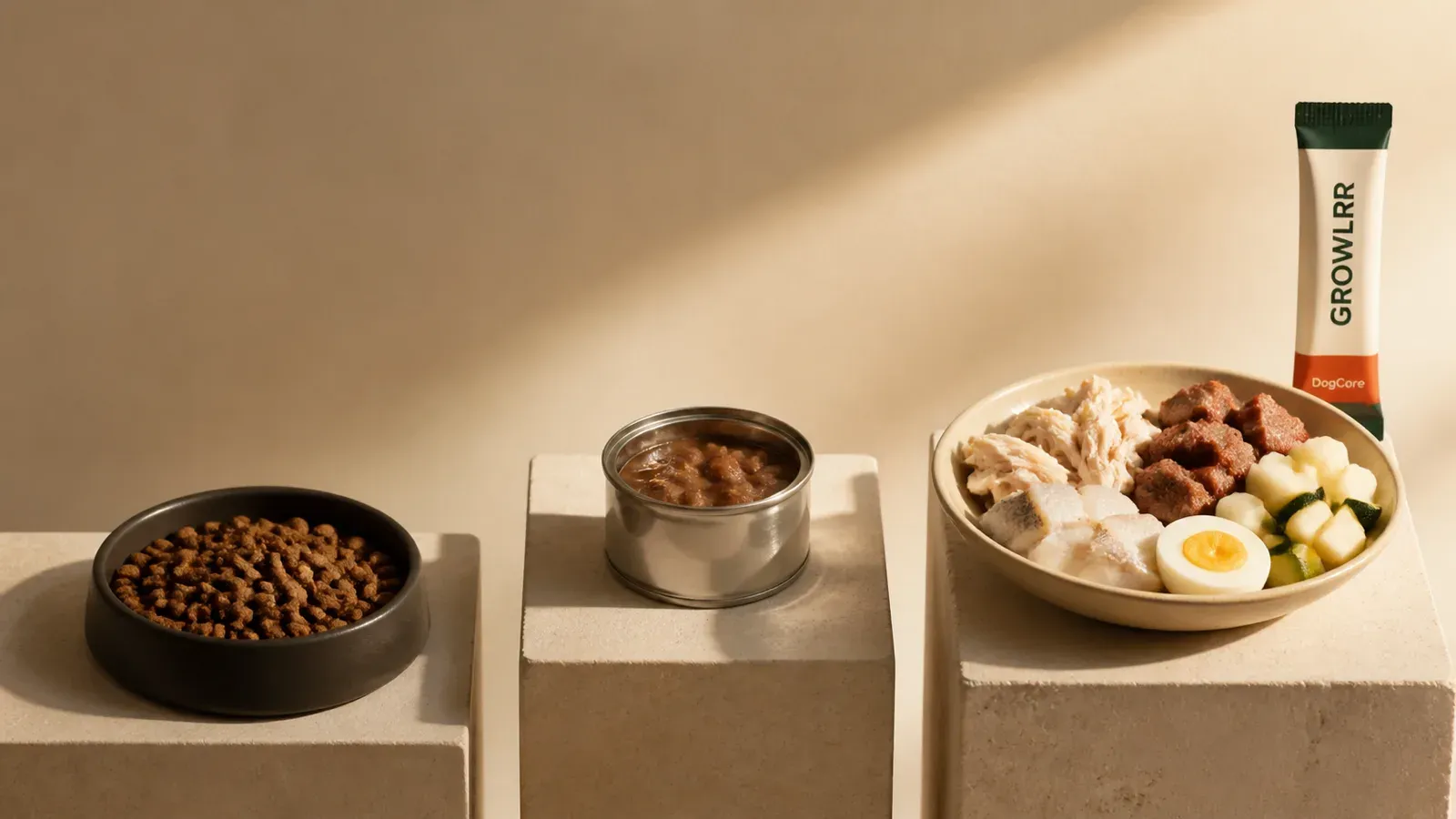
“Fresh, delivered, ready to serve” has become one of the fastest-growing ideas in pet food, and the big US names — The Farmer’s Dog, Ollie, Nom Nom, JustFoodForDogs — have made it look effortless. Before you subscribe (and these brands are not actually sold in India, so for most readers here this is education rather than a shopping list), it helps to see that “fresh” is not one thing. There are a few genuinely different architectures hiding under that one word, and which one you pick changes how much control you keep.
The four kinds of “fresh”
It is worth laying them out plainly, because the marketing rarely does:
- A — you cook, then add a nutrient premix. You supply all the food and a corrector powder closes the micronutrient gaps. Precise, but it asks the most of you.
- B — you add meat to a base (bulk) mix. The brand sells a bag of grains and vegetables with minerals folded in; you rehydrate it and stir in your own protein and oil. Dr Harvey’s and The Honest Kitchen are the well-known examples. Convenient, but a large share of the bowl is the brand’s carbohydrate base.
- C — complete fresh food, delivered ready-to-serve. The brand cooks and portions everything; you open a pack and pour. The Farmer’s Dog, Ollie, Nom Nom and JustFoodForDogs live here. You supply nothing but the subscription.
- Growlrr’s BARC — you cook a fresh base, weight-dosed sachets correct it. You keep the fresh meat decision; the correction is calculated and dosed to your specific animal.
None of these is “bad.” But Category C — the ready-to-eat delivered box most people mean when they say “fresh food” — makes a particular set of trade-offs that are easy to miss, so it is worth being clear-eyed about them.
What ready-to-eat delivery gets right
Wondering how this applies to your own pet? Build their bowl — two minutes, and it gives the exact grams for their weight.
Start with the credit, because it is real. Ready-to-eat delivery is genuinely convenient — no cooking, no calculator, a portioned pack you thaw and serve. It uses real, recognisable fresh ingredients rather than a rendered pellet, and for a household that was never going to cook, it is a real step up from a cheap bag of kibble. If your alternative is low-tier dry food and you do not want to be near a stove, this category is a genuine improvement. The critique that follows is not “these are bad products” — it is that a complete-prepared box and a cook-fresh-plus-balancer bowl are different architectures, and the differences matter.
Three trade-offs to know before you subscribe
1. The base is chosen for you, and it often leans on starch. A ready-to-eat recipe is built around a base the brand selects, and that base commonly includes rice, potato, lentils, chickpeas, peas — and, in some lines, fruit. That is carbohydrate the marketing rarely puts front and centre. Several of these brands (The Farmer’s Dog and Ollie among them) do not publish full ingredient lists at all — you have to sign up to see them — so nobody outside the company can tell you exactly how much of the bowl is carbohydrate, only that it is there and you did not choose it. You cannot see the cuts, control the sourcing, or swap an ingredient your dog does not tolerate. The base is the brand’s decision, served to your dog.
2. One nutrient density for every dog. A given recipe delivers the same nutrient profile per calorie to every animal eating it. What gets personalised is the portion — how much of the recipe your dog is sent — not the correction. A lazy senior and an athletic young dog on the same recipe get the same nutrient density; only the size of the scoop changes. Sizing the portion to the dog is real and useful, but it is not the same as tuning the nutrients to the dog.
3. You are paying to ship refrigerated food — and water — to your door. Fresh food is mostly water, and a delivered box freights that water across the country under cold-chain, then asks your freezer to hold it. That is a premium cost structure baked into the model. It is also a structure that essentially does not exist in India, where there is no national cold-chain fresh-delivery network for pet food and the meat you would cook is already a short walk or a Blinkit order away.
The Growlrr contrast: you keep the protein decision
Growlrr’s BARC model is built around the two things Category C takes off your hands. You keep control of the fresh base — buy the chicken, mutton, goat or fish you trust, from your local butcher, Licious or Blinkit — and you can swap proteins freely, because the correction was validated across that variance. Then one 5 g Growlrr BowlBalancer™ sachet, dosed to your animal’s body weight, closes the micronutrient gaps a meat bowl leaves open — calcium balance, iodine, zinc, copper, vitamin D and E, and the omega-3 fatty acids EPA and DHA — corrected to the NRC 2006 floors. The correction is personalised, not just the portion. There is no brand-chosen starch base, no cold-chain, and no shipped water. If you want to understand what “complete and balanced” actually means and why a plain meat bowl needs correcting at all, we explain it in complete and balanced, in plain English. Sachet prices are on the pricing page.
A quick word on cats
Most ready-to-eat delivery is built for dogs, but the same logic applies to cats — and the base-and-density trade-offs matter more, not less, for an obligate carnivore that needs a high-protein, low-carbohydrate, moisture-rich bowl. Growlrr’s CatCore™ sachet corrects a fresh feline bowl the same way, dosed to your cat’s weight.
So — is it actually better?
Better than a cheap bag of kibble for someone who will not cook? Often, yes. Better than cooking a fresh base yourself and correcting it precisely for your own animal? That depends on what you value. If you want to hand over every decision and pay a premium for the convenience and the cold-chain, ready-to-eat delivery does that well. If you want your dog’s calories to come from meat you chose, with the nutrient gap closed to your specific animal — and none of the shipped-water cost — that is a different product, and it is the one Growlrr is built to be. In India, where fresh meat is cheap and local and there is no subsidised fresh-delivery network, the cook-fresh-plus-balancer model simply fits the way households already feed.
Fresh dog food delivery in India: the trend and what to check
Folded in (2026-09-17): the category as it stands in India, and the three checks before you subscribe.
The fresh-food trend has reached India
For years the "fresh dog food, delivered" model was a US story. Now it is here: Doggy Dhaba (doggydhaba.in — frozen cooked meals delivered in about ten cities), Skylish (frozen cooked meals shipped from Hyderabad), Nuts Over Mutts (a fresh-frozen line in Delhi–Gurgaon), and BARF India (frozen raw and cooked ranges on a metro cold chain). One caution as you browse: several brands sold under the word “fresh” describe retort (heat-sterilised, shelf-stable) packaging on their own product pages — Sploot’s ready-to-eat line, for example, says exactly that. The storage line never lies: months at room temperature is not fresh food.
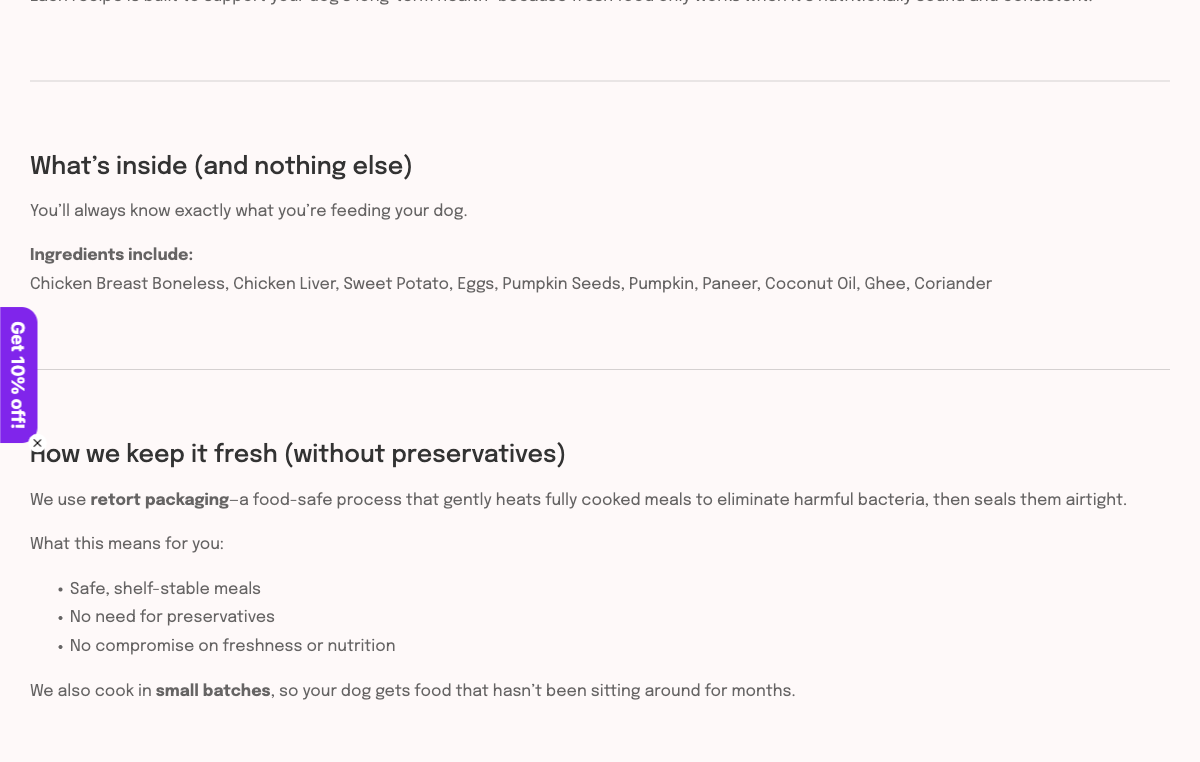
(Brand details verified from their own pages, 30 August 2026 — ranges and cities change; check the current page.) The pitch is the same everywhere — real, gently cooked food instead of extruded pellets, portioned and delivered to your door. For Indian pet parents tired of reading cereal-first kibble labels, the appeal is real.
What the category gets right
Credit where it is due. These are fresh, recognisable ingredients, gently cooked rather than high-heat extruded. The better brands bring a nutritionist into the formulation. The food is hydrating in a way dry kibble is not, and portioning is done for you. Against a bag of cereal-first kibble, a fresh cooked bowl is the better bowl — that part is not in dispute, and the trend is a good thing for Indian pets overall.
Three things to check before you subscribe
- What is in the base? Many fresh-delivery recipes lean on rice, paneer and vegetables — carbohydrate and dairy a carnivore did not evolve to run on. Some brands go further and offer vegetarian dog meals, which for a facultative carnivore is a real appropriateness question — and for a cat, an obligate carnivore, a non-starter. You do not choose the base; the brand does.
- Is it proven complete, or formulated on paper? "Formulated by a nutritionist" is a genuinely good start. The next question is whether completeness to NRC 2006 / AAFCO is validated across real-world variability — and whether you can verify it for your own dog's bowl, rather than trusting a single calculated recipe.
- The frozen subscription. Fresh delivery means cold-chain logistics and a recurring plan, and one nutrient density per recipe — only the portion is personalised to your dog, not the correction. A lazy senior and an athletic young dog on the same recipe get the same nutrients per calorie.
Where Growlrr fits
A cook-and-balance bowl keeps the fresh food and returns the two decisions a subscription makes for you: which protein your dog eats — buy it locally, swap freely — and how the nutrients are dialled in. The base is fresh, boneless and meat-first by design (≥85% animal-derived energy for dogs, ≥95% for cats — never vegetarian), and weight-dosed Growlrr BowlBalancer™ corrects it to every NRC 2006 floor, sized to your animal rather than averaged across a recipe. Completeness is validated across 1 Million+ simulations at Wilson C/R 95/99 — and there is no cold chain, no shipped water, and no recipe you are locked into.
References
- National Research Council (NRC). Nutrient Requirements of Dogs and Cats. Washington, DC: National Academies Press; 2006.
- FEDIAF. Nutritional Guidelines for Complete and Complementary Pet Food for Cats and Dogs. 2024.
What counts as fresh food → · Check your dog's bowl against NRC 2006 (free)
References
- National Research Council (NRC). Nutrient Requirements of Dogs and Cats. Washington, DC: National Academies Press; 2006.
- FEDIAF. Nutritional Guidelines for Complete and Complementary Pet Food for Cats and Dogs. 2024 edition.
Build a fresh, complete bowl for your own animal →
Base mixes (Dr Harvey’s, The Honest Kitchen): the ‘just add meat’ cousin
Merged from our earlier piece on the same question (2026-09-16), so one page answers it.
What a base mix is
A base mix is a dehydrated blend of vegetables, sometimes grains, and a vitamin-mineral premix. You rehydrate it and stir in a protein you buy and cook yourself. It sits in a category of its own — not a complete food like kibble, and not a plain home-cooked bowl, but a scaffold you finish. It is a genuinely thoughtful idea, and for people who want to add real meat without doing the whole nutrition calculation, it has real appeal.
What it gets right
Credit where it is due. You choose the protein, so you can use meat you trust and avoid one your dog reacts to. There is real vegetable and fibre content. And it is a clear improvement over a bag of cereal-first kibble. None of that is in dispute.
Three things the architecture can't do
The limits are structural, not about quality:
- The base is dehydrated, not fresh. The vegetables and carriers are dried for shelf life. You add fresh meat, but the scaffold around it is a processed dry blend.
- The base is chosen for you, and fixed. You control the protein, but not the veg, grains, or the premix ratios. You can't tune the base to the protein you picked or to your dog's weight.
- The correction is one-size. The vitamin-mineral premix is blended for an average bowl, not calibrated to how much meat you actually added or to your specific dog. You finish the bowl without a way to confirm it clears every NRC 2006 floor.
How cook-fresh-and-balance differs
Growlrr keeps the good part — you choose and cook the protein — and closes the two gaps. The base is fresh, not dehydrated, and boneless; the calcium and the heat-sensitive vitamins come from a sachet, not from a dried premix or from bone. And the correction is dosed to your animal's body weight rather than blended for an average, then validated to complete the bowl across ingredient substitution — so swapping proteins doesn't quietly open a gap. Completeness is measured against NRC 2006, not assumed.
References
- National Research Council (NRC). Nutrient Requirements of Dogs and Cats. Washington, DC: National Academies Press; 2006.
- FEDIAF. Nutritional Guidelines for Complete and Complementary Pet Food for Cats and Dogs. 2024.
Build a fresh, complete bowl → · What counts as fresh food?
Related reading
- Is Ollie dog food worth it? What to weigh up
- Is The Farmer’s Dog worth it? What to weigh up
- Base-mix dog food (Dr Harvey’s, The Honest Kitchen): what to know
- Fresh dog food delivery in India: the brands and the trade-offs
- Why the pet food rules have not changed — and what PFLM actually fixes
- “Just chicken and pumpkin. Nothing else.” — what that bowl is missing
- Herbs are not nutrients: reading an Ayurvedic pet food label