
Why we built Growlrr
Why does a fresh bowl need a BowlBalancer?
Because fresh feeding is one of the best things you can do for a dog or cat — and also the easiest place to accidentally miss a nutrient. The Growlrr BowlBalancer exists to close that one gap, so fresh food can be complete food.
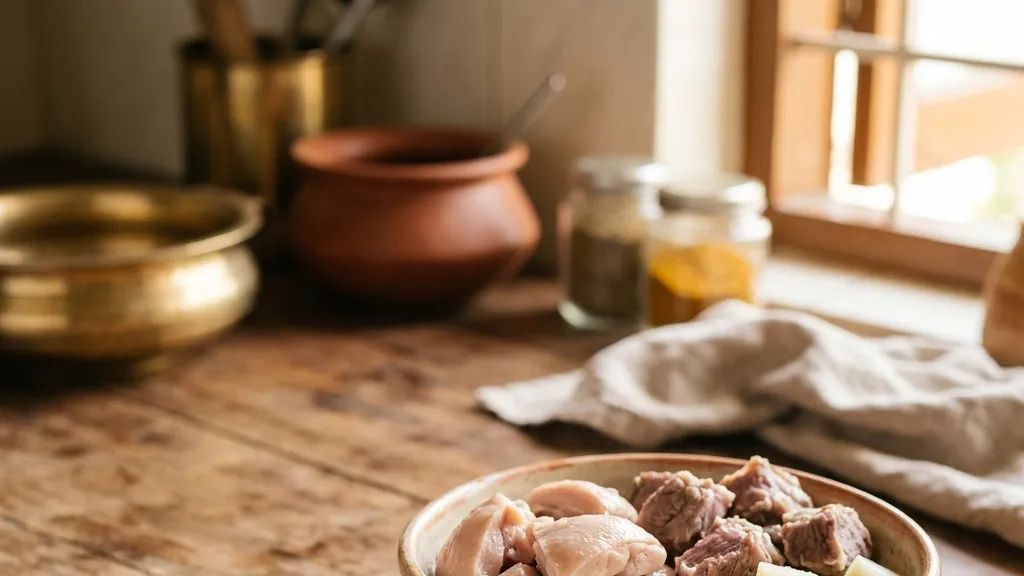
More and more Indian families are cooking fresh for their pets, and that's a genuinely good direction. Fresh, species-appropriate food is closer to what a cat or dog is built to eat, and cooking it is an act of care. We're firmly for it. There is just one part of a home bowl that is hard to get right by hand.
When researchers at UC Davis evaluated 200 home-prepared maintenance recipes drawn from 34 sources, 95% fell short on at least one essential nutrient and most were low on several; only 5 of the 200 met the full profile.* The gaps weren't carelessness — they cluster in the nutrients a cook simply can't judge by looking: calcium, iodine, zinc, copper, the B-vitamins. Fresh feeding is better for the animal in almost every way, and mathematically incomplete in this one.
India makes this harder than it needs to be. There are roughly 28–32 million pet cats and dogs in the country, and no dedicated Indian nutritional standard for them — no local equivalent of the research and labelling frameworks used elsewhere, such as the NRC in the United States or FEDIAF in Europe.** That doesn't mean every product is bad; it means a caring owner has no easy, official yardstick to measure a bowl against. So we adopted one.
What the gap actually means for your pet
Our answer
We took the highest widely-recognised reference — NRC 2006, the National Research Council's Nutrient Requirements of Dogs and Cats — and built the whole product to meet it, using tools that weren't available when that standard was written.
The method is called BARC — Biologically Appropriate, Residually Corrected, and Growlrr pioneered it. You cook a fresh, balanced bowl (chicken, mutton, farmed fish like tilapia and egg — plus curd and a little veg for dogs). We supply a single 5 g precision sachet that corrects the residual: the exact micronutrients the fresh bowl is missing, delivered as purified, assay-verifiable actives rather than variable powders.
Then we prove it holds up. We run a Monte-Carlo simulation — the recipe re-run more than a million times, each time with the realistic swings you'd see in grocery meat from batch to batch and season to season — to make sure it stays complete even on an off day. The target is a claim borrowed from reliability engineering, written as Wilson C/R 95/99: 95% confidence that your pet receives at least 90% of NRC 2006 for every essential nutrient on at least 99% of days.
That's what fills the gap for our customers — not a compliance stamp, but a bowl you can actually verify.
Your pet. Your kitchen. Our science.
The animals who share our homes deserve food that respects what they are. Our part is to make the fresh food you already love to cook for them complete — precisely, transparently, and every single day.
References
* Stockman et al. (2013). Evaluation of recipes for home-prepared maintenance diets for dogs. JAVMA — 200 recipes, 34 sources; 95% deficient in ≥ 1 essential nutrient.
** Euromonitor International (2024). Pet population India: estimated 28–32 million cats and dogs, urban households. IMARC Group (2024): India pet-care market growth 2024–2029.
NRC (2006). Nutrient Requirements of Dogs and Cats. National Academies Press.
Pion et al. (1987). Myocardial failure in cats associated with low plasma taurine. Science.