
What's missing from homemade dog food?
Published
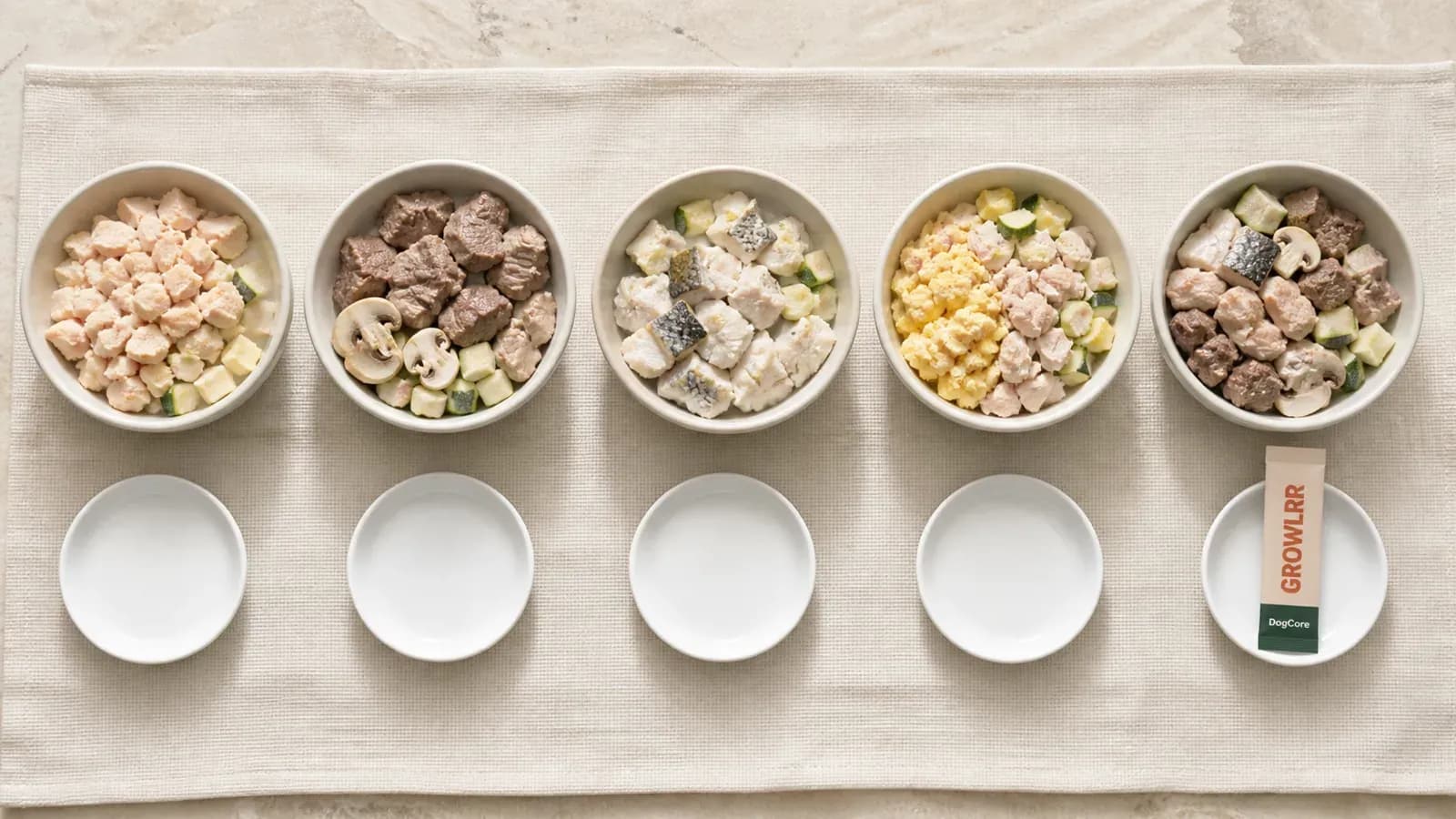
“What am I missing?” is the question every home cook eventually asks — and it is almost impossible to answer by eye. So we ran the numbers. Five bowls a real Indian kitchen might actually serve, each scored against the NRC 2006 nutrient minimums (the reference vets use) for a 20 kg adult dog, with and without the correction sachet. This is a deterministic point-estimate — a single careful calculation of one day’s bowl, not the million-run Monte-Carlo simulation we use to validate the sachet itself.
The five bowls
We started from an all-meat bowl and progressively stripped the animal protein out, the way home diets actually drift:
- All-meat — mutton, chicken, fish (tilapia), egg, curd, veg
- Chicken-mix — chicken + egg, curd, rice, dal, tofu, veg
- No meat — egg, curd, rice, dal, tofu, veg
- No veg — egg, curd, rice, dal
- No tofu — egg, curd, rice, dal, veg
Every bowl came up short — and the more plant-heavy, the worse
Wondering how this applies to your own pet? Build their bowl — two minutes, and it gives the exact grams for their weight.
First, what “short” means here. Every nutrient a dog needs has a minimum healthy daily amount — think of it as a floor you should not drop below — set by the NRC 2006 standard that vets and nutritionists use. A bowl “passes” a nutrient only if it delivers at least that minimum. Not one of the five bowls cleared every nutrient’s minimum on its own. And the count of nutrients that came in under the healthy minimum tracked the meat content almost perfectly — the less meat, the more gaps:
| Bowl | Nutrients below the healthy minimum |
|---|---|
| All-meat | 9 |
| Chicken-mix | 15 |
| No meat | 17 |
| No veg | 19 |
| No tofu | 21 |
Even the best home bowl — a diverse all-meat spread — missed nine nutrient floors. Adding the sachet took all five to zero breaches.
Four things fail in every bowl, whatever you cook
Four shortfalls showed up in all five bowls, independent of how much meat, rice or veg went in — because they are properties of home cooking itself, not of a particular recipe:
| Nutrient | Every bowl (no sachet) | Why |
|---|---|---|
| Thiamine (B1) | 0% | Destroyed by cooking — composition-independent |
| Vitamin E | 0–16% | Not present at meaningful levels in fresh inputs |
| Iodine | 25–36% | Absent from inland fresh food |
| Calcium:phosphorus | 0.18–0.69 | Out of the 1–2 range in every bowl |
Thiamine at exactly 0% in every case is the single most telling number in the study. It does not depend on your sourcing or your effort — cook the food and it is gone. This is the same B1 whose deficiency is a recognised cause of neurological disease in home-fed cats and dogs.
The calcium paradox: more meat, worse ratio
Counter-intuitively, the calcium problem gets worse as the meat fraction rises. The all-meat bowl had the worst calcium-to-phosphorus ratio of all — 0.18 against a 1–2 target — while the plant-heavy bowls sat closer to range, for the wrong reason. Fresh muscle meat is phosphorus-rich and calcium-poor; dairy and plants carry some calcium, meat carries almost none. This is a mechanism, not a scare: a bowl built on muscle meat needs calcium added. BARC (Growlrr’s gently-cooked, gap-corrected fresh-food approach) is deliberately bone-free, so that calcium arrives as a calibrated dose rather than a bone estimate you cannot measure at home.
What the meat is quietly doing right
The flip side matters just as much. Two nutrients — taurine and the omega-3s EPA and DHA — cleared only in the all-meat bowl (240% and 203% of requirement). Every other bowl came in at zero to half. Meat does real work that no plant bowl replicates, which is exactly why BARC specifies a diverse meat base and a correction — not one or the other. Strip the meat out and you lose taurine and EPA/DHA that the correction then has to carry alone.
“Adequate” is not the same as “biologically appropriate”
There are two separate questions hiding in “is my bowl good?”. One: are all the nutrient floors met? — the sachet decides that. Two: is the base itself biologically appropriate for a carnivore? — the food decides that, and no sachet can buy it. A meatless bowl can meet every floor once corrected and still not be a BARC bowl, because the base is plant-and-dairy protein and over the fibre ceiling. Growlrr’s bowl-checker reports both axes rather than stamping everything “complete”. (BARC — Biologically Appropriate, Residually Corrected — is the framework Growlrr pioneered, developed by a cardiovascular stent-design engineer for his own cats.)
You do not have to guess what your bowl is missing. Run the exact meat you feed through the checker and see the gaps — then close them with weight-dosed sachets and keep cooking.
References
- National Research Council (NRC). Nutrient Requirements of Dogs and Cats. Washington, DC: National Academies Press; 2006.
- Association of American Feed Control Officials (AAFCO). Dog and Cat Food Nutrient Profiles (current edition).
- Burger IH, Johnson JV. Analysis of the nutrient content of home-prepared and commercial pet foods; canine energy requirements. 1991.
- Stockman J, Fascetti AJ, Kass PH, Larsen JA. Evaluation of recipes of home-prepared maintenance diets for dogs. J Am Vet Med Assoc. 2013;242(11):1500–1505.
Run your own bowl through the checker →
Related reading
- Do home-cooked dogs & cats need a supplement?
- Is homemade dog food complete & balanced?
- Why a stent engineer rebuilt his cat's dinner
- Novel proteins when your pet reacts to everything
- “Complete and balanced” is a floor, not a target
- “Just chicken and pumpkin. Nothing else.” — what that bowl is missing
- Four deficiency patterns that get mistaken for something else