
How much calcium does a dog need? (Ca:P, eggshell & the math)
Published
Why meat bowls are calcium-short
Muscle meat is rich in phosphorus and poor in calcium. Feed a dog meat alone and you get the mirror image of what it needs: plenty of phosphorus, far too little calcium, and a calcium:phosphorus ratio that is inverted rather than the roughly 1.2:1 NRC 2006 targets for adults.
Our bowl-checker makes the size of the problem concrete: checked against NRC 2006, even an all-meat bowl failed calcium the hardest of any nutrient — a calcium:phosphorus ratio of just 0.18 against a 1–2 target — precisely because fresh muscle meat is phosphorus-rich and calcium-poor. BARC (our Biologically Appropriate, Residually Corrected approach) is also bone-free: calcium arrives as a calibrated dose, not an inexact bone estimate.
The target ratio — and why it matters
Wondering how this applies to your own pet? Build their bowl — two minutes, and it gives the exact grams for their weight.
Calcium and phosphorus are managed together because the ratio governs how the skeleton uses them, not just the totals. NRC 2006 centres on about 1.2:1; AAFCO accepts a band of roughly 1:1 to 2:1 for adults. Chronically outside that band places avoidable stress on bone metabolism.
Calcium sources — and the per-batch math problem
Common calcium sources include eggshell powder (~2,000 mg calcium per level teaspoon), calcium carbonate, or soluble calcium salts. The hard part isn’t the source — it’s the amount: it has to scale with how much meat you used and how big the dog is. Too little leaves the bowl short; too much creates its own problems. That per-batch calculation is where most home diets go wrong.
Large-breed puppies: a two-sided gate
Adult dogs down-regulate calcium absorption, so they mostly need a floor (a minimum healthy amount). Large- and giant-breed puppies cannot — under about six months they absorb calcium passively (Tryfonidou 2002), so excess calcium reaches a remodelling skeleton and can drive developmental orthopedic disease (Hazewinkel 1989). They need both a floor and a ceiling (NRC 2006 growth).
How Growlrr hits it automatically
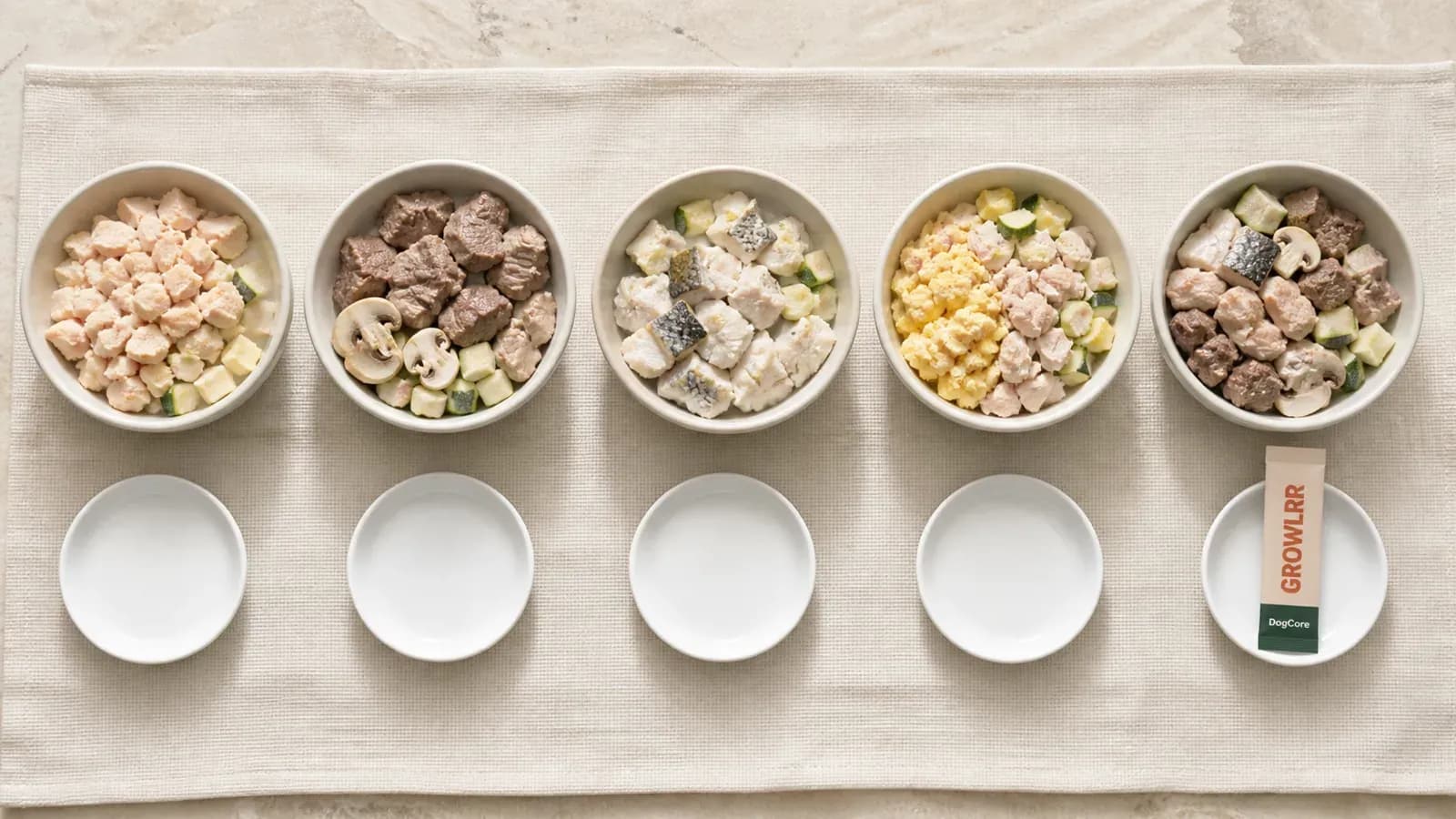
Growlrr delivers calcium from eggshell plus soluble calcium salts, dosed to your dog’s weight, so the calcium:phosphorus ratio lands near 1.38 (DogCore) on its own — no kitchen scale, no per-batch math. The correction is validated across 1 Million+ vectors · Wilson C/R 95/99 — tested across a million-plus simulated feeding days, with 95% confidence of delivering at least 90% of the standard on at least 99% of days.
References
- National Research Council (NRC). Nutrient Requirements of Dogs and Cats. Washington, DC: National Academies Press; 2006.
- Association of American Feed Control Officials (AAFCO). Dog and Cat Food Nutrient Profiles (current edition).
- Tryfonidou MA, et al. Intestinal calcium absorption in growing dogs is influenced by calcium intake and age but not by growth rate. J Nutr. 2002;132:3363–3368.
- Hazewinkel HAW. Nutrition in relation to skeletal growth deformities. J Small Anim Pract. 1989;30:525–630.