
A Monte-Carlo Reliability Framework for Nutritional Adequacy under Real-World Variability in Biologically Appropriate, Residually Corrected (BARC) Diets
Published
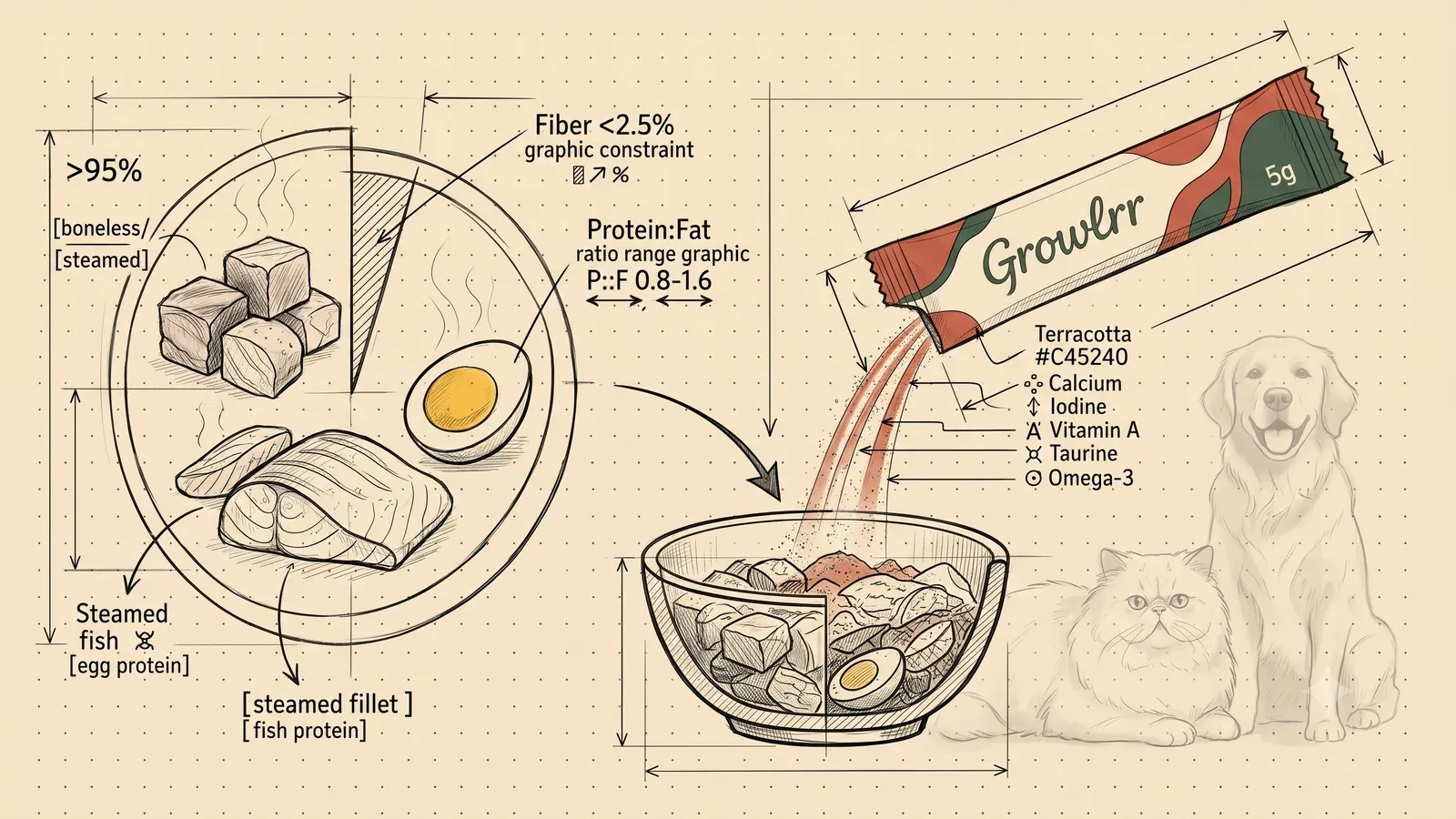
A nutrient label reports one number per nutrient; a real bowl delivers a distribution. Grocery lots vary, kitchen scales are approximate, cooking destroys heat-labile vitamins by amounts that themselves vary, and no two feeding days are identical. Checking a single idealised day against a reference table therefore certifies a bowl that is never actually served. This paper specifies the Stochastic Reliability Framework, the single-day stochastic (Monte-Carlo) validation engine of the Growlrr BowlBalancer™ stack. This Monte-Carlo framework simulates a feeding day as a set of random draws — one per source of real-world variance — scales every requirement and dose to body weight by published allometry, scores every nutrient against the Nutrient Requirements of Dogs and Cats (NRC 2006), and takes the worst nutrient of the day as that day’s floor. Repeated across up to a million simulated days per formulation, it reports a Wilson lower bound on the pass rate: the release gate is Wilson C/R 95/99 — 95% statistical confidence that at least 99% of days deliver ≥90% of every NRC requirement. Two formulations clear the gate. The diverse balanced diet (chicken, mutton, tilapia, egg, curd and vegetables) passes at Wilson-C95 99.996% for both the adult DogCore™ and CatCore™ blocks; the deliberately harsh chicken-only diet — a single-protein worst-case validation floor, not a diet we recommend — also clears, binding on copper by design. The Stochastic Reliability Framework’s companion, the Hepatic Buffering Model, then carries the surviving single-day distribution forward over weeks of tissue kinetics.
1. Introduction — why a single spec-sheet check fails
The conventional test of nutritional adequacy is a static one: assemble the recipe, look up each ingredient’s composition in a food table, add it all up, and compare the totals to a reference standard — for companion animals, NRC 2006. If every total clears its minimum, the recipe is declared complete. The trouble is that this certifies a bowl on paper that is never the bowl in the dish. Four things guarantee it:
- Ingredient variance. The copper in a batch of liver, the vitamin D in an egg, the taurine in a cut of meat — these swing lot to lot. Biological (animal-origin) micronutrients vary the most.
- Measurement variance. A home cook, and a sachet-filling machine, hit a target weight only to within a band, not exactly.
- Cooking variance. Heat destroys thiamine, folate and other labile vitamins — and the fraction destroyed is itself variable, never a fixed discount.
- Day-to-day variance. Owners rotate proteins, portions drift, some days skew fatty and some lean.
A spec-sheet check averages all of this away and asks one question: does the mean day pass? The question that actually protects an animal is different: across the spread of real days this bowl will produce, how often does the worst nutrient fall short? Variance is not noise to be removed here — variance is the thing being measured. The Stochastic Reliability Framework is built to measure it. It is the first and hardest-floor stage of the Growlrr validation cascade: a smooth-day engine that draws a fresh random feeding day thousands to millions of times and reports how the floor behaves over the whole distribution, not at its mean.
Two terms recur below and are defined on first use. Allometric means “scaling with body size by a power law” — a 40 kg dog does not need ten times the energy of a 4 kg dog but roughly (40/4)0.64 ≈ 4.4 times, and requirements and doses follow the same curve. A log-normal draw is a random multiplier that is always positive and clusters near 1.0 with an occasional larger swing — the natural shape for “this batch ran 8% rich” or “that scoop was 12% light,” and the reason the engine uses it for every noise source.
2. The stochastic model
Wondering how this applies to your own pet? Build their bowl — two minutes, and it gives the exact grams for their weight.
Each simulated day is built for one animal at a sampled body weight BW and activity multiplier m. The construction has three deterministic scaffolds — energy, requirement, and dose — onto which the random draws are layered.
2.1 Allometric energy and requirements
The day’s energy target is the animal’s maintenance energy requirement (MER) from the Burger & Johnson (1991) intra-species allometry, carried at a 10% serving head-room:
with a = 98, b = 0.64 for dogs and a = 90, b = 0.67 for cats (anchor body weights 20 kg and 4 kg). Every NRC nutrient minimum is scaled to the animal’s size by the same allometric law, so a requirement measured at the anchor weight BW0 is projected to any BW:
(c = 0.64 dog, 0.67 cat). The manufactured correction — the BowlBalancer™ sachet, or “block” — is dosed on the same size curve, so its unit count grows sub-linearly with the animal:
2.2 The per-nutrient stochastic draw
Onto those scaffolds the engine layers multiplicative noise. Every source of real-world variance is a strictly-positive, mean-corrected log-normal multiplier drawn independently each day. For a source with coefficient of variation CV and intended mean x̄:
The −σ2/2 term is a bias correction: it makes the expected value of the multiplier exactly x̄, so the noise adds spread without secretly shifting the mean up or down. The standard-normal z is generated by the Box–Muller transform. Four independent variance sources feed the day, at the coefficients of variation used in the release validation:
| Variance source | What it models | CV |
|---|---|---|
| Block fill | Sachet fill tolerance (VFFS ±5% band) | 0.05 |
| Grocery weight | Owner’s kitchen-scale portioning | 0.10 |
| Biological ingredient | Lot-to-lot assay of animal-origin micronutrients | 0.20 |
| Purified active | Assay of purified/chelated block actives | 0.05 |
Cooking-retention variance is applied as a fifth, deliberately one-sided draw: it can only reduce a heat-labile nutrient below its retained level, never raise it above 100% retention (multipliers above 1.0 are clipped). That asymmetry keeps the model conservative — cooking never accidentally creates a vitamin.
2.3 The floor and the pass rule
Summing the noisy grocery contributions and the noisy block contribution gives the delivered amount Dn of each nutrient n on that day, which is expressed as a percentage of the size-scaled requirement:
The single number that characterises the day is its floor — the worst nutrient. A day is a “pass” only if its floor clears the 90%-of-NRC reliability threshold:
Taking the minimum, not the average, is the whole point: a bowl is only as adequate as its most-deficient nutrient on its worst plausible day. By construction the binding (floor) nutrient is copper — a deliberate design choice, because copper has a wide hepatic safety margin, so pinning the floor to copper keeps every other nutrient comfortably in surplus without approaching any upper limit.
3. The Wilson confidence criterion
Running N simulated days yields a raw pass count. Reporting the raw pass fraction alone would overstate certainty at finite N, so this Monte-Carlo framework reports the Wilson lower bound — the conservative low end of the confidence interval on the true pass rate given the observed passes. For p̂ passes out of N at confidence level z:
When every day passes (p̂ = N) the expression collapses to the exact perfect-run bound pLB = 1/(1 + z2/N), which is why even a flawless million-draw run reports a finite lower bound rather than a bare 100%. The confidence multiplier z is 1.960 for 95% confidence, 2.576 for 99%, and 3.890 for 99.99%.
The release gate is stated as Wilson C/R 95/99 — a confidence/reliability pair. Read it as: with 95% statistical confidence (C = 95), at least 99% of feeding days (R = 99) deliver ≥90% of every NRC requirement. The 90% figure is the per-day reliability threshold; the 99% is the fraction of days that must clear it; the 95% is how sure we are of that fraction after accounting for finite sampling. A formulation ships only when the Wilson-C95 lower bound on its pass rate sits at or above 99%.
4. Methods
Engine. The Stochastic Reliability Framework is the smooth-day floor stage of a five-engine validation cascade; the tissue-kinetic layers that sit on top of it are described in the companion Hepatic Buffering Model paper. All numbers here are read from the canonical validation hub (not re-derived), computed on the frozen adult engine 842353e5 with a fixed random seed (42) for reproducibility.
Species and envelope. Dogs are simulated across 3–110 kg at activity multipliers 1.2–1.8; cats across 2.5–10 kg at 0.9–1.3. Body weight and activity are sampled uniformly within these envelopes so the gate covers the whole product range, not a single representative animal.
Draws. The daily gate runs 10,000 draws per point; the ship gate stacks to 100,000 per segment, and the headline single-day adequacy validation accumulates 1,000,000+ vectors — the number over which the Wilson C/R 95/99 bound is reported.
Diets tested. Two formulations bracket the real-world range:
- The diverse balanced diet — the recommended bowl: chicken and mutton, farmed fish (tilapia), egg, curd and vegetables for dogs; an animal-origin basket for cats. Multiple independent protein sources, so no single nutrient rides on one ingredient’s lot.
- The chicken-only floor — a single-protein stress test: all food energy from chicken, with mutton, fish, egg, curd and vegetables stripped out, and the correction asked to hold every floor on one protein. This is deliberately the worst plausible input, a validation floor and not a diet anyone should feed; a real bowl should always carry two or more animal-origin proteins.
The block chemistry (BOM) and dose rule are identical between the two runs; only the fresh-food basket changes, isolating the effect of protein diversity on the floor.
5. Results
5.1 Both formulations clear the gate
Across the full allometric envelope, both adult cores pass Wilson C/R 95/99 on the diverse diet, binding on copper by design, with zero safe-upper-limit (SUL) breaches:
| Adult block · diet | Wilson-C95 | Binding nutrient | SUL breaches |
|---|---|---|---|
| DogCore™ · diverse balanced | 99.996% | copper (hepatic cap) | 0 |
| CatCore™ · diverse balanced | 99.996% | copper (hepatic cap) | 0 |
| DogCore™ · chicken-only floor | clears — zero sub-floor days (copper tail ≈138% NRC) | copper | 0 |
| CatCore™ · chicken-only floor | clears — zero sub-floor days (copper tail ≈129% NRC) | copper | 0 |
The diverse diet passes at Wilson-C95 99.996% (100,000-draw cascade) for both species. The chicken-only floor also clears: even with every other protein removed, no simulated day fell below the 90% line, and the nutrient doing the binding is copper — sitting above requirement, at roughly 138% of NRC in dogs and 129% in cats. Because the chicken-only run produced zero sub-floor days at this N, its Wilson lower bound coincides with the diverse figure; the meaningful difference between the two diets is not pass/fail but margin — the diverse diet keeps the floor further from the edge.
The single-protein floor is exercised even harder in the growth-stage validation modules (2–12 month puppies and kittens), where a growing animal’s tighter requirements make chicken-only genuinely floor-binding on a vitamin rather than on copper — and it still passes:
| Growth-stage module | Chicken-only (Wilson-C95) | Diverse (Wilson-C95) |
|---|---|---|
| Puppy growth 2–12 mo | 99.421% (binds on B12) | 99.962% (copper) |
| Kitten growth 2–12 mo | 99.869% (binds on vitamin D) | 99.962% (copper) |
These are the strictest chicken-only numbers in the stack, and both remain above the 99% reliability line. The message is consistent: the correction holds the worst-case single-protein input, and a diverse bowl holds it with room to spare.
5.2 The two-protein finding — and why adequate is not BARC
A deterministic five-bowl study (the companion five-bowl test, and the live bowl checker) ran diets from all-meat to all-plant, each with and without the correction. Uncorrected, every bowl failed — between 9 and 21 nutrients below floor, the count rising as the animal-protein fraction fell. Corrected, every one reached zero breaches. The practical reading is that any home bowl built on two or more animal-origin proteins clears every NRC adequacy floor once corrected.
But clearing the NRC floors is a lower bar than being a good bowl, and the tool is careful not to conflate them. Adequate is not the same as BARC. Two orthogonal questions are at work:
| Axis | Question | Decided by |
|---|---|---|
| Adequacy | Do all NRC nutrient floors clear? | the correction |
| BARC compliance | Is the food base biologically appropriate? | the food — the correction cannot buy it |
A bowl is only BARC (Biologically Appropriate, Residually Corrected) when its base is animal-origin, its fibre is ≤5% of dry matter, and the residual micronutrient gaps are closed by the calibrated correction. A plant-and-dairy bowl can be made NRC-adequate by the sachet, yet still fail BARC on fibre or on an animal-origin base — in the five-bowl study only the all-meat bowl met every BARC criterion once corrected. So the labels are distinct: adequate — meets NRC/AAFCO, not BARC versus balanced BARC. The correction validated by this Monte-Carlo framework guarantees the first; the food the owner chooses decides the second. (For the diet-tier logic in full, see Is BARC complete, balanced, and safe?)
6. Discussion and limitations
The Stochastic Reliability Framework answers one question precisely — over the distribution of real days this formulation produces, is the worst nutrient of the day adequate with high confidence? — and it does so by measuring variance rather than averaging it away. Its boundaries are stated, not hidden:
- It is a single-day engine. The Stochastic Reliability Framework scores adequacy day by day; it does not, on its own, describe how slowly-cleared nutrients accumulate or deplete across weeks. That is exactly what the companion the Hepatic Buffering Model layer adds — a tissue-kinetic model that carries the surviving single-day distribution forward over each nutrient’s biological half-life. The Stochastic Reliability Framework establishes the daily floor; the Hepatic Buffering Model establishes the chronic floor-and-ceiling on top of it.
- The noise model is a smooth-day approximation. Variance is modelled as tidy, roughly ±5–20% log-normal spread; it does not capture a gross misweigh or a mixing error, which is why the manufacturing spec mandates assayed dilute premixes and per-lot certificates of analysis for the narrow-margin actives. Monte-Carlo adequacy is a formulation property, not a substitute for manufacturing control.
- Chicken-only is a floor, not a recommendation. It is included to prove the correction survives the worst plausible single-protein input. The recommended bowl is diverse, and the tier logic actively rewards a diverse animal-origin base over a bare single-protein pass.
- Adequacy is not safety by itself. Clearing the floors and staying under every SUL is necessary but not sufficient; the copper binding-by-design and the zero-SUL result describe the modelled distribution, and finished units are confirmed by NABL/ISO-17025 assay before any label prints.
The core result stands: on the smooth-day gate, the BowlBalancer™ correction takes both a diverse balanced diet and a worst-case chicken-only floor across the Wilson C/R 95/99 line for dogs and cats, binding on copper by design, with no upper-limit breach. It is the daily-adequacy foundation the rest of the validation stack is built on. Check your own bowl →
References
- National Research Council. Nutrient Requirements of Dogs and Cats. Washington, DC: National Academies Press; 2006.
- Burger IH, Johnson JV. Dogs large and small: the allometry of energy requirements within a single species. J Nutr. 1991;121(11 Suppl):S18–S21.
- Wilson EB. Probable inference, the law of succession, and statistical inference. J Am Stat Assoc. 1927;22(158):209–212.
- Box GEP, Muller ME. A note on the generation of random normal deviates. Ann Math Stat. 1958;29(2):610–611.
- Association of American Feed Control Officials (AAFCO). Official Publication. 2024. — and FÉDIAF, Nutritional Guidelines for Complete and Complementary Pet Food for Cats and Dogs. 2024. (Life-stage nutrient profiles referenced as formulation benchmarks, not regulatory endorsements.)
The Stochastic Reliability Framework is a single-day stochastic adequacy engine; all figures are read from the canonical validation hub on the frozen engine 842353e5, seed 42, and are reproducible on demand. This is a methods paper describing a decision-support gate, not a clinical claim for any individual animal.
© Growlrr Foods Pvt Ltd. Published under CC BY-NC-ND 4.0 — cite with attribution; no commercial use or derivatives. The sachet formulation (BOM) is proprietary and not licensed. Author: Prasanna M.