
Is grain-free dog food bad for your dog’s heart?
Published
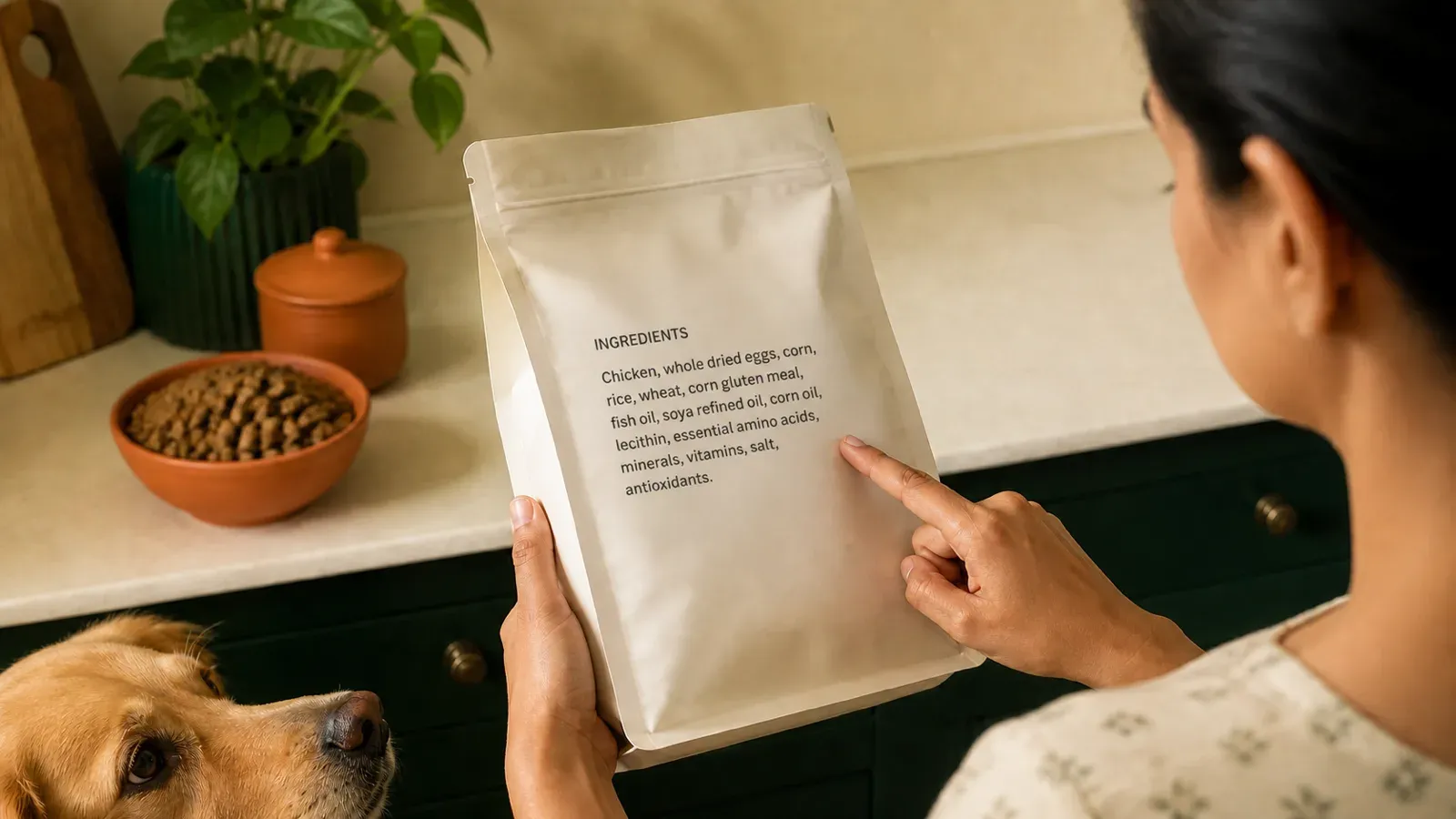
The "grain-free" illusion
As owners grew wary of corn and soy, the industry's answer was not more meat — it was to swap grains for legumes and potatoes, which still provide the starchy binder that high-temperature extrusion needs. "Grain-free" sounded healthier, but on many premium bags the first ingredients stayed plant-based. The base of the bowl didn't change; only the label did.
What the FDA reported
Wondering how this applies to your own pet? Build their bowl — two minutes, and it gives the exact grams for their weight.
In July 2019 the FDA named diet as a possible factor in a cluster of canine DCM cases, many linked to grain-free formulas rich in peas, lentils and chickpeas. Importantly, the agency described a potential association under active investigation, not a proven cause, and did not conclude that legumes directly cause heart disease. The signal was enough to make one thing clear: a starch is not neutral just because it isn't a grain.
The durable answer: diverse fresh meat
The way around diet-linked DCM risk isn't a different kibble or a new filler — it is animal-derived amino acids in a bioavailable form. It is fitting that Growlrr was developed by a cardiovascular stent-design engineer for his own cats: the heart is exactly what a mis-formulated bowl puts at risk. Under the BARC Protocol™, energy and protein come from a diverse fresh-meat bowl — chicken, mutton/goat, tilapia and egg — naturally rich in taurine and essential amino acids, with zero grains, legumes or starch fillers. The 5 g BowlBalancer™ sachet then closes the remaining micronutrient gaps against NRC 2006, validated across 1 Million+ vectors · Wilson C/R 95/99. No extruder binder to engineer around means no legume-starch trade-off to worry about.
References
- National Research Council (NRC). Nutrient Requirements of Dogs and Cats. Washington, DC: National Academies Press; 2006.
- Association of American Feed Control Officials (AAFCO). Dog and Cat Food Nutrient Profiles (current edition).
- U.S. Food & Drug Administration. FDA Investigation into Potential Link between Certain Diets and Canine Dilated Cardiomyopathy (2019 update).
- FEDIAF. Nutritional Guidelines for Complete and Complementary Pet Food for Cats and Dogs (current edition).
Build a grain- and legume-free bowl →