
Herbs are not nutrients: reading an Ayurvedic pet food label
Published
Let us be precise about what is being criticised
Ayurveda is a serious tradition with millennia of clinical practice behind it, and this article takes no position on it as human medicine. That is not the question here.
The question is narrower and entirely answerable: when a pet food label lists turmeric, ashwagandha, moringa and amla, what are those ingredients doing for a dog or a cat, at the quantity actually included — and what is on the label instead of calcium?
There is also a species point that has nothing to do with the tradition's validity. A cat is an obligate carnivore with a short gut, low amylase output and no fermentation chamber. Botanical preparations developed for a human digestive system do not transfer to that animal by default. That is a claim about physiology, not about philosophy.
Ingredient by ingredient
Wondering how this applies to your own pet? Build their bowl — two minutes, and it gives the exact grams for their weight.
Turmeric. Sold for joint health. Curcumin is poorly bioavailable on its own, which is why human formulations pair it with piperine from black pepper — and piperine is not something to be casual about in cats, whose hepatic glucuronidation is limited. Meanwhile the things joints actually need are chondroitin, glucosamine, EPA and DHA, and enough protein to build collagen. Turmeric supplies none of them.
Ashwagandha. Sold for stress. Anxiety in dogs and cats is overwhelmingly behavioural and environmental — separation, noise, territory, boredom, insufficient exercise. There is no adaptogenic herb that resolves a dog left alone for ten hours. Where nutrition contributes, it does so through tryptophan, B-complex and magnesium, and mostly it does not contribute; the answer is enrichment and, where needed, a behaviourist.
Moringa. This one is worth a warning rather than a shrug. Moringa is high in oxalate, and calcium oxalate is now a substantial share of feline urinary stones. Adding an oxalate load to a desert-descended animal with narrow renal margins is a poor trade for a nutrient claim that does not survive the species boundary. It is on our own avoid list for the same reason spinach is.
Amla and tulsi. Sold for immunity and respiratory wellness. Immune function runs on zinc, selenium, vitamin E, vitamin A, and adequate protein — particularly arginine and glutamine. Dogs, unlike humans, also synthesise their own vitamin C, so the amla claim answers a deficiency dogs do not have.
The structural trick, which is the actual story
Herbs typically appear at 0.1% to 0.5% by weight. At that inclusion they are below any plausible therapeutic dose even in a species they suited. They are on the label to be read, not to be metabolised.
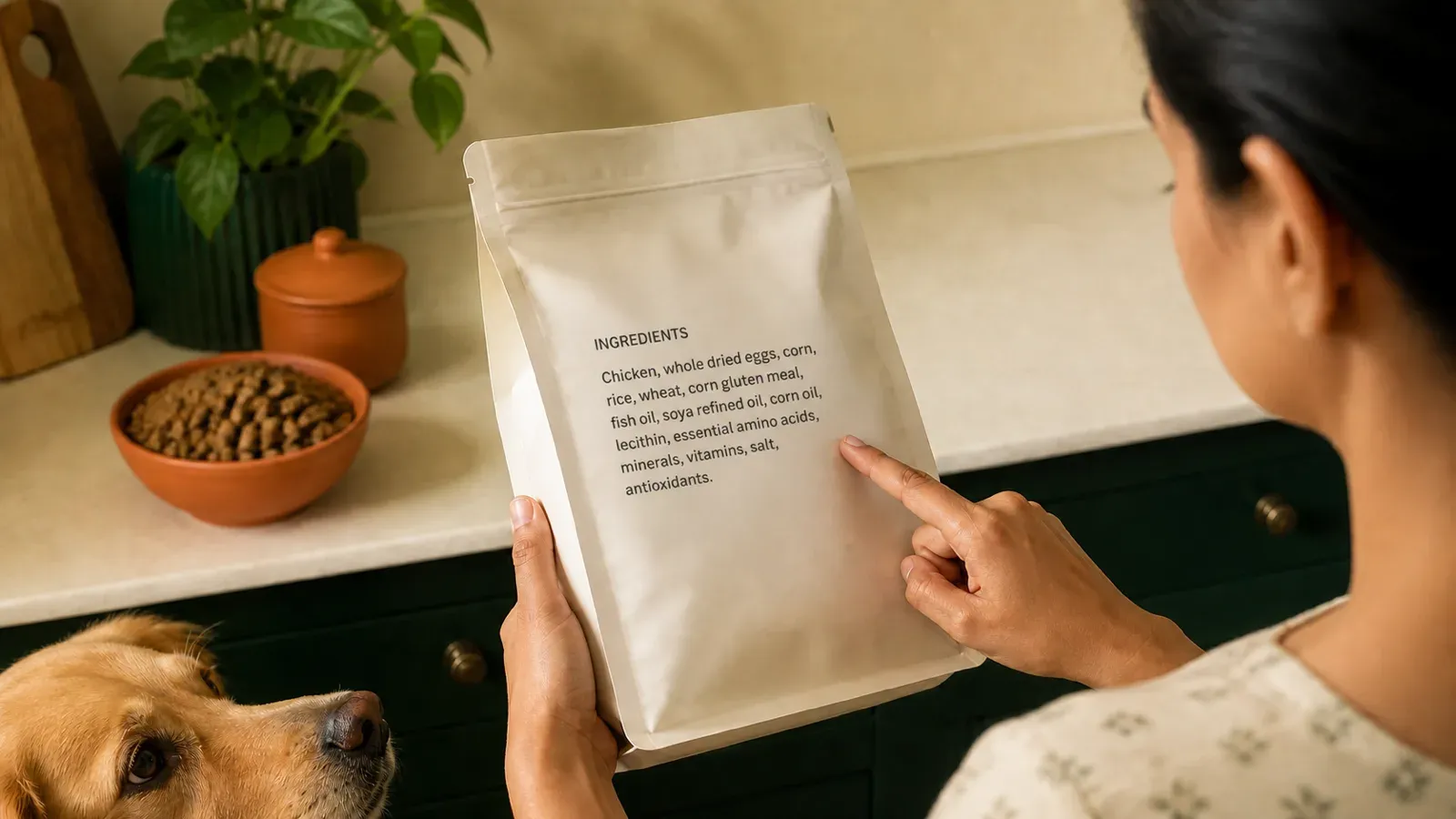
Now look at what the same label does not carry. A typical “chicken, pumpkin, turmeric, ashwagandha, moringa, sunflower oil” formulation declares no calcium figure, no taurine figure, no iodine, no zinc, no vitamin D. Not because they are being hidden — because there is no requirement in India to declare them at all.
So the front of the pack tells you about the ingredient that does the least, and is silent on the ones that decide whether the animal thrives. That is the pattern to recognise, and it is not unique to Ayurvedic branding — it is the same move as “superfood berries” on a Western label.
What we do, and what we do not
We do not put botanicals in our sachet for marketing optics. Everything in it is there because a nutrient requirement demanded it and the arithmetic showed a gap.
We are also not claiming herbs are dangerous — with the specific exception of the oxalate point on moringa, and piperine in cats, both of which are physiology rather than opinion. Turmeric in a dog's dinner is mostly inert. The harm is not the herb. It is the calcium that is not there.
Every gap we close is measured against NRC 2006, and the working is published. Build your pet's bowl →
References
- National Research Council (NRC). Nutrient Requirements of Dogs and Cats. Washington, DC: National Academies Press; 2006.
- Bureau of Indian Standards. IS 11968:2019 — Dog and Cat Foods, Specification. Voluntary standard; India sets no mandatory declaration for calcium, taurine, iodine or trace minerals in pet food.