
Can cats eat crab? And dogs? The honest answer on shellfish
Published
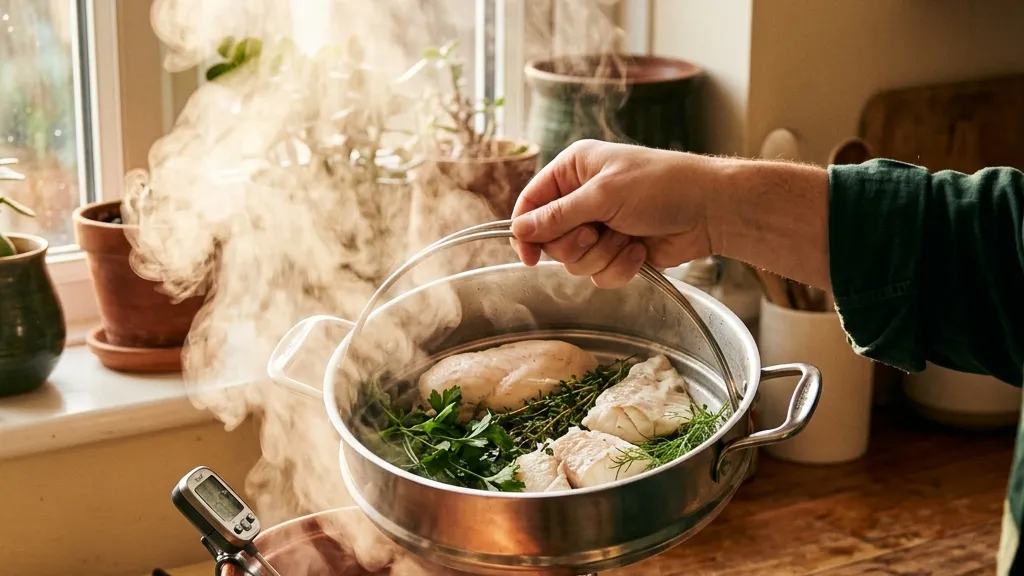
Short answer for cats: yes, occasionally, if it is cooked, shelled and unseasoned. Most cats love it and a small amount does no harm. Not raw, and not every day.
Can cats eat crab meat, cooked?
Yes. Cooked crab meat, picked clean of shell and served plain, is safe for a healthy adult cat as an occasional treat. Cooking is the part that matters: it destroys the thiaminase in raw shellfish, and it kills the bacteria that raw seafood carries. Keep it to a tablespoon or so, a couple of times a month.
Is crab good for cats?
Wondering how this applies to your own pet? Build their bowl — two minutes, and it gives the exact grams for their weight.
It is good protein and cats enjoy it, but it earns a place as a treat rather than a food. Crab is extremely high in iodine, and a cat’s thyroid is sensitive to a heavy iodine load over time. It is also a common allergen. So: a pleasure, not a staple.
Can dogs eat crab and shrimp?
Same rules. Cooked, shelled, unseasoned, occasional. Dogs are larger, so a mouthful matters less, but the thiaminase, the iodine and the allergen risk are identical.
The thiaminase problem, which is the specific one
A number of raw fish and shellfish carry thiaminase, an enzyme that breaks down thiamine — vitamin B1. This is not an obscure risk. Thiamine deficiency in cats causes neurological signs: an unsteady gait, head tilt, seizures. It is well documented, and raw fish diets are a recognised route to it.
What makes it worse in a home-cooked context is that thiamine is already the most fragile nutrient in the bowl. It is heat-labile, so cooking destroys much of what was there — which is why a corrected bowl supplies thiamine deliberately rather than relying on the ingredients. Feeding raw shellfish on top of that is subtracting from an account that was already empty.
Cooking denatures thiaminase. That single step removes the problem, and removes the Vibrio and parasite questions at the same time. There is no version of this where raw is the better call.
Iodine — the reason we say treat, not staple
Shellfish and marine crustaceans are among the most iodine-dense foods there are, by a wide margin over muscle meat. Iodine is essential, and our own formulation supplies it precisely because fresh meat carries so little — our ingredient table puts chicken at 7 µg per 100 g and farmed fish at 10 µg.
But iodine is one of the nutrients where the useful range is narrow at both ends. Feline hyperthyroidism is common in older cats, and while the causes are multifactorial and not settled, sustained iodine excess is not something to be casual about. A prawn now and then is a treat. Prawns as a protein source is an uncontrolled iodine intake laid over a diet already supplying it.
The allergen point
Shellfish is a recognised allergen in humans and reactions are reported in dogs and cats too. If your animal is already under investigation for a food reaction, shellfish is not the protein to experiment with — and it is certainly not a novel protein worth spending a trial on.
The practical rules
- Cooked through. Never raw, never partially.
- Shell, tail, legs and claws off. Crab shell in particular is sharp and rigid — a genuine perforation and obstruction risk, not a theoretical one. Prawn shells are a choking hazard.
- Devein prawns, as you would for yourself.
- Nothing on it. No salt, no butter, no masala. Onion and garlic are toxic to dogs and cats both.
- No imitation crab. Surimi is fish paste with starch, salt and sugar. It is not crab and it is not food for your pet.
- Small portions. A prawn or two for a cat, a few for a medium dog, and not every week.
Is there any actual benefit?
Honestly, not much that you cannot get more cheaply and more safely. Shellfish is lean protein with some iodine, zinc and selenium — all of which a corrected bowl already supplies in known quantities. What it mostly is, is a treat your cat will find very interesting, which is a legitimate reason to give one occasionally. We would just rather you did it knowing what it is.
The gaps that matter are measured against NRC 2006 and closed by weight.