
Is this homemade dog food balanced?
Published
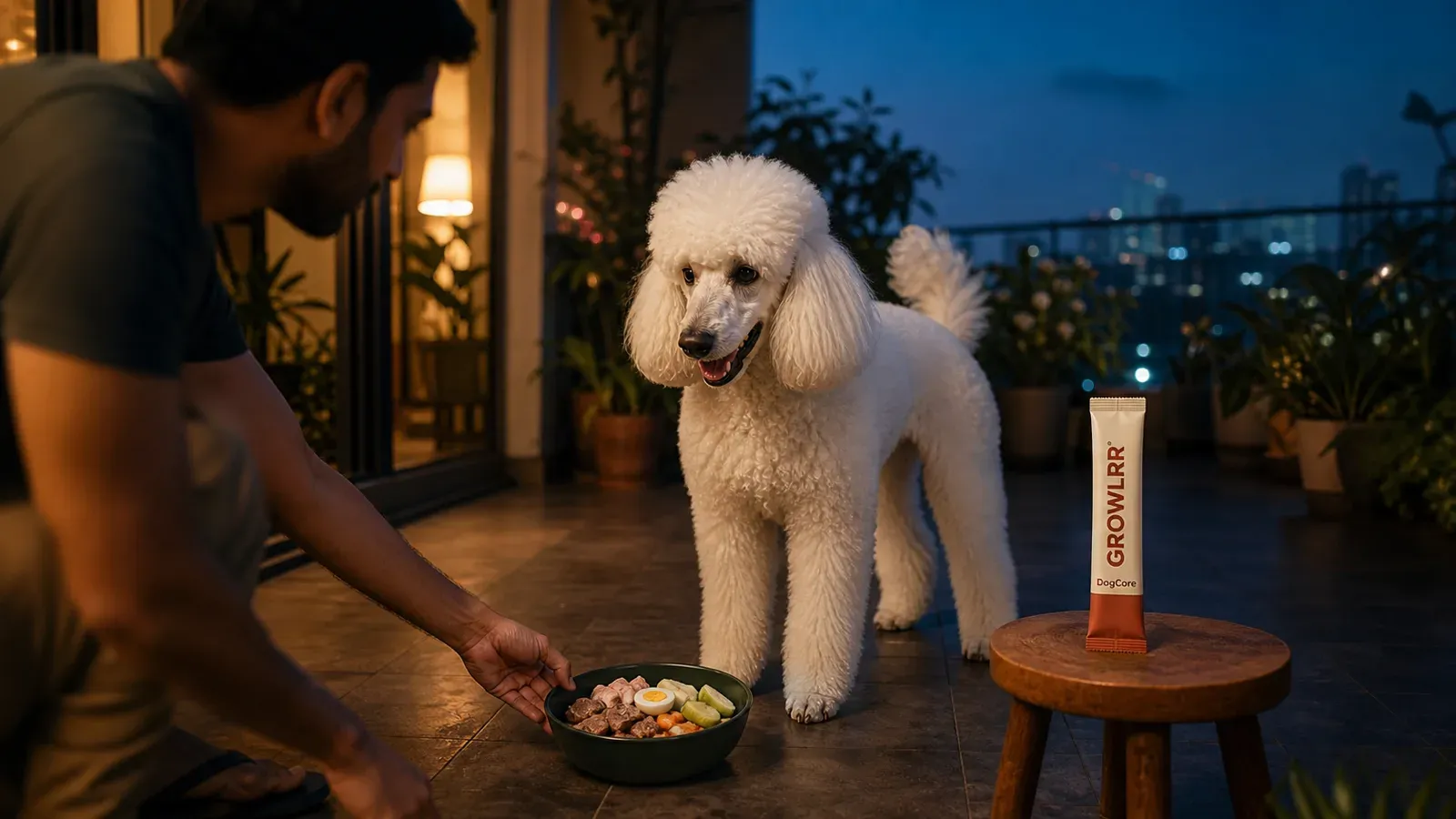
Short answer: use our tool and find out. It takes a minute and it is free: Check my bowl, free. If you would rather have the likely answer first: probably not. In the largest published review of home-prepared dog recipes, 95% were short of at least one essential nutrient (Stockman 2013), and our own modelling of uncorrected fresh bowls agrees. The second problem is consistency: even a good recipe drifts once real shopping and real mornings get involved. Here is why, reason by reason, and what to do instead.
Why is homemade dog food so rarely balanced?
1. Ancestral is not the same as appropriate
A wild canid eats the whole animal: muscle, organs, glands, blood, bone, skin, and the gut contents of its prey. That is where its minerals and vitamins come from. A home bowl is made of muscle meat, because muscle meat is what a butcher sells. Feeding “like a wolf” with supermarket chicken breast copies the idea and leaves out most of the nutrition. What carnivore actually means for dogs and cats.
2. The problem with grocery meat
Meat is bled, trimmed and deboned for people. Blood carries iron and sodium, bone carries calcium, organs carry vitamin A, copper and manganese, and all three are gone by the time it reaches your kitchen. What is left is excellent protein and fat, high in phosphorus and low in calcium, which is the wrong way round for a dog. What is missing from a home-cooked bowl.
3. The problem with “complete and balanced”
It is not a feeling about ingredients. It is around forty nutrients, each above a published floor and several below a ceiling, measured per 1000 kcal. No one can judge that by looking at a bowl, and a recipe that meets it for an active dog may not for a sedentary one that eats less. It is a floor, not a target, and it depends on how much your pet eats.
4. The problem with cooking
Cooking is the right call for safety, and it costs nutrients. Heat reduces taurine and several B vitamins, and some of what remains leaves with the cooking water if you pour it away. A recipe balanced on raw-ingredient numbers is not balanced once it has been boiled. Taurine is the clearest example.
5. The problem with bones
Bone is how nature supplies calcium, and it is a poor tool in a kitchen. Cooked bone splinters. Raw bone carries the same bacteria as raw meat and can break teeth or block a gut. And the calcium in a piece of bone varies so much that you cannot dose with it. The calcium maths.
6. The problem with raw
Raw feeding keeps the heat-sensitive nutrients and brings Salmonella, E. coli and Campylobacter into a home kitchen, which matters most where there are children or older people, and in a warm climate. It also does not fix the mineral gaps: raw muscle meat is as short of calcium and iodine as cooked. BARF and raw feeding in India.
7. The problem with kelp and iodine
Meat has almost no iodine, so recipes reach for kelp. The iodine in kelp varies many-fold between species, harvests and brands, and the dose a dog needs is measured in micrograms. A pinch can be too little one month and far too much the next, and the thyroid is sensitive in both directions.
8. The problem with manganese
Almost nobody thinks about it and almost every meat-based recipe is short of it. The natural sources are things like mussels, wool, feathers and gut contents. None of them is going in the bowl. It has to be added, in milligrams, every day.
Why do people give up on balanced homemade recipes?
Wondering how this applies to your own pet? Build their bowl — two minutes, and it gives the exact grams for their weight.
Because a properly formulated one is a second job. Typical recipes ask you to juggle around twenty separate supplements, several dosed in micrograms, on top of sourcing liver, kidney, tripe, game meats and oily fish every week. That is not feasible day after day. People simplify: a supplement runs out and is not replaced, the liver gets skipped, the scale goes back in the drawer. The recipe that was balanced on paper becomes a deficient one in the bowl, and many owners drop out from sheer fatigue and go back to a bag. Your supplement shelf is the evidence.
What to do instead: one bowl, one balancer
Growlrr BowlBalancer™ replaces the shelf. You cook one simple bowl from ordinary market groceries, following our chart for your pet’s weight, and add the day’s sachets. The sachets provide the calcium, iodine, zinc, copper, manganese, vitamins D and E, omega-3 and, for cats, taurine that the groceries cannot, in measured amounts. That does away with bones, kelp, liver, kidney and the twenty jars. And it gives you a day that meets the NRC and FEDIAF nutrient floors, the same way every day. The sachets are balanced to the bowl on our chart, not to other recipes, so the chart is part of the product. How the method works.
Sample grocery for a day: a 15 kg adult dog
| Cooked, boneless | Per day |
|---|---|
| Mutton or another lean red meat | about 115 g |
| Chicken | about 135 g |
| Tilapia or another white fish | about 110 g |
| Eggs | 2 |
| Plain curd | about 125 g |
| Mixed vegetables, cooked soft | about 260 g |
| DogCore™ BowlBalancer™ sachets | 5 × 10 g |
Sample grocery for a day: a 4 kg adult cat
| Cooked, boneless | Per day |
|---|---|
| Mutton or another lean red meat | about 65 g |
| Chicken | about 25 g |
| Tilapia or another white fish | about 20 g |
| Egg | half |
| CatCore™ BowlBalancer™ sachets | counted by weight; the builder gives the number |
These are examples for one size of dog and one size of cat. Amounts change with body weight and activity, so do not copy them for a different animal. Build the bowl for your own pet’s weight. No bones, no liver or kidney, nothing else to buy.
What does it cost?
The whole day, fresh groceries plus sachets, comes to about what premium wet food costs, and for a cat noticeably less, with no extra supplements on top. We priced every ingredient at real Indian grocery apps and published the receipts: what homemade pet food really costs in India.
Is my homemade cat food balanced?
The same reasons apply, more sharply. Cats need nearly all of their energy from animal food and cannot make taurine, arachidonic acid or vitamin A for themselves. The checker handles cats too: Check my bowl, free. See also whether a cat and a dog can share a homemade food.