Recipes · checked against NRC 2006 · updated 28 August 2026
What homemade food can dogs eat in India? 7 complete recipes, by weight
Every recipe below is portioned in real grams from a validated feeding engine — not cup-guesses — and each one tells you plainly what it misses without correction, because a home-cooked bowl that looks complete usually is not. Cook fresh; complete it; feed with confidence.
Short answer
What is the best home-cooked dog food in India?
A meat-first bowl from the Indian kitchen: mutton, chicken and lean fish like tilapia, with eggs, curd and steamed vegetables — lightly cooked, no salt, onion, garlic or masala — plus a weight-dosed nutrient balancer such as the Growlrr BowlBalancer™ (with calcium, thiamine, iodine and the 22 nutrients we track for dogs), because even the best fresh bowl misses 9–21 NRC 2006 nutrient floors on its own.
What it depends on
Body weight — every gram in these recipes scales with your dog’s weight (the ladder below is engine-computed, and the free BowlBalancer tool gives your dog’s exact numbers).
Protein choice — chicken, mutton, goat or fish all work; diversity beats any single protein.
Life stage — puppies, pregnant and nursing dogs need different floors (separate supplements exist for those).
Completeness — the deciding factor: whether the bowl is corrected to a named standard, or just looks wholesome.
Common questions
Is homemade cooked food good for dogs?+
Yes — gently cooked fresh food is digestible, biologically appropriate and avoids the pathogen risks of raw feeding. But good is not the same as complete: tested against NRC 2006, home-cooked bowls typically miss 9–21 nutrient floors (thiamine is destroyed by cooking; muscle meat has an inverted calcium-to-phosphorus ratio). Cooked fresh food plus a measured correction is the strongest everyday diet a dog can eat.
Which is the best dog food in India?+
There is no single best brand — the best food is a biologically appropriate diet that is provably complete for your dog. A fresh meat-first bowl from local ingredients, completed to the NRC 2006 standard with a weight-dosed balancer, clears both bars at home-kitchen cost. Judge any alternative the same way: is it meat-first, and is completeness shown to a named standard?
What is the 95% rule in dog food?+
It is a labelling rule (from AAFCO naming conventions): a food named “Chicken Dog Food” must be at least 95% chicken of the named ingredient. It governs what the name can claim — not whether the diet is complete. A product can pass the naming rule and still not publish any completeness validation, which is the number that actually matters.
Is it safe to feed chapati (roti) to my dog?+
In moderation, yes — plain roti with no ghee excess, salt or masala is safe for most dogs. But roti is a topper, not a meal: a roti-led diet is starch-led, and whatever the staple, the bowl needs animal protein leading it and the micronutrient floors covered. Wheat-allergic dogs (itching, ear infections) should skip roti entirely.
Which Indian daal should I feed my dog?+
Plain cooked moong or masoor dal in small amounts is safe and adds some plant protein and folate. But dal cannot substitute for meat: its iron is poorly absorbed by dogs, it carries no taurine precursors or B12, and dal-rice bowls are exactly the shape that failed 17–21 nutrient floors in our five-bowl test. Use dal as a minor add-in on a meat-first bowl — never as the protein.
What should I feed street dogs in India — cheap but healthy?+
The kindest cheap bowl is egg-forward: eggs plus rice and a little curd beats chapati-and-milk on every nutrient that matters, at similar cost. Avoid milk (most adult dogs are lactose intolerant), onion-seasoned leftovers and cooked bones. For a community feeder, one balanced batch cooked in bulk goes further than bread — and if a dog is in your regular care, a corrected bowl costs only the sachet more.
What should the top 3 ingredients in dog food be?+
Named animal proteins — for a fresh Indian bowl, that means real mutton, chicken or fish leading the bowl by weight, the way these recipes are built. Ingredients are listed by weight, so whatever leads IS the food. Grain, starch or unnamed “meat by-products” leading the list means the bowl is built on filler.
1. The Standard Complete Bowl (the one we validated a million times)
20 kg adult dog · ~964 food kcal — the everyday reference bowl
Ingredients
137 g mutton mince (12% fat)
161 g chicken mince (8% fat)
132 g lean fish fillet (tilapia/rohu, boneless)
3 whole eggs (~150 g)
150 g fresh curd (dahi)
310 g rainbow veg (white pumpkin 50% + yellow pumpkin, chayote, zucchini, mushroom, bell pepper)
1 dose Growlrr BowlBalancer™ (DogCore™, by body weight)
Method
Steam the meats, fish and veg lightly for ~10 minutes (no salt, no onion, no garlic, no masala). Hard-boil or scramble the eggs plain. Cool, mix, stir in the curd, sprinkle the sachet over the day’s portions.
What this bowl misses on its own
Without the correction, even this diverse bowl misses ~9 nutrient floors — thiamine lands at 0% (cooking destroys it), the calcium-to-phosphorus ratio inverts (meat is phosphorus-rich, calcium-poor), and iodine and vitamin E fall short. The sachet closes all of them.
2. Chicken & Egg Everyday Bowl (the floor, done right)
20 kg adult dog — the simplest shape we validate against
Ingredients
Chicken mince replacing the mutton and fish shares, calorie-matched (~430 g total chicken for a 20 kg dog)
3 whole eggs
150 g curd
310 g rainbow veg
1 dose BowlBalancer™
Method
Same 10-minute steam, plain. This single-protein shape is what we stress-test as the worst case — our validation holds even here, which is why it is the floor, not the recommendation.
What this bowl misses on its own
A chicken-only bowl is the most gap-prone shape: it fails ~15 floors uncorrected and loses the nutrient diversity mutton and fish carry (iron, selenium, EPA/DHA). Fine occasionally with the sachet; rotate proteins when you can.
3. Tilapia Summer Bowl (fish-forward, for the heat)
20 kg adult dog — higher moisture for Indian summers
Ingredients
~263 g tilapia fillet (takes the mutton share, matched on calories: 137 g mutton ≈ 263 g tilapia)
161 g chicken mince
3 eggs
150 g curd
310 g rainbow veg
1 dose BowlBalancer™
Method
Steam gently; tilapia cooks fast — 6–8 minutes. Fish-forward bowls carry more water per calorie, which helps hydration in hot months.
What this bowl misses on its own
Lean fish is protein-rich but fat-poor — an all-fish bowl would drift out of the healthy protein-to-fat band. Keeping chicken and egg in the bowl holds the ratio; the sachet still carries the micronutrients.
4. Mutton-Forward Winter Bowl
20 kg adult dog — red-meat-forward, denser kcal
Ingredients
~250 g mutton mince (takes the fish share too: 132 g tilapia ≈ 69 g mutton on calories)
161 g chicken mince
3 eggs
150 g curd
310 g rainbow veg
1 dose BowlBalancer™
Method
Steam ~12 minutes. Mutton is the iron- and zinc-dense anchor of the Indian fresh bowl; goat works the same way (red meat for red meat).
What this bowl misses on its own
Red-meat-forward bowls still miss the same core floors (thiamine, Ca:P, iodine) — richness is not completeness. Sachet closes the set.
5. The Budget Bowl (complete without expensive cuts)
20 kg adult dog — cheapest complete shape
Ingredients
Chicken mince as the main protein (calorie-matched to the standard bowl)
3–4 eggs (the cheapest quality protein in India)
150 g curd
310 g seasonal veg from the standard rainbow list
1 dose BowlBalancer™
Method
Eggs do heavy lifting here — protein, choline, vitamin A. Steam everything plain as usual.
What this bowl misses on its own
Cheap does not change the gap pattern: the same floors fail uncorrected. The point of the correction model is that a budget bowl and a premium bowl reach the SAME standard — the sachet is identical.
6. Sensitive-Stomach Bowl (bland diet, upgraded)
short recovery phases — then return to a diverse bowl
Ingredients
Boiled chicken (plain, boneless)
A small share of plain rice for easy digestion
A spoon of curd (probiotic)
1 dose BowlBalancer™
Method
The classic vet bland diet — chicken and rice — with the difference that the micronutrients are not abandoned during recovery. Days, not months; if symptoms persist, see your vet.
What this bowl misses on its own
Chicken-and-rice alone fails ~15 floors — as a recovery diet that is tolerable for days, not as a life. The sachet keeps the floors covered even during the bland phase.
7. The Veg-Day Question (paneer, dal — where the line is)
an occasional day — not a diet
Ingredients
Paneer or dal + rice + the rainbow veg, for an occasional meat-free day
Eggs if acceptable (they carry most of the load)
1 dose BowlBalancer™
Method
Dogs are facultative carnivores — they can process an occasional plant-forward day. Cats cannot, ever.
What this bowl misses on its own
A vegetarian DIET is a different claim from a veg DAY: taurine precursors, EPA/DHA, iron bioavailability and the protein-to-fat balance all degrade without animal tissue. Our standard requires ≥85% animal-derived calories for dogs — a veg day breaks the average briefly; a veg diet breaks the animal. Read the science: can dogs be vegetarian?
How much to feed: the validated ladder (standard bowl, grams/day)
These are engine-computed portions, not ranges. Between weights, use the free calculator — it also adjusts for activity, season and body condition.
Dog
Mutton
Chicken
Fish
Eggs
Curd
Veg
Food kcal
5 kg
57 g
69 g
57 g
1
62 g
128 g
388
10 kg
87 g
100 g
82 g
2
96 g
199 g
615
20 kg
137 g
161 g
132 g
3
150 g
310 g
964
30 kg
177 g
207 g
170 g
4
194 g
402 g
1251
50 kg
241 g
274 g
225 g
6
270 g
557 g
1731
Plus one weight-dosed Growlrr BowlBalancer™ dose per day — validated across 1 Million+ simulations · Wilson C/R 95/99 to clear every NRC 2006 floor with zero safe-upper-limit breaches.
Why every recipe here says “what this bowl misses”
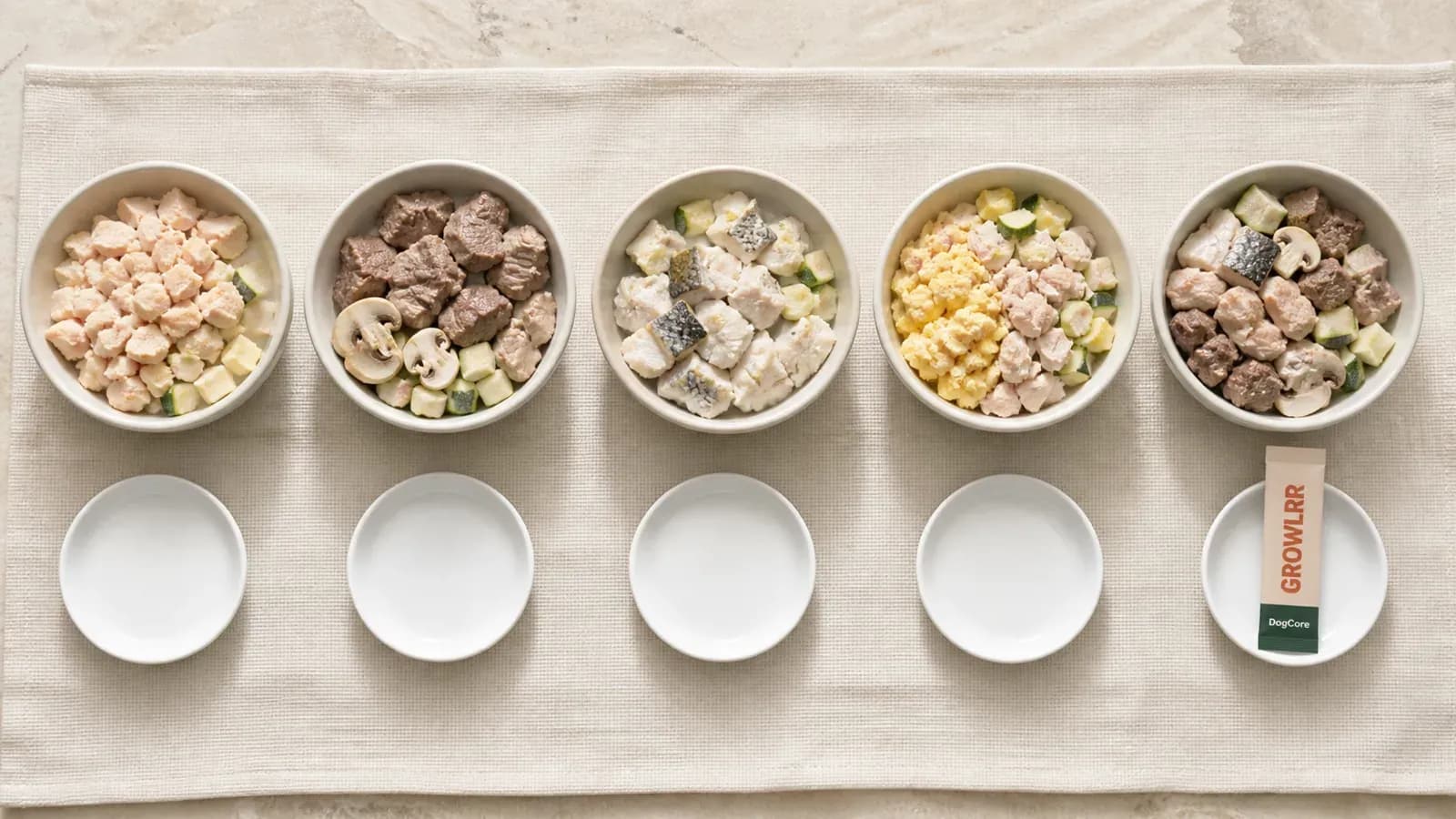
We ran five real home-cooked bowls — from all-meat to all-plant — against the NRC 2006 standard. Every single one fell short, by 9 to 21 nutrients. Four failures appeared in every bowl regardless of recipe: thiamine at 0% (cooking destroys it), vitamin E, iodine, and the calcium-to-phosphorus ratio. That is not a cooking mistake; it is the structure of home cooking — and it is precisely what a measured, weight-dosed correction fixes. Full study: what's missing from homemade dog food? (we ran 5 real bowls) · the supplement itself: the homemade dog food supplement.
One more thing the forums never say: across the most-read Indian homemade-feeding threads, answer after answer recommends rice, curd, chicken and roti — and not one mentions calcium, a nutrient standard, or any supplement. The community has the ingredients right and the completeness missing. On cost, they are right too: a fresh bowl runs on commodity eggs, rice and chicken — cooking fresh is the affordable option in India. The full cost arithmetic shows a corrected home bowl competing with — and often beating — premium packaged food per day.
Cooking for your dog is not the risky option — uncorrected cooking is. Correct it, and a fresh Indian kitchen beats anything in a bag. Check what your current bowl is missing with the free bowl checker.