
Roti for dogs: how bad is it, really?
Published
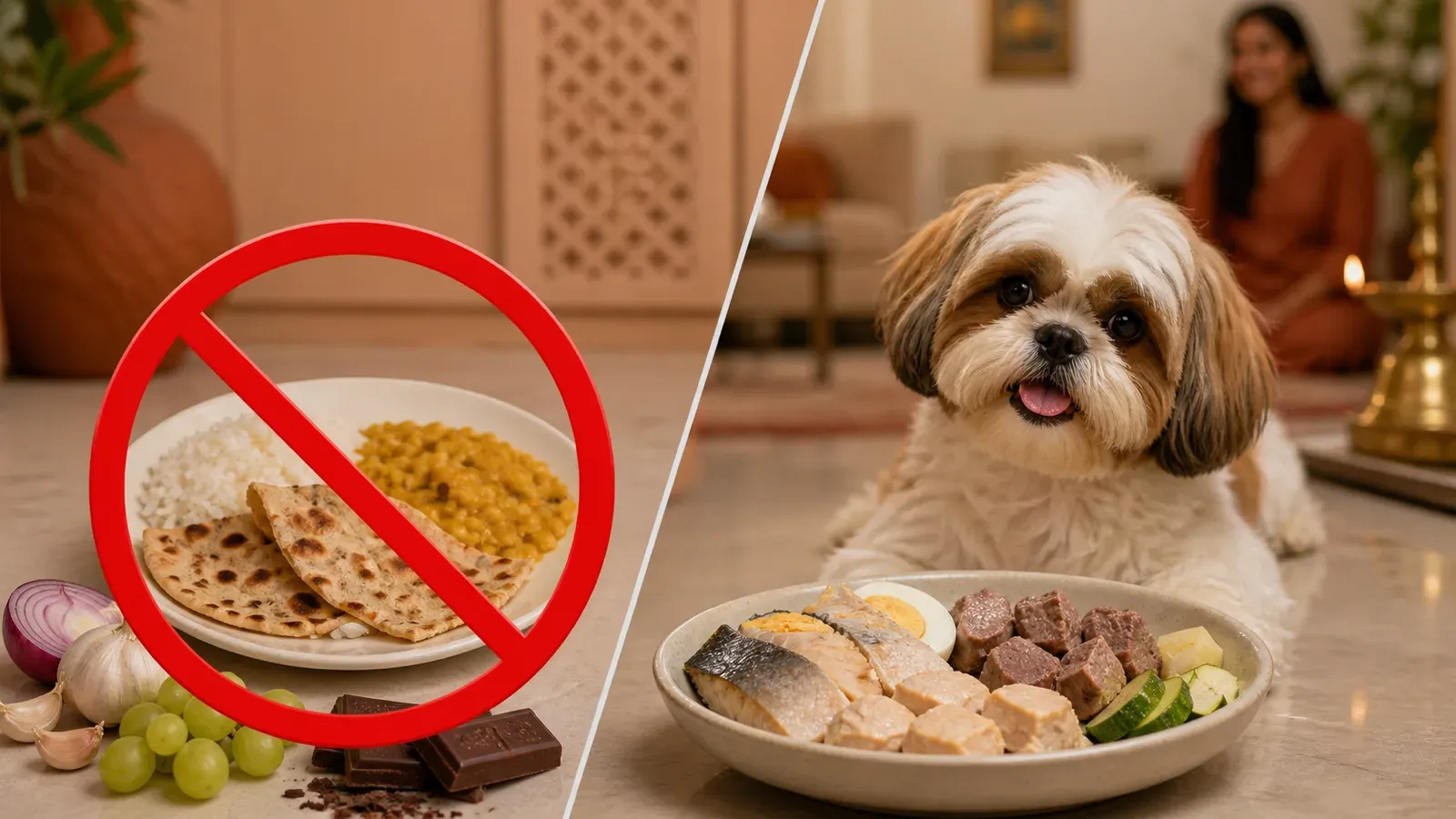
You are not getting it wrong
Roti and dal is what a great many Indian dogs have eaten for generations, often to a decent old age, and we are not going to pretend otherwise or make you feel bad about it. Dogs are remarkably tolerant. But tolerant is not the same as well fed, and the gap shows up slowly rather than suddenly — which is exactly why it goes unnoticed.
The actual objection: displacement
Wondering how this applies to your own pet? Build their bowl — two minutes, and it gives the exact grams for their weight.
A dog's daily energy is finite. Our engine puts a moderately active 10 kg dog at roughly 640 kcal. A medium roti is around 100–120 kcal. Three of those is a fifth of the day, and what that fifth delivers is starch — no taurine, negligible zinc, no iodine, no long-chain omega-3, and a protein that is incomplete for a carnivore.
Every calorie of roti is a calorie of meat that did not fit. That is the whole argument, and it is the same argument we make about rice, potato and sweet potato. It is not about carbohydrates being sinister. It is about crowding.
Three specific things about roti in particular
- Wheat is a recognised canine food allergen. In Mueller, Olivry & Prélaud (2016), wheat sits among the more frequently implicated food sources in dogs, behind beef, dairy and chicken. Not a reason to panic — a reason to remember it if your dog itches.
- Ghee, oil and salt. A dry phulka is one thing. A roti smeared with ghee, or a paratha, is a fat load your dog did not need. Salted dough adds sodium that nothing in a dog's diet asks for.
- Glycaemic load. Refined maida rotis and white flour spike harder than whole atta. If roti is in the bowl, whole wheat atta is the better of the two.
What about dal?
Dal is a better companion than roti — it carries real protein, though plant protein with a different amino-acid profile than a dog needs, and it brings fermentable fibre that some dogs handle poorly. In moderation it is fine. As the protein source, it is not enough, and for a cat it is not a protein source at all.
The bit roti never fixes
Even a bowl with no roti at all is short. Fresh muscle meat runs a calcium-to-phosphorus ratio around 1:17 — chicken is 12 mg calcium against 200 mg phosphorus per 100 g in our ingredient table — where an adult dog needs it the other way round. Iodine, zinc, vitamin E and thiamine are short too. That is a correction problem, not an ingredient-swap problem.