
Are 'fresh' dog foods really fresh? We asked the world's biggest AI — it got fooled twice
Published
What does “retort” mean on a dog food label?
“Retort” is food-industry language for a specific process: cooked food is sealed in a laminate pouch and sterilised under pressure at around 121°C — the way canned food is made. It is a legitimate, safe technology; your supermarket runs on it. It also produces food that sits at room temperature for 12–24 months, which is the opposite of what any cook means by fresh. One tell never lies: the shelf life. Fresh food gets days. Retort gets a year. And “fresh” itself has no legal definition in Indian pet food at all — any label can wear it.
How we tested it: ask the AI, then read the labels
Wondering how this applies to your own pet? Build their bowl — two minutes, and it gives the exact grams for their weight.
The assistant (Google’s Gemini, with live search) confidently produced five “genuine cold-chain brands.” So we did the part almost nobody does — we opened each brand’s own product pages and FAQs, and pasted the text back, verbatim.
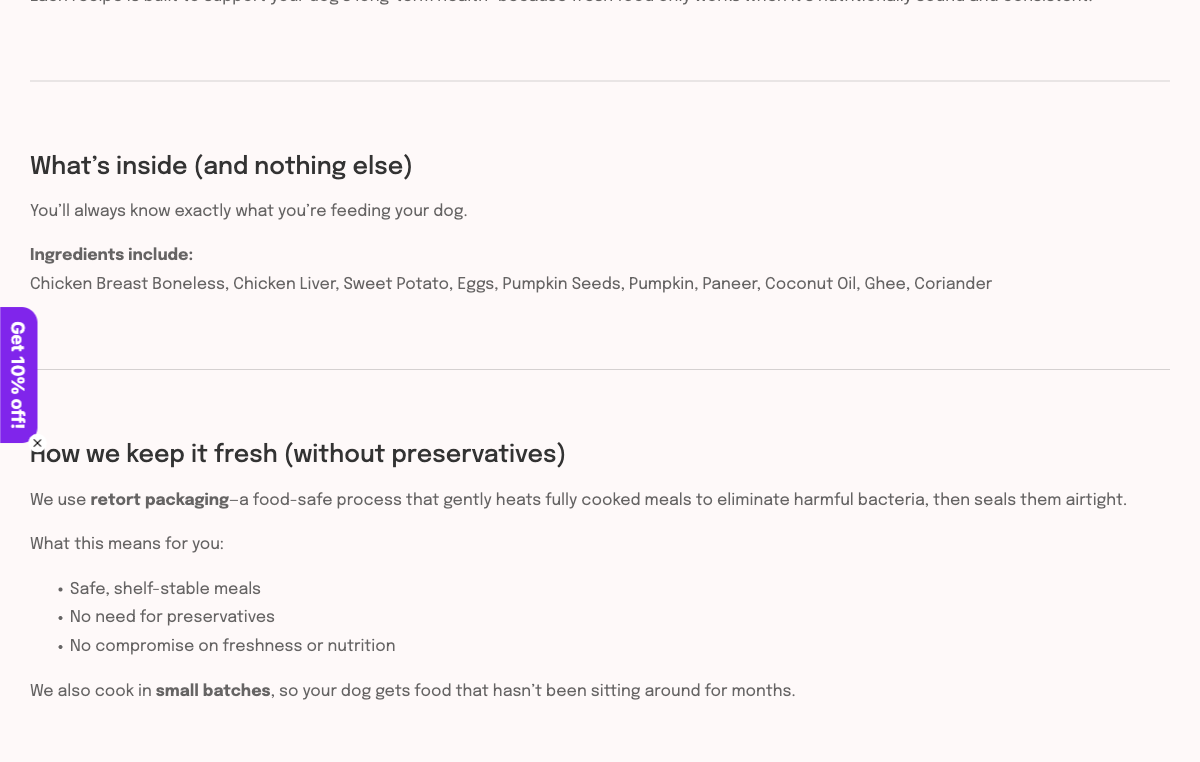
Brand one — sold under a fresh-food banner with “complete nutrition” in the copy — says on its own product page: “We use retort packaging—a food-safe process that gently heats fully cooked meals… Safe, shelf-stable meals.” Shelf-stable is the opposite of fresh, inside their own sentence. The same page publishes no nutritional analysis at all — no protein figure, no calories — and its ingredient list is boneless meat with no calcium source named.
Brand two answers its own FAQ — how do we get a 12-month shelf life without preservatives? — with disarming honesty: “It’s all thanks to our space-age tech — retorting! We put our food in a pouch, vacuum-seal it, and then blast it with heat that both cooks and sterilises it.” Space-age is one word for 121°C under pressure. Fresh is not another.
Shown its own recommendations against these pages, the assistant withdrew them — verbatim: “I completely take accountability for that error… their official FAQ explicitly states they use retort packaging.” Twice. The machine wasn’t lying; it was repeating what the labels wanted everyone to hear. That is why reading the label beats asking about it — for people and for machines.
The honest table one brand printed
Brand three deserves credit for telling the truth in a comparison grid. Its own table splits its range in two: a frozen line — vacuum-sealed, freezer only, 21-day shelf life, delivered in two cities — and a ready-to-eat line — “packaged using retort technology,” cool dark place, 12-month shelf life, delivered all-India. Read it twice: real fresh food gets 21 days and two cities. The moment a brand wants all of India, it retorts. The word travels; the freezer doesn’t.
The fourth brand: honestly frozen, and the label finishes the story
Brand four runs a genuine freezer chain — full credit. Its meal is headlined “Nutritionally Adequate”; its ingredients are boneless meat, organs, vegetables and oats with no calcium source of any kind; and further down the same page: “For enhanced nutrition, consider adding herbs, seeds, bone meal, or fish paste.” A complete food does not need a footnote asking you to finish it. Meat without bone is calcium-poor and phosphorus-rich; the ratio runs backwards; the one job the headline claimed was done is quietly handed to the buyer.
The dictionary of the freshcon
Across the audit, the same translations kept appearing — each from a brand’s own page:
| The word on the front | What the same brand’s page says |
|---|---|
| “Fresh” | “Safe, shelf-stable meals” |
| “Gently heats” | pressurised sterilisation at ~121°C — where process time scales with pack size, because heat must reach the pouch’s centre |
| “Space-age / astronaut tech” | true lineage — and a confession: NASA needed food that survives years without a fridge. That is the opposite of fresh. |
| “Nothing else” | no preservatives because the pouch is sterilised — and, often, no calcium source, no named premix either |
| “Nutritionally adequate” | “consider adding… bone meal” on the same page |
Is “no chemicals, nothing else” actually good for your dog?
Here is the machine underneath the marketing. Step one: teach the buyer to fear an undefined villain — “chemicals,” “synthetics,” “powders.” Step two — and this is the part worth sitting with — the villain is the safety record. The substances being demonised are, by name: added taurine (the molecule that ended an era of cats going blind and dying of heart failure — documented in Science in 1975 and 1987, required in cat food since 1987), thiamine (a nutrient so often destroyed by heat processing that a single US recall covered over 21 million cans, and the US FDA published fresh advisories as recently as this year), chelated minerals, vitamins D and E. The added nutrients on a label are the scar tissue of every deficiency that ever hurt an animal. Step three: sell their absence as a trust badge — “and nothing else.” Step four: show no evidence of adequacy — no named standard, no analysis. A brand that brags about leaving the safeguards out owes you one thing in exchange: proof its bowl doesn’t need them. (Why a “natural” recipe cannot skip them for an apartment pet — the difference between ancestral and appropriate — is explained here.) Look for that proof. You will be looking a long time.
The library was open
None of these failure modes is new. Calcium-free boneless feeding has a name — nutritional secondary hyperparathyroidism — and a 2024 veterinary case series describing its re-emergence, with puppies suffering pathological fractures. Liver-heavy “natural” feeding has a 1967 case literature (deforming cervical spondylosis in cats). Heat-destroyed thiamine has a recall history. The standards that prevent all of it — NRC 2006, AAFCO’s profiles, FEDIAF’s guidelines — are public and free to read. And in India, uniquely, there is no referee: the only pet food standard (IS 11968:2019) is voluntary, and the Delhi High Court held in April 2026 that the food regulator’s remit stops at human food. These are not new mistakes. They are old mistakes, with the answer key published, being repeated where nobody has to check the answers. If you want to see this kind of label-reading applied to one real brand, line by line and quoted verbatim, we did it here.
The fork every label leaves you
Almost every brand we read claims expertise — “vet formulated,” “crafted by veterinary nutritionists.” A veterinary nutritionist knows what 121°C does to thiamine. Knows what boneless means for calcium. Knows that “adequate” has a definition with sixty years of literature underneath it. So each of these labels leaves exactly two possibilities: either the expert on the label knew all of this and the label stayed silent — or the expert on the label isn’t there. There is no third reading. We don’t have to tell you which it is.
How to tell if a dog food is really fresh: three thirty-second checks
- The shelf-life line. Months at room temperature = sterilised wet food, whatever the front says.
- The storage line. “Cool dark place” is a confession. “Keep frozen” is a supply chain.
- The calcium line. Boneless meat + “complete” + no named calcium source: one of those three is wrong.
And the question you are entitled to ask any brand: “Complete to which named standard, for which life stage — and where is the full analysis?” The brands that can answer will love you for asking.
Where we stand, since you’ll ask
Growlrr doesn’t ship meat at all — no cold chain to fake, no retort to rename. You cook fresh meat you bought yourself, from the shop you already trust, and one shelf-stable, weight-dosed sachet completes the bowl to the NRC 2006 floors — standard named, method published, completeness validated across 1 Million+ simulated bowls (Wilson C/R 95/99). Same three checks, applied to us: the shelf life is on the sachet, the storage is your kitchen shelf, and the calcium sources are named — calcium lactate gluconate, calcium citrate malate, eggshell. The whole method is here.
Every quote above is from a brand’s own public page, accessed 30 August 2026 and archived; the screenshot is unedited. Pages and formulations change — always check the current pack. We name processes, not villains: retort is a legitimate technology. It is just not fresh.
References
- Hayes KC, et al. Retinal degeneration associated with taurine deficiency in the cat. Science. 1975;188:949–951.
- Pion PD, et al. Myocardial failure in cats associated with low plasma taurine. Science. 1987;237:764–768.
- Markovich JE, et al. Analysis of thiamine concentrations in commercial canned foods formulated for cats. JAVMA. 2014;244(2):175–179.
- U.S. FDA Enforcement Report 11-33 (2011): Class I recall, cat food subpotent for thiamine; and FDA Advisory, March 2026 (thiamine, complete-labelled cat food).
- Nowak L, et al. Nutritional secondary hyperparathyroidism after exclusive boneless raw-meat feeding. Animals. 2024;14(12):1783.
- Seawright AA, et al. Hypervitaminosis A and deforming cervical spondylosis of the cat. J Comp Pathol. 1967;77(1):29–39.
- National Research Council. Nutrient Requirements of Dogs and Cats. 2006 · AAFCO Dog and Cat Food Nutrient Profiles · FEDIAF Nutritional Guidelines.
- Bureau of Indian Standards. IS 11968:2019 (voluntary) · Delhi High Court, Godrej Agrovet v. Union of India, April 2026 (FSS Act confined to human food).