
Best food for dogs in India: 5 options compared
Published
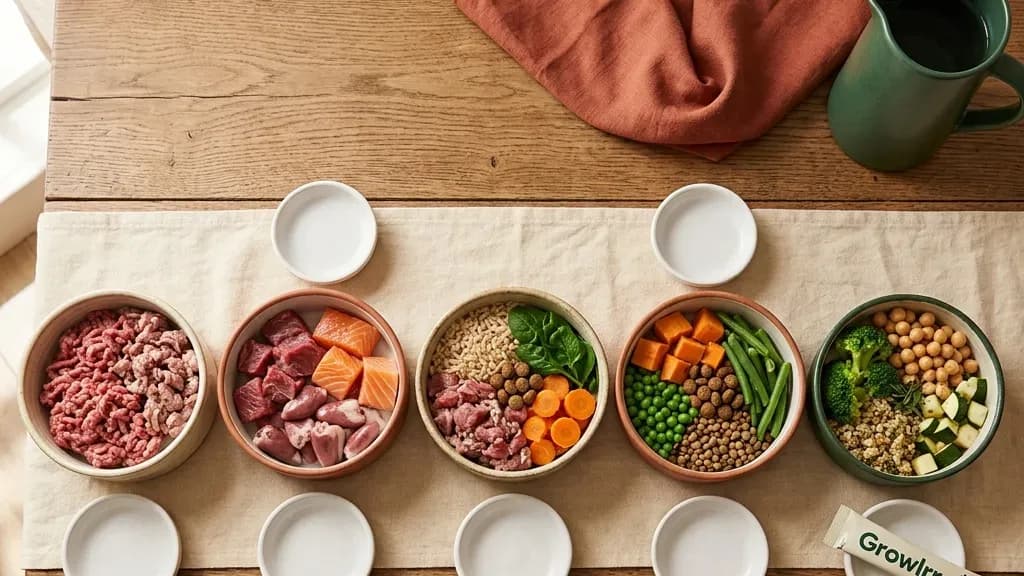
The Indian companion-animal market is growing fast, and the products filling it fall into five categories. Each one trades away something important. We have surveyed each, and none of them solves the whole problem. This is not market criticism — it is arithmetic.
1. Extruded dry kibble
Convenience leader. Long shelf life. Pour into a bowl. The cheapest category per calorie — and the most compromised. Kibble is made by extrusion: starch, ground meat meal and water forced through a die at 150–180°C. That heat degrades sensitive vitamins, so a synthetic vitamin premix is sprayed onto the finished pellets afterwards to restore label minimums. What arrives in the bag is a spray-coat on top of a starch matrix.
The cereal-to-animal-protein ratio is the category's open secret. A typical Indian mass-market bag is roughly a third animal-derived by weight; the rest is rice, wheat, corn, pulses and binders. For an obligate carnivore (a cat, which must eat animal tissue) or a facultative one (a dog, omnivorous by adaptation), that is a flour-based biscuit with meat flavour, sold as "complete" because a premix compensates for what the base never contained.
Fails on: biological quality, processing damage, carbohydrate load. Wins on: price, shelf life, convenience.
2. Dehydrated and freeze-dried meat
Wondering how this applies to your own pet? Build their bowl — two minutes, and it gives the exact grams for their weight.
Higher-priced. Animal-protein content is genuinely higher and the format sidesteps retort damage. But the economics defeat the claim: freeze-drying is capital-intensive, landing several times kibble's per-calorie cost, so most households can't sustain it as daily feeding. The category is small, so SKU variety is thin. And completeness still leans on a synthetic premix — dehydration doesn't restore what butchering leaves out.
Fails on: price, SKU range, premix dependency. Wins on: biological quality, no extrusion damage.
3. Wet retort pouches
Premium shelf, visible meat chunks in gravy, no extrusion — it looks like the answer. It isn't. Retort processing (pressurised steam at ~121°C for 20–40 minutes) destroys thiamine, damages folate and degrades the omega-3 profile. Milder than extrusion, not clean. The structural issue is water: a premium wet pouch is roughly three-quarters water by weight, so you pay to ship and store water, at a per-calorie cost several times kibble — and you can read the consequence off the manufacturer’s own pack. Royal Canin’s Labrador Retriever Adult wet food is 140 g a pouch at 827 kcal/kg — about 116 kcal, under a tenth of what a Labrador eats in a day. So their feeding table asks for 10½ pouches a day at 26 kg, and 13½ at 38 kg. At the ₹153 a pouch it retails for, that is ₹48,000–62,000 a month. Almost nobody pays that, and that is the finding rather than a caveat. Royal Canin knows it too: printed beside that column on the same panel is an “or” — one pouch, plus kibble. The feeding instructions concede what the marketing does not, which is that the pouch was never meant to be the meal. It is priced and portioned as a garnish, and the bowl underneath it is still kibble. In India, processed packaged pet food also sits in a much higher GST slab than the fresh meat you'd buy at the market.
Fails on: price, retort damage, water shipping. Wins on: shelf life, portion format.
4. Fresh cold-chain
The newest category — fresh or lightly cooked food, cold-chain distributed in a few metros. Genuinely high animal-protein content and the closest of the existing categories to biological adequacy. But the monthly cost runs to ₹___/mo for a large dog, the cold chain is fragile and postcode-restricted, and completeness is claimed against profile compliance rather than published stochastic validation. We looked for published validation data on the major Indian fresh brands and did not find it — informative silence for a category sold on scientific rigour.
Fails on: price, cold-chain dependency, absence of published validation. Wins on: biological quality.
5. Home-cooked
The oldest and most common category — a plate of chicken and rice, sometimes with curd. Cheapest by a wide margin, and it fails on precision more severely than any commercial product. When researchers evaluated 200 home-prepared maintenance recipes, the large majority fell short on at least one essential nutrient (Stockman 2013). Meat is high in phosphorus and low in calcium, so a meat bowl inverts the calcium:phosphorus ratio (the balance of calcium to phosphorus); cats need dietary taurine (an amino acid cats must get from food), which cooking lowers further; iodine is geologically scarce in most Indian soil; copper and marine EPA/DHA (the omega-3 fatty acids EPA and DHA, from fish) are routinely missing. The home cook isn't wrong to cook — only to assume a plate of real food is already a complete diet for a different species. It is the start of one.
Fails on: nutritional precision, species-specific requirements, calculation burden. Wins on: price, freshness, control.
The sixth way
Each of the five trades precision for price or price for precision, with convenience as the tie-breaker. Growlrr doesn't accept the trade — the system was developed by a cardiovascular stent-design engineer for his own cats, then generalised to dogs. You keep the fresh meat you already buy — chicken, mutton/goat, tilapia, egg — and add one measured 5 g BowlBalancer™ sachet dosed to your pet's weight. That closes the calcium, iodine, zinc, copper, vitamin D/E and EPA/DHA gaps a meat bowl leaves open, against the NRC 2006 reference framework — NRC 2006 being the international nutrient reference vets and nutritionists use — without a synthetic-premix-in-a-bag. Adequacy is proven not on a spec sheet but across 1 Million+ vectors · Wilson C/R 95/99, with zero safe-upper-limit breaches (nothing exceeds the safe maximum).
The one dimension we don't beat the other five on is raw convenience: our protocol asks for a few minutes of gentle cooking, then you tear a sachet into the warm food and serve. Longer than scooping kibble; shorter than cooking for yourself. We are not asking you to make your pet's food from scratch. We are asking you to complete it.
References
- National Research Council (NRC). Nutrient Requirements of Dogs and Cats. Washington, DC: National Academies Press; 2006.
- Association of American Feed Control Officials (AAFCO). Dog and Cat Food Nutrient Profiles (current edition).
- FEDIAF. Nutritional Guidelines for Complete and Complementary Pet Food for Cats and Dogs (current edition).
- Stockman J, Fascetti AJ, Kass PH, Larsen JA. Evaluation of recipes of home-prepared maintenance diets for dogs. J Am Vet Med Assoc. 2013;242(11):1500–1505.