
Is homemade dog food complete and balanced? The pillar guide
Published
Why homemade looks complete but usually isn’t
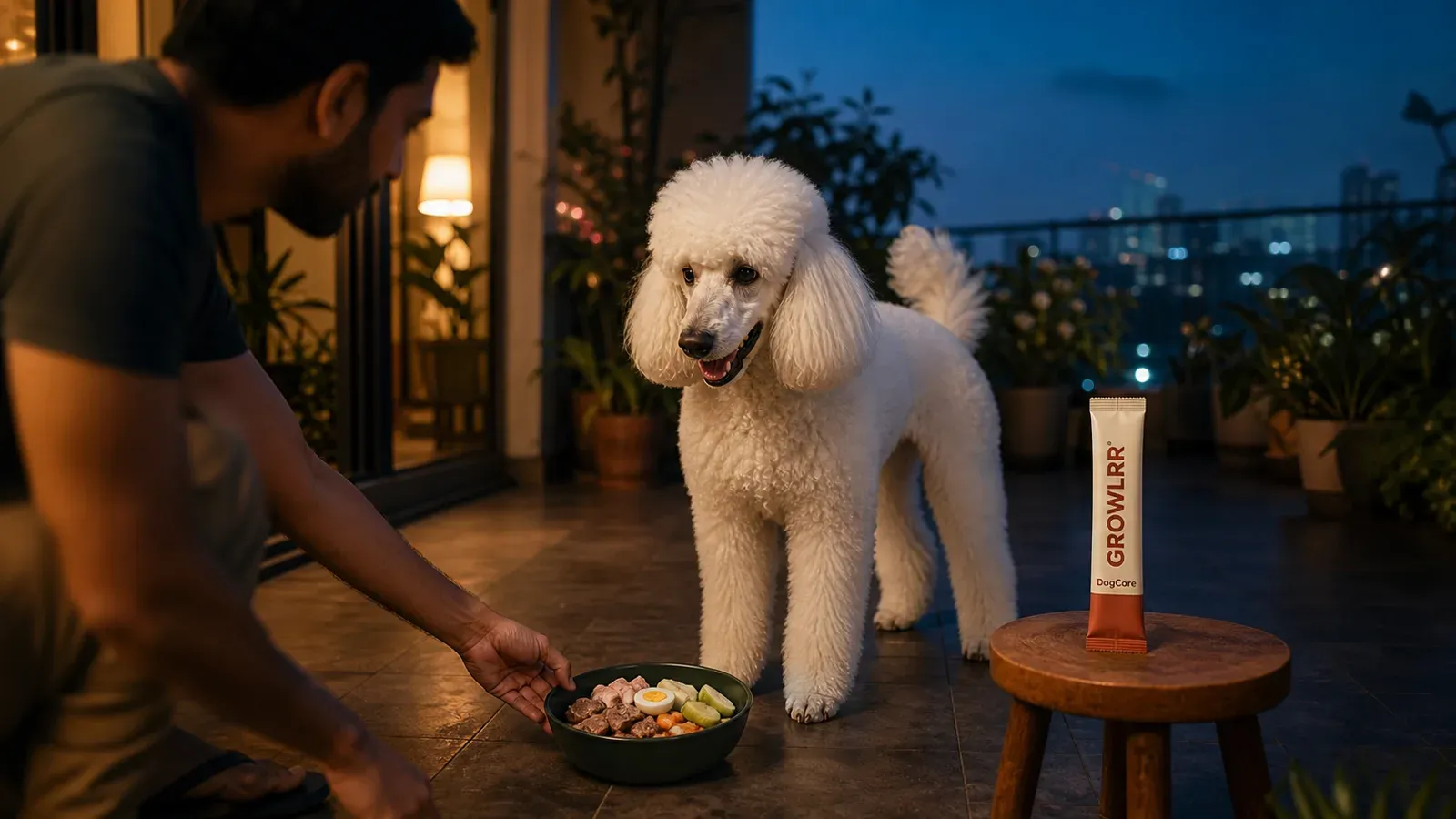
A bowl of fresh chicken, egg and vegetables looks like real food — because it is. The catch is that “real food” and “a complete diet for a different species” are not the same thing. Home recipes drift over time, ingredients get swapped, and there is no mandated nutrient floor — no minimum healthy amount — telling a home cook when a batch is short. When Stockman and colleagues assessed home-prepared maintenance recipes for dogs, most failed to meet at least one essential nutrient allowance (Stockman 2013).
The specific gaps
Wondering how this applies to your own pet? Build their bowl — two minutes, and it gives the exact grams for their weight.
Muscle-meat bowls are reliably deficient in a predictable handful of nutrients measured against the NRC 2006 standard — the international nutrient reference vets and nutritionists use:
- Calcium — meat is calcium-poor and phosphorus-rich, so the calcium:phosphorus ratio — the balance of calcium to phosphorus — is usually inverted (it should sit near 1.2:1).
- Iodine — geologically scarce in much of Indian soil; rarely met without a deliberate source.
- Zinc and copper — copper in particular needs organ or a chelated source.
- Vitamin D — dogs get it from diet, not sunlight.
- EPA/DHA — the omega-3 fatty acids, low in most land-animal meat.
Our own bowl-checker puts numbers on this. Running home diets against NRC 2006 as a deterministic point-estimate (a single careful calculation of one day's bowl), four things failed in every single bowl regardless of recipe: thiamine (vitamin B1) at 0% — cooking destroys it — plus vitamin E, iodine and the calcium:phosphorus ratio, all out of range. The total breach count ran from 9 in an all-meat bowl to 21 in a plant-heavy one, and a measured correction closed all of them to zero every time.
The two fixes
There are only two intellectually sound ways to close these gaps. One: balance every single batch by hand — weighing supplements against the exact meat you used that day, per NRC 2006 / AAFCO / FEDIAF targets. That works, but almost nobody sustains it. Two: decouple — cook the meat you trust, and add one measured correction sized to your pet’s weight.
How Growlrr does it
Growlrr uses the decoupled approach: fresh market meat (a diverse base of chicken, mutton, farmed tilapia and egg) plus a 5 g BowlBalancer™ sachet dosed to weight, which delivers the exact micronutrients a home bowl misses. Adequacy is not asserted on a label — it is proven by Monte-Carlo simulation across 1 Million+ vectors · Wilson C/R 95/99. You keep control of the protein; the sachet closes the gap — no per-batch math that drifts with the meat and the season. Check your bowl and switch today.
“Just chicken and pumpkin. Nothing else.” — the worked example
Folded in from a separate piece (2026-09-17): the arithmetic you can repeat on any two-ingredient bowl.
The claim, and why it works on people
You have seen this label. Just chicken and pumpkin. Nothing else. Because your pet deserves real food, not chemicals. Sometimes it is tuna. Sometimes it is a single protein with a vegetable.
It works because it borrows a genuine principle from human food — that shorter ingredient lists tend to mean less processing — and applies it to an animal whose situation is different. You eat a varied diet across a week and take the sun. A cat eats one thing, from one bowl, every day, indoors, for fifteen years. A short ingredient list is a risk profile for that animal, not a reassurance.
The arithmetic, which you can repeat
Take a 4 kg indoor cat at roughly 200 kcal a day. Cooked chicken in our ingredient table runs 17 g protein and 6 g fat per 100 g, so about 122 kcal per 100 g — meaning roughly 164 g of chicken covers the day's energy.
Now compare what that delivers against the adult cat requirement, stated per 1000 kcal and scaled to 200:
| Nutrient | Supplied | Needed | % of requirement |
|---|---|---|---|
| Manganese | 0.00 mg | 0.24 mg | 0% |
| EPA + DHA | 0 mg | — | 0% |
| Calcium | 19.7 mg | 200 mg | 10% |
| Iodine | 11.5 µg | 70 µg | 16% |
| Folate | — | — | 17% |
| Thiamine (B1) | 0.13 mg | 0.28 mg | 47% |
| Copper | 0.11 mg | 0.24 mg | 48% |
| Vitamin A | 24.6 µg | 50 µg | 49% |
| Iron | — | — | 49% |
| Zinc | 2.46 mg | 3.70 mg | 67% |
| Taurine | 82 mg | 100 mg | 82% |
And the ones that overshoot, which matter too: phosphorus at 182%, selenium at 273%, vitamin B6 at 492%. The calcium-to-phosphorus ratio lands at roughly 1 : 17, where an adult cat wants calcium slightly ahead of phosphorus.
What the pumpkin is doing
Almost nothing, nutritionally. Pumpkin is water, some fibre and a little sugar — genuinely useful for stool quality and satiety, which is why it is in our own dog vegetable blend, described there explicitly as being fed for satiety, not as a micronutrient source.
The one thing it is usually credited with, it cannot do for a cat. Pumpkin's vitamin A is beta-carotene, and cats cannot convert beta-carotene to retinol — they require preformed vitamin A from animal tissue. On the label it reads as the vitamin A source. In the cat it is not one.
What these shortfalls look like clinically
Nothing, for a long time. That is the whole difficulty. Then:
- Calcium. A body held at 10% of its calcium requirement takes the balance from the skeleton. Nutritional secondary hyperparathyroidism — bone pain, pathological fractures, loose teeth. In a growing animal it is faster and worse.
- Taurine. At 82% you are not in acute danger, but you have no margin, and taurine is heat-labile and leaches into cooking water. Sustained deficiency gives dilated cardiomyopathy and retinal degeneration.
- Iodine at 16%. Muscle meat carries almost none. Deficiency presents as lethargy, weight gain and a poor coat — which owners read as age.
- Zinc and copper. Chronic dull coat, scaling, recurring yeast. Frequently treated as allergy for years.
- Thiamine at 47%, before you account for cooking destroying much of what was there.
Every one of these takes a year or more to show, and none of them arrives labelled. That delay is what lets the claim keep selling.
The fair version of the argument
We are not saying these brands are lying about the ingredients, or that fresh chicken is bad food. Chicken is excellent food. The failure is not the chicken — it is the word “else”.
And the same arithmetic indicts a home-cooked bowl exactly as hard. A chicken-and-rice bowl you cooked yourself has the same calcium problem as a pouch. That is the honest symmetry, and it is why our answer is a correction rather than a recipe: cook what you like, then close the gaps deliberately.
Calling added taurine and zinc “chemicals” is technically accurate and practically backwards. They are the difference between food and adequate food.
Every gap above is measured against NRC 2006 and closed by weight. Build your cat's bowl →
References
- Growlrr Central Food-Ingredient Nutrient Table (per 100 g cooked, edible portion; provenance USDA FoodData Central + FEDIAF/NRC where species-relevant) and Growlrr Nutrient Requirements table (per 1000 kcal ME). Both are the tables the production engine reads.
- National Research Council (NRC). Nutrient Requirements of Dogs and Cats. Washington, DC: National Academies Press; 2006.
References
- Stockman J, Fascetti AJ, Kass PH, Larsen JA. Evaluation of recipes of home-prepared maintenance diets for dogs. J Am Vet Med Assoc. 2013;242(11):1500–1505.
- National Research Council (NRC). Nutrient Requirements of Dogs and Cats. Washington, DC: National Academies Press; 2006.
- Association of American Feed Control Officials (AAFCO). Dog and Cat Food Nutrient Profiles (current edition).
- FEDIAF. Nutritional Guidelines for Complete and Complementary Pet Food for Cats and Dogs (current edition).
Check your bowl with the Growlrr bowl-checker →
Related reading
- Do home-cooked dogs & cats need a supplement?
- What’s missing from homemade dog food? (we ran 5 bowls)
- The vegetables a carnivore can actually use
- Which fish is safe for dogs and cats in India?
- “Complete and balanced” is a floor, not a target
- Four deficiency patterns that get mistaken for something else
- “Just chicken and pumpkin. Nothing else.” — what that bowl is missing