
Is premium dog food worth it? Read the label, not the story
Published
By Prasanna M, founder, Growlrr Foods Pvt Ltd · ORCID 0009-0003-6812-347X
Every figure below is quoted from a product label, a company's own website, or a cited paper. Label photographs are our own.
Disclosure. Growlrr sells a nutrient-correction sachet for home-cooked dog and cat bowls. That is a commercial interest in this subject, and it is why every figure here is tied to a product label, a company's own website, or a peer-reviewed paper you can check without trusting us. Nothing on this page is veterinary advice: if your animal is stiff, limping or unwell, the right first step is a vet, not a product.
Is premium dog food worth it? Start with the bag in your hands
You are standing in the pet aisle, or scrolling one. The bag says no corn, no soy, no wheat. It says real chicken first. It says vet-approved, human-grade, no nasties, and somewhere small, meets the standard. The design is warm and lowercase. There is a golden retriever. You feel — this is the important part — slightly better than you did a minute ago. A little more responsible. A little less guilty about the kibble years.
Now turn it over. The first ingredient after chicken is rice. Then potato. Then pumpkin. The protein is a nitrogen number. The "standard" is a minimum written with the industry in the room. Nothing on the back is a secret; it is simply not the story, and the story is what you were holding.
That gap — between the front of the bag and the back — is the entire product. Here is how it is built.
Pet food ads sell you, not the dog (Act I: The Century of the Self)
Wondering how this applies to your own pet? Build their bowl — two minutes, and it gives the exact grams for their weight.
Adam Curtis's first great film is about how the twentieth century learned to sell not goods but selves — buy this and be that kind of person.
Look at a premium pet food advert with that in mind. The dog is incidental. The customer is being sold an identity: responsible pet parent, the kind who reads labels, the kind who would never feed filler. The bag is a badge. And the fuel is not greed but guilt — the quiet, continuous anxiety of loving an animal that will not live as long as you, and being handed, daily, a chance to buy some protection.
The industry did not invent that feeling. It found it, priced it, and built a factory behind it.
In the wild — the name everyone trusts. Take the bag most Indian dog owners would name first. The Pedigree® India page for Chicken and Vegetables for Adult Dogs (Mars; read 14 Sep 2026) says "Time tested flavour", "Wholesome and complete meal", "Made with Quality Ingredients", and describes "the natural goodness of cereals, soybean, carrots, peas & milk." Its printed ingredient list, in full: "Meat and Meat by-products, Chicken and Chicken by-products, Vegetables and Vegetable by-products, Vegetable oils, Milk powder, Iodised salt, Essential Vitamins and Minerals, Cereals and Cereal by-products, Permitted Preservatives, Antioxidants and Flavours, No beef or pork." Nutritional info: crude protein 20 %, crude fat 10 %, crude fibre 5 %. That is the whole disclosure. What the remaining sixty-five per cent of the bag is, the label does not say; on a dry kibble, once moisture and ash are subtracted, what is left is carbohydrate — the cereals. None of this is hidden. It is simply not the story, and the story is time tested.
(The same year, a two-year-old challenger brand raised ₹19 crore to build a factory for a chicken-rice-and-pumpkin kibble and the promise "no fillers". Small player, same play; the money bought the factory and the feeling, not a new bowl.)
How "no fillers" manufactures a villain (Act II: The Power of Nightmares)
A public frightened of the right thing can be led anywhere.
For pet food the villains were chosen for us: corn, soy, wheat, by-products. None of them is one — soy is a better protein than rice by a distance; corn is perfectly digestible energy — but a villain is useful, because fleeing it feels like arriving somewhere. So the bag says no corn, no soy, no wheat in the largest type it owns and fills itself with white rice, potato and pumpkin, which cost less, digest no better, and carry no fear. The customer gets the relief of avoiding a threat that was never there.
In the wild. Drools' own site (read 14 Sep 2026) lists wheat among the ingredients of its everyday dog food range, with the gloss "Provides carbohydrates for energy and dietary fiber for digestion." Its veterinary Mobility line is sold as "single grain — NO CORN, WHEAT OR SOYA." Same company, same year: wheat is nourishment on one shelf and a villain on the next. The ingredient did not change. The customer did — and the price with it. (That mobility diet's own back label is read line by line in Act IV.)
And once, the flight from the villain drew blood. When grain-free became the American premium story in the 2010s, the grain came out and peas, lentils and chickpeas went in — same starch job, better-sounding ingredient. In July 2018 the US FDA opened an investigation into dilated cardiomyopathy, a heart-muscle disease, in dogs of breeds that do not usually get it. By April 2019 it had 515 canine reports; more than 90 % of the diets involved were labelled grain-free and 93 % contained peas and/or lentils. The mechanism is still argued over — taurine, fibre, what the legumes displace — but the shape of the episode is not: a villain invented for marketing, a substitute chosen for the label, and the bill arriving in the one organ nobody was looking at. Nobody printed may affect the heart on the front of those bags either.
This is the first of three moves you will see repeated: separate the transaction from the consequence in time. Sell the relief today; let tomorrow, if it comes, arrive under another name — old age, genetics, bad luck.
Everyone knows what "meets the standard" means (Act III: HyperNormalisation)
A system can run for decades on a story everyone inside it knows to be incomplete, because the story is more comfortable than the alternative.
Everyone in the industry knows "crude protein" is a nitrogen assay, not meat. Everyone knows a cat is an obligate carnivore being fed starch. Everyone knows the seal on the bag certifies a floor, not an optimum. None of that is hidden. It is simply not the story, and the seal — the second move, borrowed authority — closes the conversation the moment a customer opens it. Why is this 40 % starch? — It meets the standard. The argument has been moved from biology to compliance, where the customer cannot follow.
It is also the move with the longest fuse. A poison kills in a day and creates a liability. A merely inadequate diet does nothing visible for years, and whatever it costs the animal arrives at eight or ten with a dozen true-enough explanations queued up in front of it. The feedback loop is longer than anyone's attention span, and nobody is paid to shorten it.
In the wild. Watch who arrived in 2025–26. Godrej launched Ninja in April 2025 at ₹239/kg, targeting a ₹500 crore business in three years; Reliance followed in November with Waggies at ₹199–249/kg; Wipro's Snuggles came in August 2026 at ₹530/kg. These are not nutrition companies discovering dogs. They are consumer-goods and distribution companies discovering that only 7–8 % of the pet food eaten in India is packaged (against 70 % in the US), and that a truck already delivering soap and cooking oil to every kirana can carry a bag of extruded cereal with the distribution already paid for. The bag will meet the standard. The standard is the point.
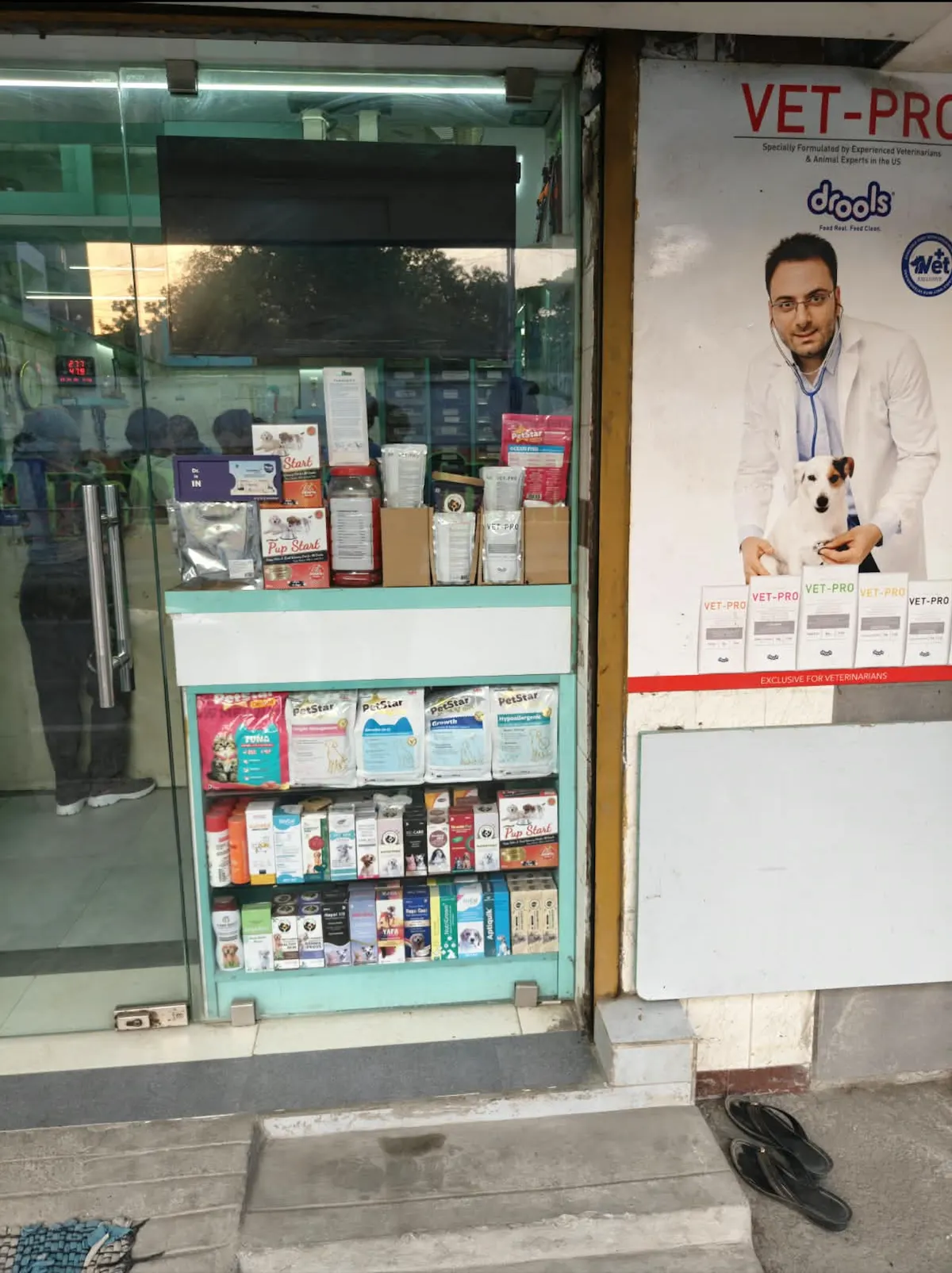
In the wild — the window. Here is what borrowed authority looks like as a building. A good, busy veterinary clinic in Chennai, photographed from the pavement in May 2026. The entire right-hand panel of the frontage is a Drools Vet-Pro poster, floor to ceiling: a man in a white coat and stethoscope holding a terrier, "Specially formulated by experienced veterinarians & animal experts in the US", a "Vet" roundel, a row of Vet-Pro bags, and along the bottom in red, "EXCLUSIVE FOR VETERINARIANS." The glass display case beside the door — the first thing a worried owner sees — is stocked shelf by shelf with Mankind's PetStar range: the pouches, the "Pup Start" boxes, the bottles. Neither company treated an animal in that building. Both have their name on the wall. The owner walks past the white coat on the poster before they have met the one inside, and by the time they sit down, the brands have already been introduced by the clinic's own front door.
In the wild, the pharma company. Same waiting room, same afternoon. Mankind — a pharmaceutical company that makes, among much else, vitamin and mineral formulations, and whose consumer history runs from condoms and emergency contraception into pharma and now pets — markets PetStar through Mankind Pet Nutrition. The Gravy for Cat pouch, 85 g, ₹50: ingredients "Chicken, Seaweed Extract, Guar Gum, Starch, Wheat Flour, Turmeric Powder, Vitamin E." Badges on the front: seaweed "supports oral and dental", turmeric "digestive and joint support". Analytical constituents, approx. per 100 g: protein 9 g, fat 8 g, moisture 83 g — which is exactly 100 g, leaving nothing for the starch, wheat flour and guar gum the same panel lists two inches to the left. The feeding guide says the quiet part: "(As topper on dry food)" — 1 to 5 pouches a day by weight. It is not a food. It is ₹50 of chicken and thickener to make the kibble go down, from a company that makes micronutrient formulations, with one micronutrient on the label.
The dog pouch, V-diet Gravy for Dog: "Chicken, Pumpkin, Potato, Fish, Potato Starch, Rosemary, Ashwagandha, Chicken Liver and Turmeric"; protein 10 g, fat 10 g, 150 kcal, moisture 70 g per 100 g; 300–450 g a day for a 25–40 kg dog, "use as directed by the veterinarian". At 150 kcal/100 g that is 450–675 kcal for an animal that needs about 1,200 — so either it is a topper too, or the dog is hungry. What a pharma brand brings to the vet's shelf turns out to be what everyone brings: chicken, thickener, a herb with a story, and the name on the front.
And the industry already knows the one thing that works. The most rigorous long-term feeding study ever run on dogs was run by a pet food company. Kealy and colleagues at Purina paired 48 Labrador retrievers from eight weeks of age and fed one of each pair 25 % less for life. The restricted dogs lived significantly longer — the median life span moved by close to two years — and chronic disease, including osteoarthritis, arrived later. Published in 2002, in the Journal of the American Veterinary Medical Association, funded by the people who sell the food. Twenty-four years on, feeding guides have not shrunk by a quarter — a company cannot sell you 25 % less of anything. Everyone knows. Nothing changes. That is the film's title.
Gut health, joint chews, and the wellness turn (Act IV: The Trap)
When clean label wore thin, the third move kicked in: change the story, not the product.
The story moved to the gut and the joint. Probiotics were sprayed onto the outside of a pellet after it was cooked, because extrusion kills the cultures it is meant to carry (only spore-formers survive the process). Joint chews arrived carrying a whisper of every ingredient a journal ever praised — enough milligrams to print the name, nowhere near enough to do what the journal did. The supply side had a surplus of industrial ferment and bulk actives; the demand side had three years of human biohacking reels; the dog scratching on the sofa was the bridge between them. The fix for a processed food became another processed additive, and the feeling of doing something was, once again, the thing actually sold.
Curtis would cut here from the boardroom to the litter tray: a firmer stool, a reassured owner, and underneath it a bowl that has not changed.
In the wild, the "vet" bag. Photographed by us at a veterinary clinic's front office in Chennai, May 2026: Drools Vet-Pro Mobility, 3 kg, stickered "Exclusively for veterinarians", front panel: "Specially formulated by experienced veterinarians & animal experts in the US · Precisely balanced nutrition to improve mobility & joint health · interrupt the degradation of cartilage · provide building blocks for cartilage repair · help dogs to burn fat maintaining lean muscle mass · SINGLE GRAIN FORMULA — NO CORN, WHEAT OR SOYA."
Now turn it over. Ingredients, in printed order: "Whole Grain Rice, Hydrolyzed Chicken Protein, Powdered Cellulose, Soya Protein Isolate, Soya Refined Oil, Chicken Oil, Fish Oil, Beet Pulp…" The front of the bag says no soya. The fourth and fifth ingredients on the back are soya. The third is powdered cellulose — wood-pulp fibre. That is not an interpretation; it is the same bag read from both sides.
Guaranteed analysis, verbatim: protein 24 %, fat 16 %, carbohydrate (NFE) 51.1 %, crude fibre 7.8 %; glucosamine hydrochloride 1,900 mg/kg; chondroitin sulphate 100 mg/kg; EPA 0.493 %; ALA 2.73 %; "Total Omega 3 fatty acid 3.74 %". Feeding: below 10 kg 50–180 g; 11–25 kg 180–360 g; 25–45 kg 360–540 g; above 45 kg 540–800 g.
Read it for a 30 kg dog on the label's own band, 360–540 g a day:
- Starch: 51.1 % of 360–540 g is 185–275 g of carbohydrate a day, on a diet whose front panel says burn fat — for the medium and large breeds it is formulated for, the exact dogs in which the industry's own study (Kealy, above) found that less food meant later, milder arthritis. (The label prints no energy figure; at a typical ~3.6 kcal/g the band is 1,300–1,950 kcal a day. A 30 kg adult needs about 1,200, so the bottom of the band is already at maintenance and the middle is a fifth above it — the top is meant for a 45 kg dog.)
- Glucosamine: 1,900 mg/kg × 0.36–0.54 kg = 680–1,030 mg a day, ≈23–34 mg/kg — genuinely at the level Kampa's trial used. Dosed honestly. The trial found that dose no better than placebo.
- Chondroitin: 100 mg/kg × the same = 36–54 mg a day, ≈1–2 mg/kg — a tenth of the trial's ~12 mg/kg. It is on the label so the front can say building blocks for cartilage repair.
- Omega-3: the honest line. 0.493 % EPA is 1.8–2.7 g a day — a genuine marine dose, if a modest one: Fritsch's 2010 dose trial started its therapeutic food at 0.8 % EPA+DHA and saw the clearest benefit at three times that. But the headline Total Omega 3 — 3.74 % is three-quarters ALA (10–15 g a day of it), the plant omega-3 from flaxseed and soya oil, of which a dog converts only a few per cent to EPA and DHA. The big number is padding around the one good one — and the soya oil that supplies part of it is the soya the front says is not there.
So the fairest reading of a bag sold exclusively for veterinarians: fish oil at a genuine but modest dose; glucosamine dosed at a level shown not to; chondroitin as decoration; a headline built on the wrong omega; half the bag as rice and a fifth of the top-five ingredients as the soya it denies; with a feeding band that starts at maintenance and goes up, on a diet for joints.
In the wild, the "honest" chew. ho.pe. — The Honest Pet Co. — sells "Zero-Asterisk Nutrition… No asterisks leading to disclaimers" on its homepage, and a Hip + Joint Hoplet™ whose own label lists green-lipped mussel at 5 mg per chew, against randomised dog trials that used 600–1,470 mg a day for a retriever-sized dog. The asterisk they removed is the one that would have carried the dose. Its gut chew carries one bacterial strain and the word honest. (The full arithmetic, label against trial, is in the companion piece.)
The retreat into the ledger (Act V: Can't Get You Out of My Head)
The last film is about people who tried to step outside the story machine and mostly found the machine had already priced them in.
In a small room, somewhere hot, a handful of people decided not to make a better story. They took the animal's requirement — per nutrient, per day, by body weight — wrote it down, built the dose to meet it, ran the validation, and put the arithmetic on an open-science archive where anyone can rerun it. It is not a narrative. It photographs badly. It cannot be told in a reel. In a world run on perception it is, as the film would say, just another voice shouting into the void — with one difference: it can be checked, and a story cannot.
In the wild, the other direction. BARF is a thirty-year-old grassroots idea — Biologically Appropriate Raw Food, a community's acronym, published by an Australian vet in 1993 and argued over on forums ever since. (Whether ancestral is the same thing as appropriate — a wolf's energy budget is not a flat's — is its own argument.) In India the word now carries an ® on a storefront, re-expanded on its own homepage as "B.A.R.F. Basic Ancestral Raw Food", and "backed by 36 years in Animal Nutrition." You can trademark a word. You cannot trademark a division. That is why the exit from the theatre is not a better brand.
That is the only reason Growlrr publishes a method rather than a mood: the NRC 2006 floors, the dose ladder by weight, the validation runs, on Zenodo with the working exposed. Not because open data is virtuous. Because it is the one thing a narrative cannot do. You cannot fairy-dust a spreadsheet.
The pet food marketing pattern, named
Put the labels side by side and one shape appears three times over. It has three parts, and none of them is an opinion.
1. It feeds on other people's science. Every ingredient on these panels was made respectable by a trial somebody else ran — green-lipped mussel at 20–49 mg/kg, glucosamine at 30 mg/kg, EPA in grams, weight restriction over a lifetime. The product borrows the name of the finding and leaves the dose behind: 5 mg where the trial used hundreds; 1–2 mg/kg of chondroitin where the trial used 12; "1,000+ research publications" for a formulation none of them tested. The science is the host; the label is what lives on it.
2. It wears the authority it did not earn — or rents it. A clinic's front window as a poster site. Exclusively for veterinarians. Formulated by experienced veterinarians and animal experts in the US. Vet & PhD formulated. A pharma company's name above a chicken-and-wheat-flour gravy. A registered ® on a community's thirty-year-old acronym. None of these badges is false, and none of them says what the buyer hears — that the number on the back was set by the person on the front. The signal is real. What it signals is not.
3. It is sold where people are frightened. These photographs were taken at a veterinary clinic's front office, in May 2026, by one of us — waiting on a sick one-year-old cat. That is where a mobility bag with half its weight in rice, and a hip + joint chew with a rounding error of mussel, are placed: in front of an owner who has just been told something is wrong and wants, more than anything, to be handed something to do. The customer in the least position to check the label is the one the label is designed for.
Borrow the science, borrow the authority, sell to the vulnerable. There is a word for an organism that feeds on a host it did not build and weakens it. We have not used it. We have printed the labels, and the reader can choose.
How to read a dog food label: what is left when the story goes
Numbers. Boring ones. What does this animal need, and does what is in the bowl meet it? That question has an answer you can write down, and it does not care about the typography, the lowercase brand name, or the vet on the advisory board.
Read the back of the pack. Divide. Ignore the adjectives. It is less fun than the story, and it is the whole game.
Where pet food marketing came from: Edward Bernays
None of this is a pet-industry invention. In 1929 Edward Bernays — Freud's nephew, who coined the phrase "public relations" — was hired to sell cigarettes to women. He did not advertise cigarettes. He arranged for debutantes to light up during the Easter parade and told the press they were carrying torches of freedom. Sales followed the story. A year later, hired by a pork packer, he asked doctors whether a hearty breakfast was healthier than a light one, published the yeses, and gave America bacon and eggs. Nobody lied. The doctors were real. The product was unchanged. The narrative was the product.
The three moves above — separate today from tomorrow; borrow authority; change the story when they catch on — are his. He wrote them down in 1928, in a book he had the nerve to call Propaganda. The pet aisle is only the latest room he is standing in.
Further reading: What is the best supplement for dogs? — one product's own label, the peer-reviewed dog trials, and the division the front of the pack leaves out. Act IV, with a calculator.
Sources for the examples (all public, read 14 Sep 2026). Kealy RD et al., J Am Vet Med Assoc 2002;220(9):1315–1320 (PMID 11991408) — 48 Labradors, 25 % diet restriction from 8 weeks, median life span significantly longer, later onset of chronic disease. US FDA, Investigation into a Potential Link Between Certain Diets and Canine Dilated Cardiomyopathy (opened July 2018; 515 canine reports 1 Jan 2014–30 Apr 2019; >90 % grain-free, 93 % peas/lentils; updates paused Dec 2022); Freeman LM et al., JAVMA 2018;253(11):1390–1394 (PMID 30451613). Pedigree: pedigree.in, PEDIGREE® Chicken and Vegetables for Adult Dogs product page — INGREDIENTS and NUTRITIONAL INFO sections quoted verbatim (© Mars or Affiliates). Drools: drools.com, Daily Nutrition range page ("Pure Ingredients" panel: Wheat — provides carbohydrates for energy…) and the Vet Pro Mobility listing ("single grain… NO CORN, WHEAT OR SOYA"); Vet Pro Mobility back label as photographed [to be added]. The ₹19 crore round: business press, September 2026 (brand unnamed by choice). Conglomerates: Mint, 26 Aug 2026, "Wipro Consumer launches Snuggles, joining Reliance and Godrej in pet-food push" (Ninja Apr 2025 ₹239/kg, ₹500 crore target; Waggies Nov 2025 ₹199–249/kg; Snuggles ₹530/kg; 7–8 % packaged vs 70 % US; market ≈ ₹5,500 crore). ho.pe.: honestpetco.in homepage ("Zero-Asterisk Nutrition") and Hip + Joint Chicken Hoplet™ product page (GLM 5 mg); trial doses per the companion piece. BARF India: barfindia.com homepage (BARF®, "B.A.R.F. Basic Ancestral Raw Food", "36 years"); the original acronym per Billinghurst, Give Your Dog a Bone (1993).
Fish-oil dose context: Fritsch DA et al., JAVMA 2010;236:535–539 (PMID 20187817) and Fritsch D et al., J Vet Intern Med 2010;24:1020–1026 (PMID 20707845) — therapeutic food at 0.8 % EPA+DHA, clearest benefit at 3×; Roush JK et al., JAVMA 2010;236:67–73 (PMID 20043801) — 82 % vs 38 % improved peak vertical force.
More reading — the same method, other labels: Is fresh dog food in India really fresh? The retort test — the “fresh” con — a retort pouch is shelf-stable for a year; what a lab-style check of the pouch shows · Are ‘fresh’ dog foods really fresh? We asked the world’s biggest AI — it got fooled twice — the same story, run past a large language model — which repeated the marketing back · Is BARF India’s cooked dog food good? Reading the recipe like a nutritionist — the ® on a community acronym, and what the recipe inside it actually contains
Films referenced: Adam Curtis — The Century of the Self (2002), The Power of Nightmares (2004), The Trap (2007), HyperNormalisation (2016), Can't Get You Out of My Head (2021). Edward Bernays — Propaganda (1928); the 1929 "Torches of Freedom" campaign for the American Tobacco Company; the Beech-Nut Packing bacon campaign.