
The BARC Protocol: Where Fresh Food Meets Nutrient Engineering
Published
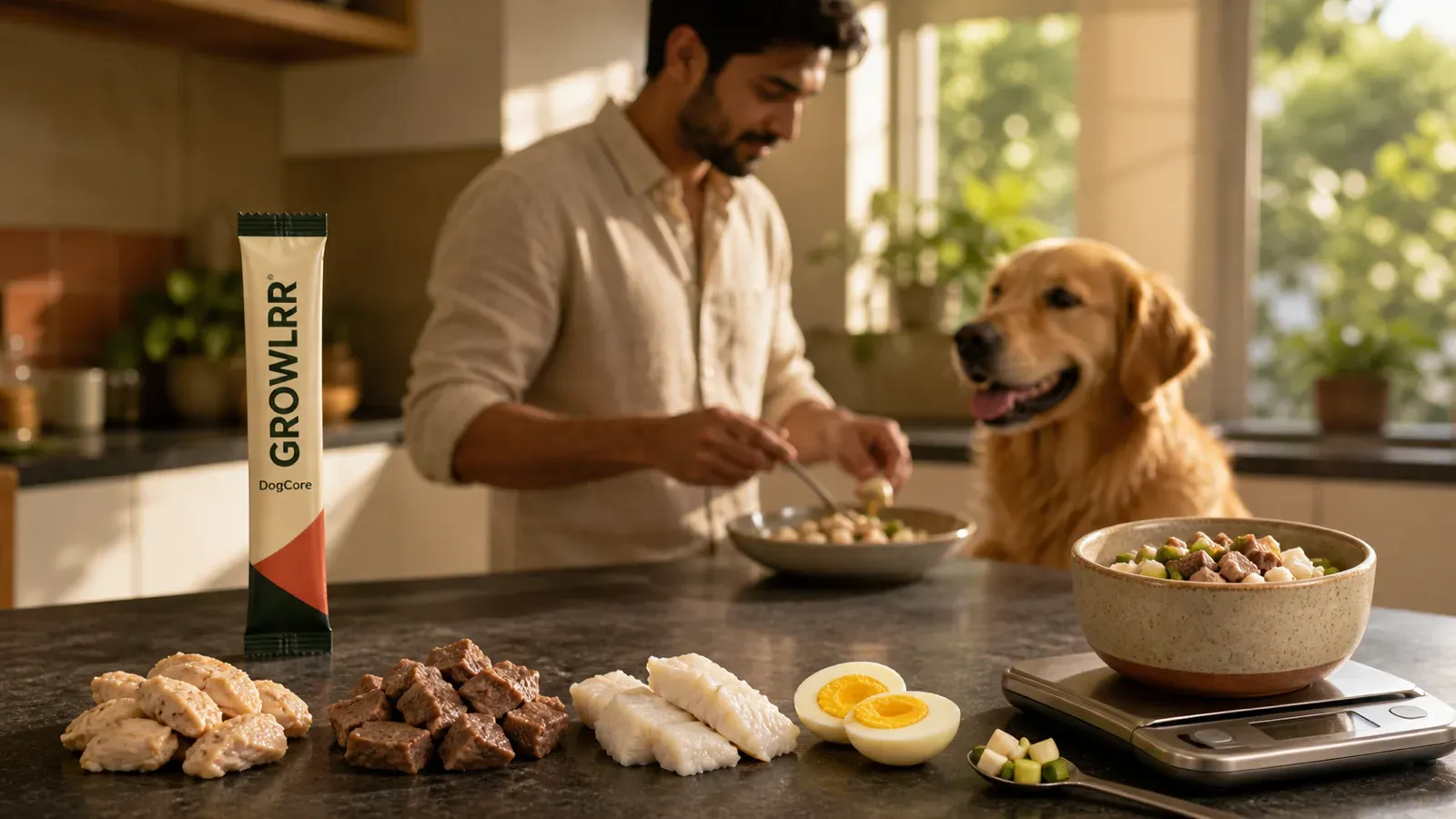
The home-cooking dilemma
Home cooking promises real food but usually swings between two failure modes: either it is nutritionally incomplete, or it becomes a second career of organ sourcing, bone grinders, mineral-salt roulette and spreadsheets — and even then the gaps often remain. No one should have to turn dinner into a daily chemistry exam.
The BARC solution
Wondering how this applies to your own pet? Build their bowl — two minutes, and it gives the exact grams for their weight.
The protocol rejects both extremes. You handle the calories; we handle the micronutrient precision. Each day you source fresh animal-protein inputs — chicken muscle, goat/mutton mince, tilapia (farmed fish), eggs — from your grocery app or butcher, whichever offers the best value. You control the protein: human-grade, affordable, local. We provide the CatCore™ or DogCore™ BowlBalancer™: a single 5 g dry-powder sachet carrying the vitamins, minerals and amino-acid support the meat bowl can't, calibrated to NRC 2006 for dogs and cats and dosed to your pet's weight.
Engineering, not a synthetic premix
This is deliberate: the protocol was developed by a cardiovascular stent-design engineer for his own cats, so precision is treated as an engineering problem rather than a label claim. The correction leans on whole-food and highly bioavailable sources rather than a blanket synthetic vitamin blend: calcium from eggshell powder plus soluble calcium salts (calcium lactate-gluconate and calcium citrate-malate), marine EPA/DHA (the omega-3 fatty acids EPA and DHA, from fish), and chelated trace minerals with copper as the sole binder. Synthetic components are used only where precision genuinely demands it. And adequacy isn't asserted on a label — it is validated across 1 Million+ vectors · Wilson C/R 95/99, with zero safe-upper-limit breaches (nothing exceeds the safe maximum).
This is the decoupling principle in practice: buy fresh where fresh is cheap and good, engineer precision where precision is hard. Balancing every batch by hand at home is cumbersome and drifts with the meat and the season; the protocol removes that burden entirely. For the full "is fresh complete, balanced and safe?" case — BARC (Biologically Appropriate, Residually Corrected — gently cooked, then topped up with the exact nutrients the fresh bowl misses), the framework Growlrr pioneered — see our BARC explainer.
References
- National Research Council (NRC). Nutrient Requirements of Dogs and Cats. Washington, DC: National Academies Press; 2006.
- Association of American Feed Control Officials (AAFCO). Dog and Cat Food Nutrient Profiles (current edition).
- FEDIAF. Nutritional Guidelines for Complete and Complementary Pet Food for Cats and Dogs (current edition).
© Growlrr Foods Pvt Ltd. Published under CC BY-NC-ND 4.0 — cite with attribution; no commercial use or derivatives. The sachet formulation (BOM) is proprietary and not licensed. Author: Prasanna M.