
Can dogs eat paneer?
Published
What paneer actually is
Paneer is milk acidified and pressed. Most of the water leaves in the whey, and so does a good deal of the lactose. What stays behind — protein, fat and calcium — is concentrated. That concentration is the whole point when you are cooking for people. It is also the whole problem when you are feeding a 6 kg dog.
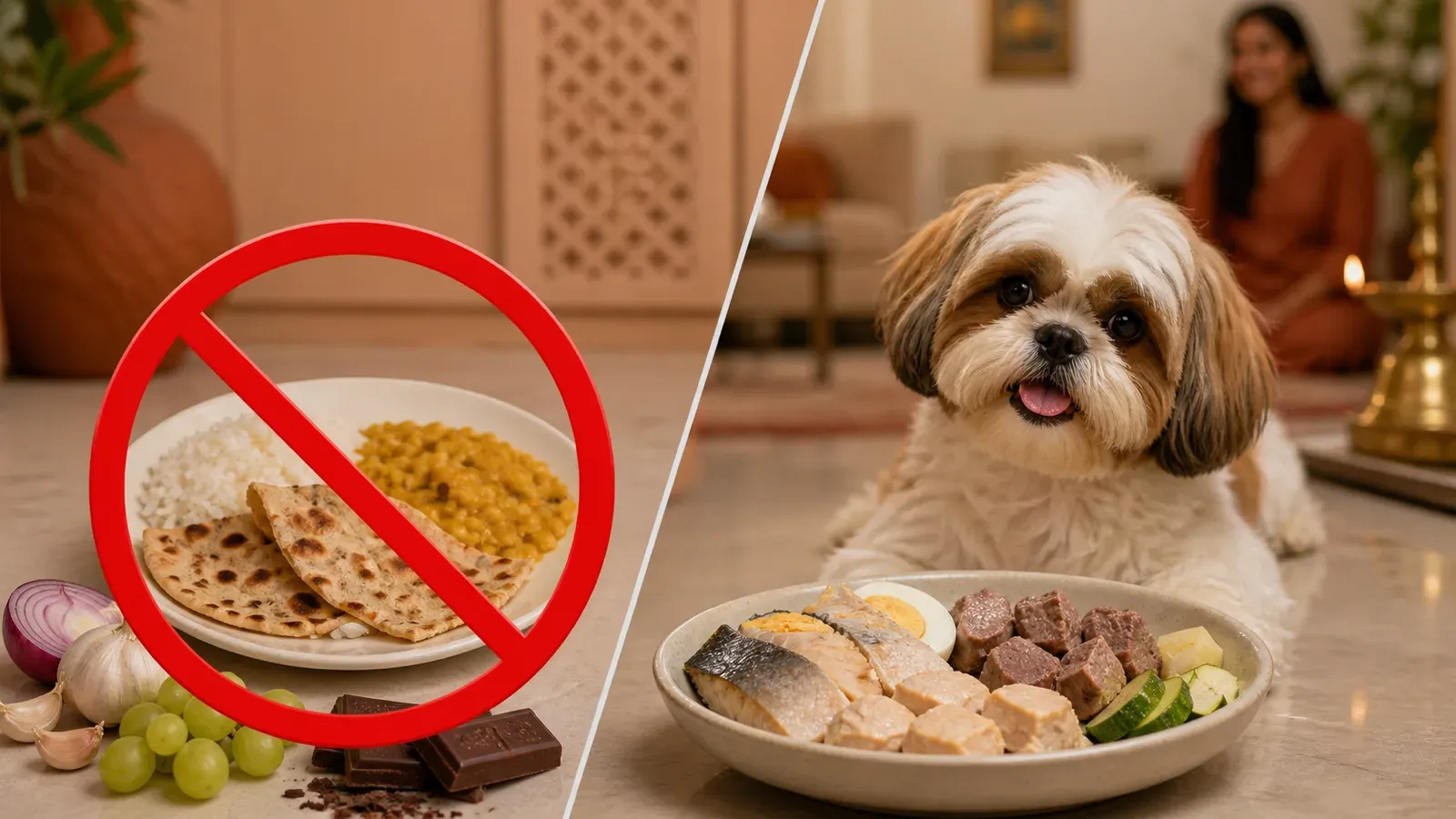
Two Indian specifics make it richer than the generic advice assumes. Paneer here is often made from buffalo milk, which carries appreciably more fat than cow milk. And it is usually eaten fried or in a gravy, which adds oil, salt, chilli, onion and garlic — the last two matter, because both are genuinely toxic to dogs. If paneer reaches your dog, it should be the plain, unfried, unsalted kind.
The arithmetic, so you can do it for your own dog
Wondering how this applies to your own pet? Build their bowl — two minutes, and it gives the exact grams for their weight.
Our engine sets maintenance energy as MER = 98 × BW0.64 × M, where BW is body weight in kilograms and M is an activity multiplier. For a moderately active 10 kg dog that is roughly 640 kcal a day.
Paneer runs somewhere near 270–300 kcal per 100 g depending on the milk. So a 100 g slab is close to half that dog's daily energy — delivered as fat, with almost no taurine, no iodine to speak of, and none of the trace minerals a bowl is actually short of. It is not a nutritional contribution. It is a large, rich snack.
Lactose: less of an issue than people think, but not zero
Adult dogs produce little lactase, which is why milk causes loose stool. Pressing removes much of the lactose with the whey, so paneer is gentler than milk — but it is not lactose-free, and a dog that reacts to dairy will still react. Which brings us to the ranking.
Our ranking for dairy in a dog's bowl
Kefir, then fresh curd, then tofu, then paneer. The order follows how much of the lactose has been fermented away and how much fat comes with it. Curd is the sensible daily option: our ingredient table puts it at 120 mg calcium against 95 mg phosphorus per 100 g, which is the only common fresh food whose calcium-to-phosphorus ratio runs the right way round — every muscle meat runs about 1:17 in the wrong direction. Curd will not fix that on its own, but it is not fighting you.
Paneer sits last on that list. Acceptable, not encouraged.
Cats and paneer
Same answer, smaller margins. A cat's whole day might be 200–250 kcal, so a matchbox of paneer is a serious dent in it. Cats also have no dairy requirement whatsoever. A lick of it is fine; a habit is not.
None of this closes the gaps that matter — calcium, iodine, taurine, zinc and the long-chain omega-3s are not in the dairy aisle. Those are measured against NRC 2006 and supplied deliberately.