
Is goat meat good for dogs?
Published
A note on the word
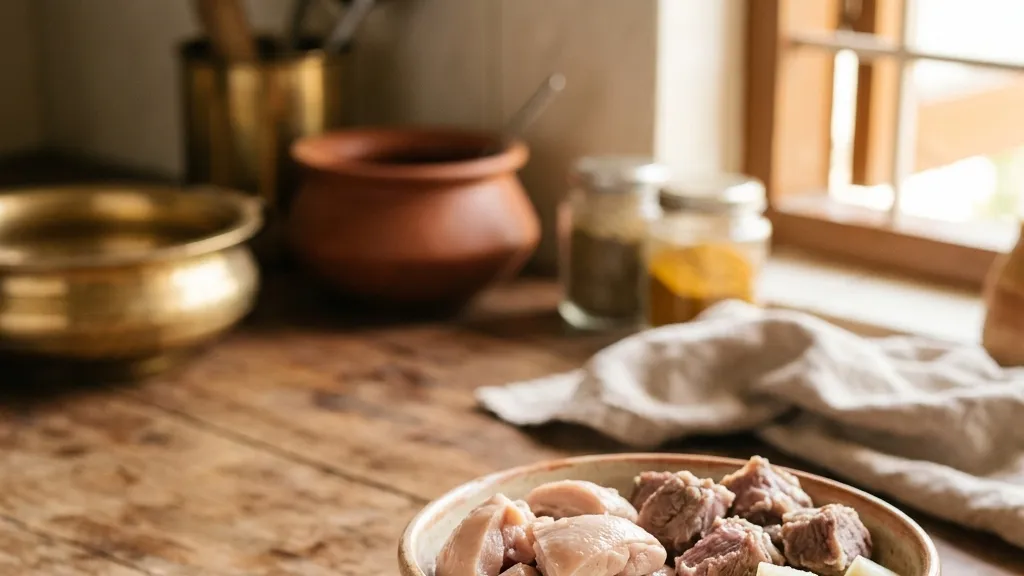
In India, mutton at the butcher generally means goat. Elsewhere it means adult sheep. This post is about goat, which is what you will actually be handed.
What our own table says
Wondering how this applies to your own pet? Build their bowl — two minutes, and it gives the exact grams for their weight.
These are the figures our engine reads, per 100 g cooked, edible portion — sourced from USDA FoodData Central and cross-checked against species-relevant requirements:
| Per 100 g cooked | Goat (mutton) | Chicken |
|---|---|---|
| Protein | 20.5 g | 17.0 g |
| Fat | 4.5 g | 6.0 g |
| Iron | 2.8 mg | 1.0 mg* |
| Zinc | 4.5 mg | 1.5 mg |
| Calcium | 11 mg | 12 mg |
| Phosphorus | 185 mg | 200 mg |
| Calcium : phosphorus | 1 : 17 | 1 : 17 |
*Chicken iron varies by cut; the table value is for the mixed cooked muscle our engine models.
What that tells you
Goat is leaner and denser than chicken. More protein, less fat, three times the zinc and nearly three times the iron. For a dog that needs to lose weight, or one whose coat and skin are poor, that combination is doing real work — zinc deficiency shows up in exactly those places.
It is also, for most Indian dogs, a protein they have not been eating for years. That matters if you are working through a suspected food reaction, because chicken is one of the more commonly implicated proteins and goat is not. It is a plausible novel protein in a country where rabbit is hard to find and venison is not legally available at all.
The catch, and it is the same catch as every fresh meat
Look at the last row. 1 part calcium to 17 parts phosphorus. An adult dog needs roughly the reverse — calcium ahead of phosphorus, not a seventeenth of it. Goat does not fix this. Neither does chicken, fish, egg or beef, because muscle is muscle: the calcium in an animal is in its skeleton, and we do not feed bone.
Goat also carries no long-chain omega-3 and no vitamin D worth counting, and its taurine, at 50 mg per 100 g, is half what farmed fish gives. It is an excellent protein and a poor multivitamin, which is true of every single meat on the counter.
Liver, kidney and the rest
Goat organ meat is cheap, widely sold and nutritionally dense — genuinely useful in small quantities. It is also easy to overdo: liver is extremely high in preformed vitamin A and copper, and both accumulate. Small and occasional, not a staple.
The residual gaps — calcium, iodine, zinc, vitamin E, thiamine and the omega-3s — are measured against NRC 2006 and closed by weight-dosed sachets, so the meat can just be meat.