
Is wet dog food a complete meal? Read the feeding table
Published
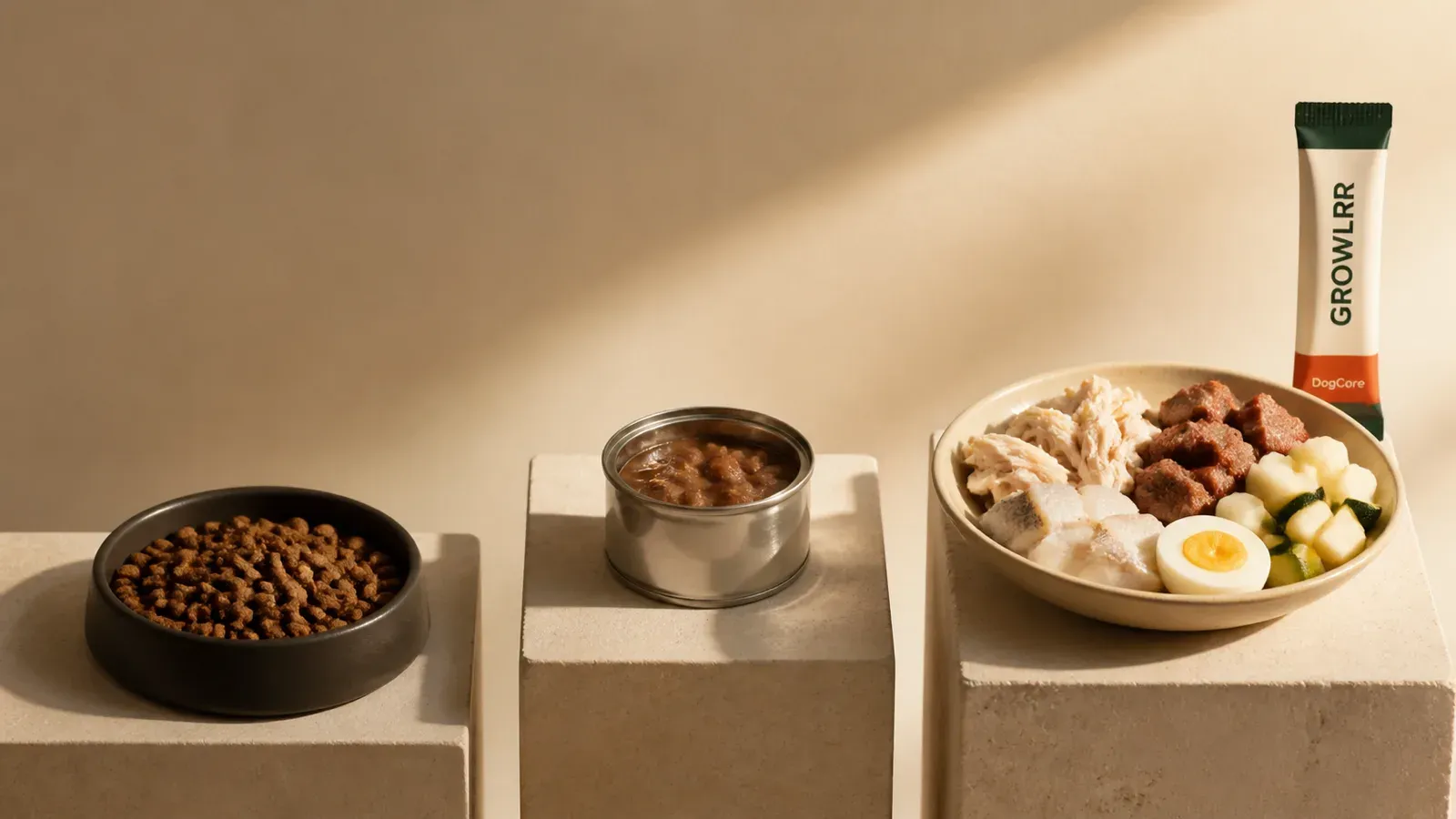
Wet food is genuinely better than kibble on several counts. It carries more moisture, which matters for cats especially; it is milder to process than extrusion; and dogs and cats generally find it far more appetising. None of that is in dispute here.
What is worth examining is a quieter question: is a wet pouch a meal, or a garnish? You do not need our opinion on that. The answer is printed on the pack.
What the feeding table actually asks for
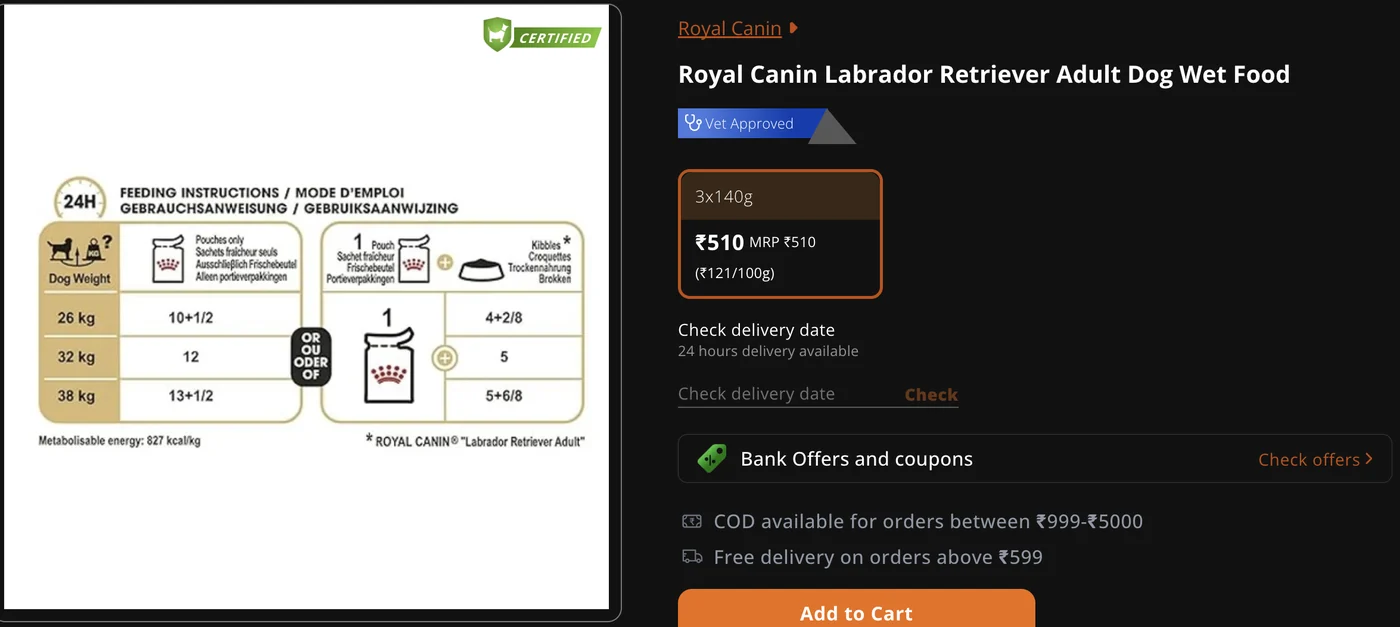
That is Royal Canin’s Labrador Retriever Adult wet food. The pouch is 140 g and the pack states a metabolisable energy of 827 kcal/kg — so one pouch delivers about 116 kcal. A 26 kg Labrador needs somewhere near 1,200 kcal a day. The arithmetic is not subtle: one pouch is under a tenth of the day.
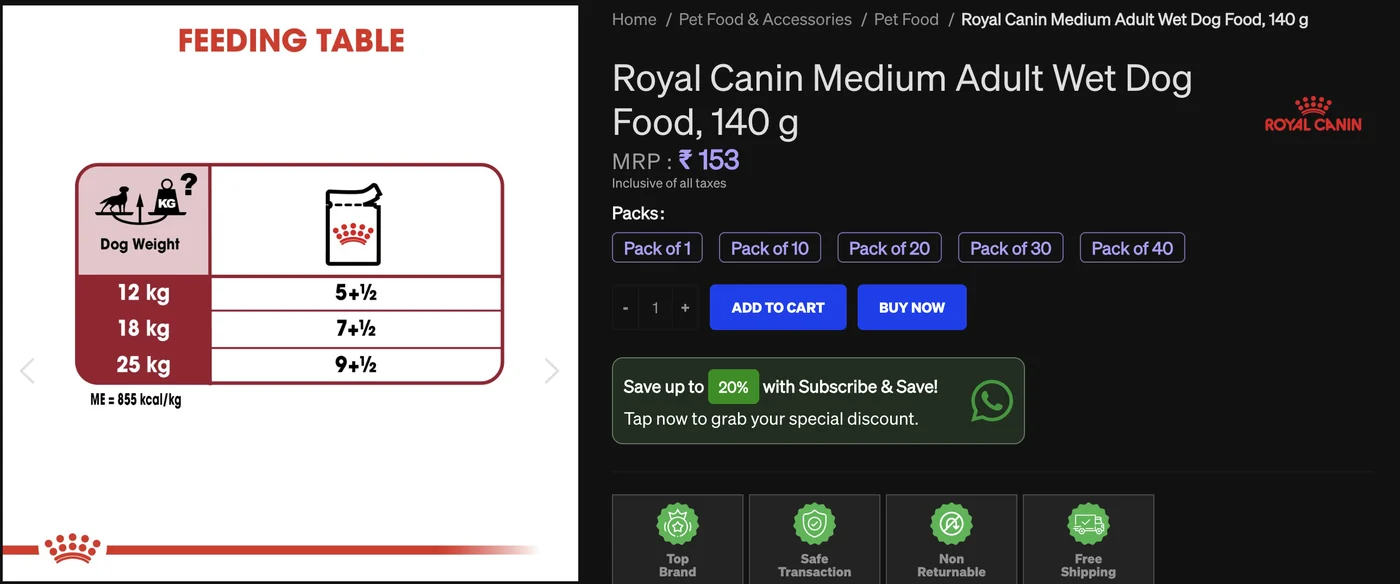
The same pattern appears on the Medium Adult version, at a slightly different energy density.
What that costs, at the price on the page
Wondering how this applies to your own pet? Build their bowl — two minutes, and it gives the exact grams for their weight.
At ₹153 a pouch — the MRP printed on the second listing — the feeding table prices out like this. These are the manufacturer’s own quantities, not ours.
| Dog | Pouches/day (their table) | Wet, per month | Fresh bowl + BowlBalancer™ |
|---|---|---|---|
| 12 kg | 5½ | ₹25,245 | ₹16,637 |
| 18 kg | 7½ | ₹34,425 | ₹22,969 |
| 26 kg | 10½ | ₹48,195 | ₹28,166 |
| 38 kg | 13½ | ₹61,965 | ₹35,996 |
Both columns as at 30 August 2026. Wet column: Royal Canin’s own feeding quantities × ₹153 MRP. Fresh column: groceries at Licious / FreshToHome Chennai app prices captured 30 Aug 2026 — premium delivery, among the priciest cuts in the country, so this is a ceiling. A local butcher costs materially less. Plus our sachets at their published per-gram price. Both are what it costs to feed that dog completely — neither is a topper.
So the comparison is not close, and it is not close in an interesting way. Feeding fresh with a corrective sachet runs a little over half the cost of feeding the same dog on wet food the way its own label instructs — and the gap widens as the dog gets bigger, from about 1.5× at 18 kg to 1.7× at 38 kg.
That widening is the same arithmetic as before, running in our favour instead. Wet food costs whatever the animal’s calories cost, so it scales straight up with size. A corrective sachet is dosed to bodyweight, and bodyweight grows more slowly than appetite. The bigger the dog, the more the pouch route punishes you — which is precisely why the pouch route quietly becomes a topper for big dogs and stays a diet for small ones.
Two things follow. The first is obvious: almost nobody spends ₹48,000 a month feeding a Labrador. The second is the one worth sitting with — that is not a caveat about the number, it is the finding. A format priced beyond what people will pay cannot function as a complete diet. It can only function as a topper.
Worth noticing what that receipt can do that a pouch cannot: it separates the two halves. ₹1,985 of it is groceries you buy at the market, at market prices, from whoever you already trust. ₹2,695 is what we charge. A wet-food pouch cannot show you that split, because there isn’t one — the margin is inside the food.
Why a Labrador gets a worse diet than a Shih Tzu
Here is the question that reframes all of it. Is there anything about a Retriever’s digestion that stops it living on wet food, when a Shih Tzu can?
No. Same species, same gut, same food, same digestibility. The only thing that changes across the range is a multiplier: a 38 kg dog eats roughly three and a half times what a 5 kg dog eats, so the identical pouch costs three and a half times as much to feed with.
That is a strange way for nutrition to work. Nothing in the biology says a big dog deserves a more compromised bowl. Only the arithmetic does.
The escape hatch Royal Canin prints on the pack
Look again at the first image. Beside the pouches-only column there is a divider marked “OR”, and a second column: one pouch, plus kibble.
That column is an admission, and a fair one. Royal Canin knows the pouches-only regime is not what anyone buys. So the pack offers the realistic version — and the realistic version is a bowl of kibble with wet food on top. Whatever you thought you were solving by switching to wet, the bowl underneath is still kibble, and it still carries kibble’s problems. You have simply added ₹153 a day to the top of it.
None of this makes wet food dishonest. The feeding table is right there; nobody hid it. But it does mean the label and the practice describe two different products, and only one of them is on the shelf.
What to do if you feed wet food
- If you feed wet as a topper, know that is what you are doing. The nutrition of the meal is being set by whatever is underneath it, not by the pouch.
- Check the ME on the pack and divide. Kcal per kilogram × pack weight tells you what one unit really delivers. It is usually a smaller share of the day than the packaging implies.
- Price the day, not the pouch. ₹153 sounds small. ₹1,606 a day is the same decision, seen honestly.
- If cost is what pushed you to a topper, fresh food is worth costing properly. A home-cooked bowl is bought at grocery prices rather than pet-aisle prices, which is a different arithmetic entirely — see what a balanced bowl costs.
The pouch is not the villain. It is just smaller than it looks, and priced as though nobody would ever multiply.