
Hepatic Buffering and Micronutrient Absorption, Storage and Clearance in Biologically Appropriate, Residually Corrected (BARC) Diets: A Toxicokinetic Model
Published
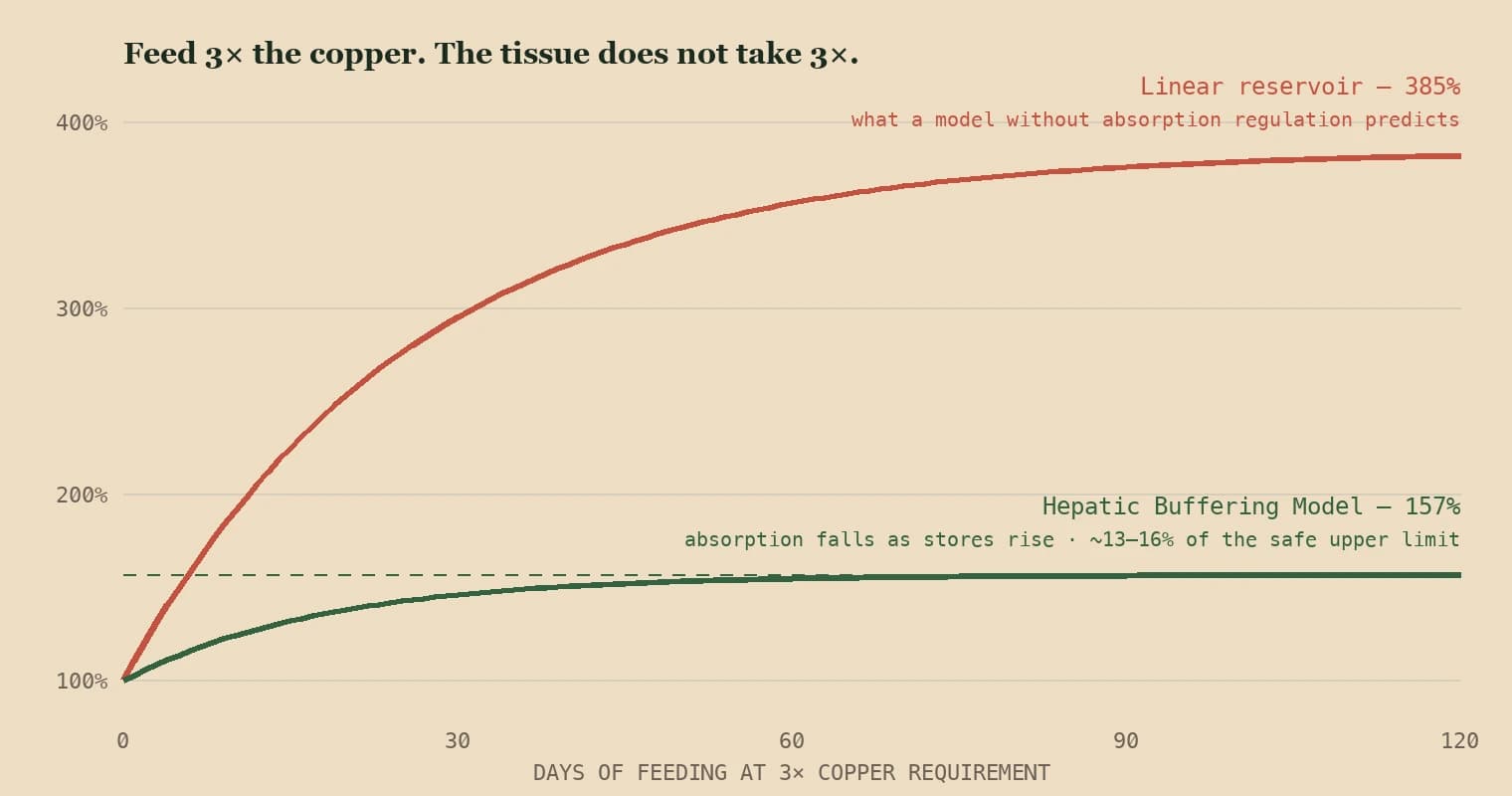
A single-day nutrient-adequacy check cannot describe how a companion animal fares over weeks of feeding, because tissue stores accumulate slowly-cleared micronutrients and buffer day-to-day variation. This paper specifies the Hepatic Buffering Model, the toxicokinetic layer of the Growlrr BowlBalancer™ validation stack. The Hepatic Buffering Model begins from an exponential-moving-average (EMA) reservoir keyed to each nutrient’s biological half-life, then replaces that linear filter with a one-compartment model carrying explicit homeostatic absorption regulation and first-order clearance, every parameter of which is drawn from peer-reviewed literature. The model is a strict generalisation of the EMA: with the absorption exponent set to unity it reduces exactly to the linear reservoir, so it can only add mechanistic detail, never contradict the adequacy floor. Applied to 10,000 simulated animals per species, the Hepatic Buffering Model confirms the adequacy floor identically to the linear model (Wilson lower bound at 99.99% confidence = 99.85%, zero animals below the 90% line) while the copper set-point, governed by a cited human absorption curve, compresses tissue copper toward 100%: even under 3× deliberate over-supply copper plateaus near 155–160% of requirement (~13–16% of the safe-upper-limit) rather than the 360–400% a linear model predicts. The chronic-safety ceiling thus becomes a derived mechanism rather than an assertion.
1. Introduction
Nutritional adequacy is conventionally verified against a reference standard — for companion animals, the Nutrient Requirements of Dogs and Cats (NRC 2006) — as a single-day snapshot: does the bowl, on the day it is served, meet every nutrient minimum? That test is necessary but not sufficient. Animals are not fed one idealised day; they are fed a sequence of real days whose composition drifts with grocery lots, assay error, cooking losses and owner behaviour. Two questions the snapshot cannot answer therefore remain open: (i) do slowly-turned-over nutrients accumulate to unsafe tissue levels over weeks of steady supply, and (ii) does normal day-to-day variance ever deplete a store below adequacy before it can refill?
The organ that answers both questions is the liver. It is the body’s principal reservoir for copper, retinol (vitamin A) and, in its 25-hydroxy form, vitamin D, and it is the site of the excretory machinery — ATP7B-mediated biliary copper efflux, CYP24A1 vitamin-D catabolism — that clears excess. A store that fills slowly and clears slowly is exactly a low-pass filter on intake: it smooths the peaks and troughs of a variable bowl, but it can also carry a chronic surplus. Modelling that reservoir is what turns a daily adequacy check into a chronic-adequacy-and-safety statement.
This paper develops that model in two steps. First (§2) the reservoir is represented as an exponential moving average parameterised by each nutrient’s biological half-life — the linear L-Octa layer, which is the correct tool for the adequacy floor because a reservoir can only raise the effective floor. Second (§3) the linear filter is generalised into a one-compartment kinetic model — the Hepatic Buffering Model — that adds homeostatic absorption regulation and an explicit clearance term, so that the ceiling — the chronic-safety side — becomes a mechanism derived from primary absorption data rather than an assumption.
2. The EMA reservoir model
Wondering how this applies to your own pet? Build their bowl — two minutes, and it gives the exact grams for their weight.
Let intaket be the nutrient delivered on day t, expressed as a percentage of the animal’s NRC requirement (the per-nutrient quantity the underlying snapshot engine produces for the locked BowlBalancer™ dose). The tissue reservoir for that nutrient is modelled as a first-order exponential moving average:
The smoothing constant α is fixed by the nutrient’s biological half-life through its time constant τ (in days):
where a large τ (long-stored nutrient) gives a small α and heavy smoothing, and a small τ (rapidly turned over) gives α near 1, so the reservoir tracks daily intake almost directly. The half-life horizons used are transcribed from the validation engine:
| Horizon | Nutrients | τ (days) | α |
|---|---|---|---|
| Long | B12 | 180 | 0.00554 |
| Long | Iron | 120 | 0.00831 |
| Long | Copper (binder) | 90 | 0.01105 |
| Medium | Vitamin A, Vitamin D, B9 | 45 | 0.02198 |
| Medium | Zinc, Selenium, Manganese | 30 | 0.03279 |
| Short | B2, B5, B6 | 10 | 0.09516 |
| Short | B1 | 7 | 0.13314 |
Because the EMA is an unbiased linear filter, its fixed point equals the expectation of daily delivered %NRC. That expectation is estimated by Monte-Carlo averaging J = 64 independent daily draws per animal — mathematically the EMA steady state for any τ — dropping only the day-to-day jitter around the mean, whose amplitude scales as σdaily / √(2τ) (a factor of ~13 for the copper reservoir, negligible). Against a literal 400-day recursive EMA over 2,000 animals the fast estimator matched to a mean absolute error of 0.47 percentage points (max 2.39 pp), so the reservoir endpoint is faithful.
3. The hepatic (one-compartment kinetic) model
The EMA of §2 is linear and symmetric: one time constant governs both fill and drain, intake is treated as fully absorbed regardless of how full the store is, and there is no explicit excretion pathway. Those simplifications are safe for the floor but silent on the ceiling. The Hepatic Buffering Model replaces the filter with a one-compartment kinetic model of the tissue store. Let St be the normalized tissue reserve, defined so that S = 100 when intake exactly meets the NRC requirement at reference absorption and clearance. The daily recurrence is:
with a homeostatic absorption term and a first-order clearance rate:
Here It is the delivered intake that day (%NRC); p is the homeostatic absorption exponent — with p < 1, fractional absorption falls as intake rises and rises as intake falls, the signature of a regulated store; and kout is the whole-body clearance rate derived from the cited biological half-life t½ (biliary for copper, renal for the water-soluble vitamins, near-zero for iron). The general homeostatic form underlying netAbs is a saturating Hill regulator on the store,
where a(C) ∈ (0, 1] is the fraction absorbed (falling as the store C fills toward the set-point Creg), h is the Hill coefficient, and B is baseline fractional absorption. This is the mechanism behind hepcidin (iron), metallothionein (zinc) and ATP7B (copper): up-regulated uptake in deficiency protects the floor; down-regulated uptake plus clearance in excess protects the ceiling.
3.1 Strict generalisation of the linear reservoir
Setting p = 1 gives netAbs(I) = I, and Eq. (3) collapses to
which is exactly the EMA of Eq. (1) with α = kout. The linear reservoir is therefore the p = 1 special case of the Hepatic Buffering Model. Any nutrient for which no absorption-vs-intake curve exists in the literature is run at p = 1 — no regulation credit — so the kinetic model degrades gracefully to the linear floor result and can never report a floor weaker than the EMA.
3.2 Steady state and the hepatic cap
The fixed point of Eq. (3) solves netAbs(Imean) = S*, giving a steady-state store that depends only on the mean intake and the exponent — not on the clearance rate:
This is the load-bearing property. For p = 1, S* equals mean intake (the linear reservoir value). For p < 1 — copper — deficient animals are lifted and over-supplied animals compressed toward the 100% set-point, with kout setting only the transient speed and the jitter amplitude (~σdaily √(kout/2)), never the set-point. The liver’s biliary copper cap is thus expressed as a curve, not an assertion: at 120% delivered copper the store settles near 106%; at 200% delivered, near 127%.
4. Methods
4.1 Cited parameters
Every rate constant is taken from peer-reviewed literature; where no citable absorption curve exists the exponent falls back to p = 1. The single load-bearing citation is copper’s absorption exponent — the only place the model departs from linear intake, and copper is the diet’s binding nutrient.
| Nutrient | t½ (whole-body) | kout /day | p | Basis |
|---|---|---|---|---|
| Copper (binder) | 23 d (13–33) | 0.030 | 0.34 | t½: Johnson, Milne & Lykken (AJCN 1992). p: Turnlund et al. (AJCN 1989) — absorption 55.6→36.3→12.4% over rising intake ⇒ abs ∝ I−0.66 ⇒ p = 0.34 |
| Iron | near-closed pool | ~0 (floor 0.01) | 1 | Obligatory-loss basis; hepcidin regulation real but no citable curve ⇒ conservative p = 1 |
| Zinc | slow pool | 0.01 | 1 | Metallothionein-gated (King et al. 2000); no citable curve ⇒ p = 1 |
| Manganese | ~12–22 d | 0.045 | 1 | Biliary-excretion-gated; no absorption curve ⇒ p = 1 |
| Selenium | 65–116 d | 0.008 | 1 | Excretory (selenosugar), not absorptive ⇒ p = 1 |
| Vitamin A | ~13 d | 0.053 | 1 | Absorption not feedback-regulated (Steinhoff 2022) ⇒ clearance-limited, p = 1 |
| Vitamin D | 15 d (25-OH-D) | 0.046 | 1 | Jones et al. (JCEM 2014); passive absorption, CYP24A1 clearance-gated ⇒ p = 1 |
| Iodine | 66 d | 0.011 | 1 | Kramer et al. 2002; GI absorption ~complete & unregulated ⇒ p = 1 |
| B1 / B6 / B9 / B12 | 7–400 d | 0.043–0.0017 | 1 | Renal / catabolic clearance; no absorptive feedback curve ⇒ p = 1 |
| B2 / B5 | no tissue store | 1.0 (unbuffered) | 1 | Renal, no reservoir ⇒ tissue ≈ daily intake (B5 dog-native, Taylor 1974) |
Copper kinetics are human-derived (Turnlund 1989; Johnson 1992) and transferred to dog and cat as a dimensionless homeostatic response shape, not as an organ-mass equivalence — stated openly as a limitation (§6) and tested by sensitivity sweep (§5.3).
4.2 Allometric scaling and coupling to the bowl
Nothing enters the Hepatic Buffering Model in milligrams. The snapshot engine expresses every intake as a percentage of the species’ NRC requirement, and the requirement is itself body-scaled before kinetics begin. Maintenance energy and the nutrient floor scale with body weight on measured sub-allometric exponents (the 0.64 dog exponent is Burger & Johnson’s 1991 directly measured value over 5.8–48.8 kg; 0.67 for cats):
where M is a metabolic multiplier (clamped to [1.2, 1.8] for dogs, [0.9, 1.3] for cats). Because a 4 kg cat and a 40 kg dog at “100% NRC” are already normalized, the kinetic state variable St carries no liver-mass term: it is a normalized reserve (%-of-adequate), not milligrams of copper. The model is therefore scale-invariant — doubling body size, liver mass and requirement together returns the identical answer — which is why absolute organ mass and body-surface-area correctly never appear. NRC has already done the body scaling; the model transfers only a dimensionless shape.
4.3 Simulation and gate
The kinetic model (cited p) and the linear reservoir (p = 1) were computed on the same 10,000 animals per species (×64 daily draws) on the locked dose rule, using the frozen validation engine (842353e5), seed 42, across 14 tracked nutrients. Each daily draw is a full snapshot evaluation in which the manufactured sachet contribution is constant (cv 0.02) while the owner’s fresh bowl, retention and assay variance are redrawn from lognormal noise (cv 0.10–0.20). The adequacy floor is the minimum tissue %NRC across all reservoir nutrients per animal; an animal passes at floor ≥ 90% NRC. The release statistic is the Wilson score lower bound at 95 / 99 / 99.99% confidence (z = 1.96 / 2.576 / 3.891); the gate requires the floor Wilson bound at 99.99% confidence to exceed 99%.
Two sensitivity sweeps were run: the clearance half-life t½ from 5 to 160 days (§5.4), and the absorption exponent p from 0.20 to 0.50 plus the linear 1.0 (§5.5).
5. Results
5.1 Adequacy floor — the Hepatic Buffering Model confirms the linear model exactly
| Species | Linear floor (Wilson 99.99%) | Kinetic-model floor (Wilson 99.99%) | Pass | Below 90% |
|---|---|---|---|---|
| Dog (3–110 kg) | 99.8489% | 99.8489% | 10,000 / 10,000 | 0 |
| Cat (2.5–10 kg) | 99.8489% | 99.8489% | 10,000 / 10,000 | 0 |
The kinetic model passes the floor identically to the linear reservoir — as it must, since it reduces to the EMA for the 13 p = 1 nutrients and the one regulated nutrient (copper) is buffered toward 100%, never below 90%.
5.2 Copper — the mechanistic ceiling cap
Homeostatic absorption (p = 0.34) compresses copper tissue toward the set-point. Tissue copper (percentile 5 / 50 / max, %NRC):
| Linear reservoir | Kinetic model | |
|---|---|---|
| Dog copper | 106.1 / 120.1 / 145.0 | 102.0 / 106.4 / 113.5 |
| Cat copper | 117.8 / 131.7 / 165.1 | 105.7 / 109.8 / 118.6 |
Under deliberate over-supply the divergence is stark. Copper tissue store (%NRC) at 1×–3× the delivered dose:
| Over-supply | Dog linear | Dog kinetic | Cat linear | Cat kinetic |
|---|---|---|---|---|
| 1× | 120% | 106% | 133% | 110% |
| 1.5× | 180% | 122% | 199% | 126% |
| 2× | 241% | 135% | 265% | 139% |
| 3× | 361% | 155% | 398% | 160% |
Even at 3× deliberate over-supply, copper tissue caps near 155–160% of requirement — against 360–400% for the linear model, and well inside the copper safe-upper-limit (SUL: 1000% NRC dog, 1250% NRC cat; the 3× store is ~15.5% and ~12.8% of SUL respectively). The “copper binds by design” hepatic cap is now a mechanism derived from primary human absorption data, not an engineering assertion.
The same mechanism resolves a prior watch item: the linear model read cat copper at percentile-50 ≈ 132%, marginally over the 130% house line. Under the kinetic model that identical cohort sits at percentile-50 ≈ 110% (max 119%) — the 132% was the linear filter over-reading an intake that homeostatic absorption down-regulates.
5.3 Iodine
Iodine runs unregulated (p = 1) but is buffered by its ~66-day reservoir: tissue percentile-50 of 170% (dog) and 163% (cat), maxima 207% / 200% — comfortably above the 90% floor and under the SUL (400% dog, 500% cat). Steady block-borne delivery avoids the low/fluctuating-iodine pattern implicated in feline thyroid disease; Wolff-Chaikoff thyroid autoregulation is additional, uncredited headroom.
5.4 Half-life sensitivity — the steady state is clearance-invariant
Copper recursion, cats, N = 3,000 × 250 days, half-life swept 5→160 days:
| t½ (d) | kout /d | Cu tissue mean | Within-animal jitter | Below 90% |
|---|---|---|---|---|
| 5 | 0.139 | 109.8% | 0.70 pp | 0.00% |
| 11 (allometric cat) | 0.062 | 109.8% | 0.42 pp | 0.00% |
| 23 (human, as used) | 0.030 | 109.8% | 0.25 pp | 0.00% |
| 80 | 0.009 | 109.8% | 0.17 pp | 0.00% |
| 160 | 0.004 | 109.8% | 0.16 pp | 0.00% |
The tissue mean is identical (109.8%) at every half-life; only the jitter and time-to-equilibrium change (consistent with Eq. 9). The uncorrected human copper half-life therefore cannot move the model’s floor or ceiling — it sets response speed, not steady-state adequacy — and an allometric correction to ~11 days changes nothing material.
5.5 Absorption-exponent sensitivity — the only load-bearing parameter
Copper, N = 10,000 × 48 draws, p swept 0.20→0.50 plus 1.0. Two findings hold for both species:
| p (dog) | Floor p5 / min | Below 90% | Ceiling 1× / 2× / 3× | 3× as %SUL |
|---|---|---|---|---|
| 0.20 | 101 / 99 | 0.00% | 104 / 119 / 129 | 12.9% |
| 0.34 (Turnlund) | 102 / 99 | 0.00% | 106 / 135 / 155 | 15.5% |
| 0.50 | 103 / 98 | 0.00% | 110 / 155 / 190 | 19.0% |
| 1.00 (no regulation) | 106 / 97 | 0.00% | 120 / 241 / 361 | 36.1% |
(i) Adequacy is completely insensitive to p: zero animals fall below 90% for every exponent from 0.20 to 1.0, in both species, because the locked dose delivers copper above 100% so netAbs > 100 for any p > 0. (ii) Safety stays inside the SUL across the whole range — including the p = 1 no-regulation worst case, where 3× over-supply still reaches only ~36% of the copper SUL. The one parameter borrowed from human data is therefore load-bearing for neither the adequacy nor the safety conclusion; it only sharpens the precise ceiling number within an already-safe zone — exactly where feline-specific data would refine, not overturn, the model.
6. Discussion and limitations
The Hepatic Buffering Model converts a single-day adequacy check into a chronic-adequacy-and-safety statement while remaining, by construction, unable to weaken the floor: it is a strict generalisation of the linear reservoir, reducing to it exactly at p = 1. Its contribution is on the ceiling — turning the copper safety cap from an assertion into a curve derived from primary absorption data — and the sensitivity analyses show that neither conclusion depends on the borrowed parameters. The following boundaries are stated rather than hidden:
- Copper kinetics are human-derived. No dog or cat copper absorption-vs-intake curve exists in the literature searched; the transfer assumes the dimensionless homeostatic response is conserved enough across mammals for a first-order transfer, pending species-specific validation. The
p-sweep shows the verdict is insensitive to the exact exponent, so feline data would refine, not overturn, the model — but veterinary confirmation remains the sensible next step. - One compartment. Real tissue distribution (plasma / liver / peripheral) is multi-compartment; the whole-body pool is used as the adequacy-relevant reservoir. Defensible for a floor/ceiling gate, not for acute plasma dynamics.
- Regulation applied to copper only. Iron and zinc, which have stronger real regulation, are held at
p = 1for lack of a citable curve — a conservative choice, so the true floor is at least what the model reports. - Unbuffered vitamins. B2 and B5 collapse to “tissue ≈ daily intake” (no reservoir credit) — the conservative daily-snapshot treatment.
- Scope. The Hepatic Buffering Model is a decision-support adequacy and safety gate, not a clinical pharmacokinetic claim for any individual animal, and not a physiologically-based PBPK model — it answers “will this feeding strategy maintain tissue adequacy and avoid chronic accumulation?”, not “where does every microgram reside?”
The Hepatic Buffering Model is the chronic-accumulation layer that sits atop Growlrr’s single-day Monte-Carlo adequacy validation (1 Million+ vectors · Wilson C/R 95/99), which is a separate result; the two together describe both a single served day and the weeks that follow it. It is this kinetic layer that underpins the chronic-safety case for the BowlBalancer™ copper-bound correction. See how the correction is dosed for your animal → or read the companion study on what a home-cooked bowl actually misses.
References
- National Research Council. Nutrient Requirements of Dogs and Cats. Washington, DC: National Academies Press; 2006.
- Turnlund JR, Keyes WR, Anderson HL, Acord LL. Copper absorption and retention in young men at three levels of dietary copper by use of the stable isotope 65Cu. Am J Clin Nutr. 1989;49(5):870–878. [PMID 2718922]
- Johnson PE, Milne DB, Lykken GI. Effects of age and sex on copper absorption, biological half-life, and status in humans. Am J Clin Nutr. 1992;56(5):917–925. [PMID 1329483]
- Burger IH, Johnson JV. Dogs large and small: the allometry of energy requirements within a single species. J Nutr. 1991;121(11 Suppl):S18–S21.
- Jones KS, Assar S, Harnpanich D, et al. 25(OH)D3 half-life is determined by DBP concentration and genotype. J Clin Endocrinol Metab. 2014;99(9):3373–3381. [DOI 10.1210/jc.2014-1714]
- Ganz T, Nemeth E. Hepcidin and disorders of iron metabolism. Blood. 2011;117(17):4425–4433.
- King JC, Shames DM, Woodhouse LR. Zinc homeostasis in humans. J Nutr. 2000;130(5S Suppl):1360S–1366S.
- Steinhoff JS, Lass A, Schupp M. Retinoid homeostasis and beyond: how retinol binding protein 4 contributes to health. Nutrients. 2022;14(6):1236.
- Kramer GH, Hauck BM, Chamberlain MJ. Biological half-life of iodine in adults. Radiat Prot Dosimetry. 2002. [PMID 12408489]
- Taylor T, Cameron E, et al. Pantothenic acid turnover in the dog. Res Vet Sci. 1974. [PMID 4854724]
- Wedekind KJ, et al. Feline iodine requirement. 2010.
- Wolff J, Chaikoff IL. Plasma inorganic iodide as a homeostatic regulator of thyroid function. J Biol Chem. 1948;174(2):555–564.
The Hepatic Buffering Model is a mammalian homeostatic adequacy model; where the literature does not support a species-native value, parameters are transferred across mammals and flagged as such. Species-extrapolated copper kinetics await veterinary confirmation. This is a methods paper, not a clinical claim for any individual animal.
© Growlrr Foods Pvt Ltd. Published under CC BY-NC-ND 4.0 — cite with attribution; no commercial use or derivatives. The sachet formulation (BOM) is proprietary and not licensed. Author: Prasanna M.