
Homemade cat food & taurine deficiency: what every cat owner must know
Published
Why cats are different
Cats are obligate carnivores. Unlike dogs, they cannot synthesise enough taurine from other amino acids, so it must come pre-formed from the diet. The same is true of a short list of other nutrients: arachidonic acid and pre-formed vitamin A (cats cannot efficiently convert plant beta-carotene). These are animal-tissue nutrients — NRC 2006 sets explicit feline requirements for them.
What a shortfall does
Wondering how this applies to your own pet? Build their bowl — two minutes, and it gives the exact grams for their weight.
Sustained taurine deficiency has two well-documented consequences: dilated cardiomyopathy (DCM), a weakening of the heart muscle, and retinal degeneration that can progress to blindness. These are not scare stories — they are the reason commercial cat foods are required to guarantee a taurine level, and the reason a home cook cannot leave it to chance.
Cooking lowers taurine — so “just chicken” isn’t enough
Taurine is water-soluble and heat-sensitive. Cooking, and the moisture lost with it, reduce the taurine actually delivered to the bowl. So even a meat-forward home diet can drift below the feline requirement — which is why a cat bowl needs a guaranteed taurine floor rather than an assumption that “meat has taurine.”
Our bowl-checker shows how tightly this tracks the meat. Across the test diets, taurine and EPA/DHA rose and fell with the animal fraction of the bowl — plant and mixed bowls landed at just 0–52% of the taurine target, and only the all-meat bowl cleared it unaided (checked against NRC 2006 as a point-estimate — a single day’s calculation). More meat helps taurine; it does not fix the calcium and micronutrient gaps, which is why the correction still matters.
How Growlrr’s cat bowl handles it
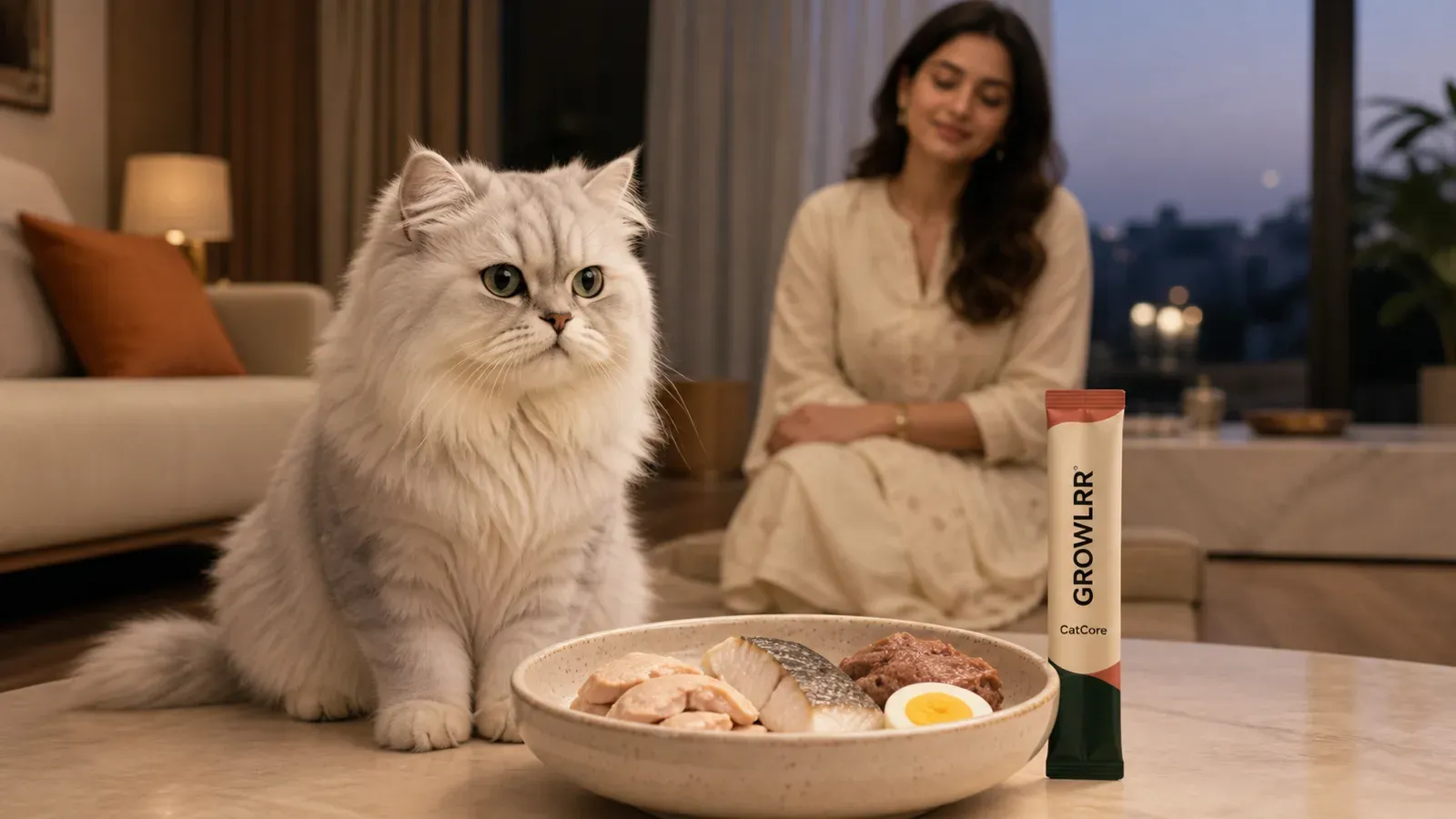
Growlrr’s cat diet is animal-first — mutton, chicken and lean fish fillets like farmed tilapia — an easily-available lean protein that helps keep the bowl’s protein-to-fat ratio in balance (~0.8–1.2:1 by energy) — plus egg — paired with a CatCore™ sachet that delivers the taurine floor along with EPA/DHA and the other feline-specific micronutrients. Dosing is whole-sachet and simple: 5 g, three meals a day. Adequacy is validated across 1 Million+ vectors · Wilson C/R 95/99, so the taurine floor is guaranteed, not hoped for.
References
- National Research Council (NRC). Nutrient Requirements of Dogs and Cats. Washington, DC: National Academies Press; 2006.
- Association of American Feed Control Officials (AAFCO). Dog and Cat Food Nutrient Profiles (current edition).
Related reading
- Can cats drink milk? The most persistent Indian pet myth
- Which fish is safe for dogs and cats in India?
- Is Licious raw chicken safe for cats?
- “Complete and balanced” is a floor, not a target
- Why a cat cannot skip meals the way a dog can
- “Just chicken and pumpkin. Nothing else.” — what that bowl is missing
- Four deficiency patterns that get mistaken for something else