
Is fresh dog food in India really fresh? The retort test
Published
What retort actually is (and how old it is)
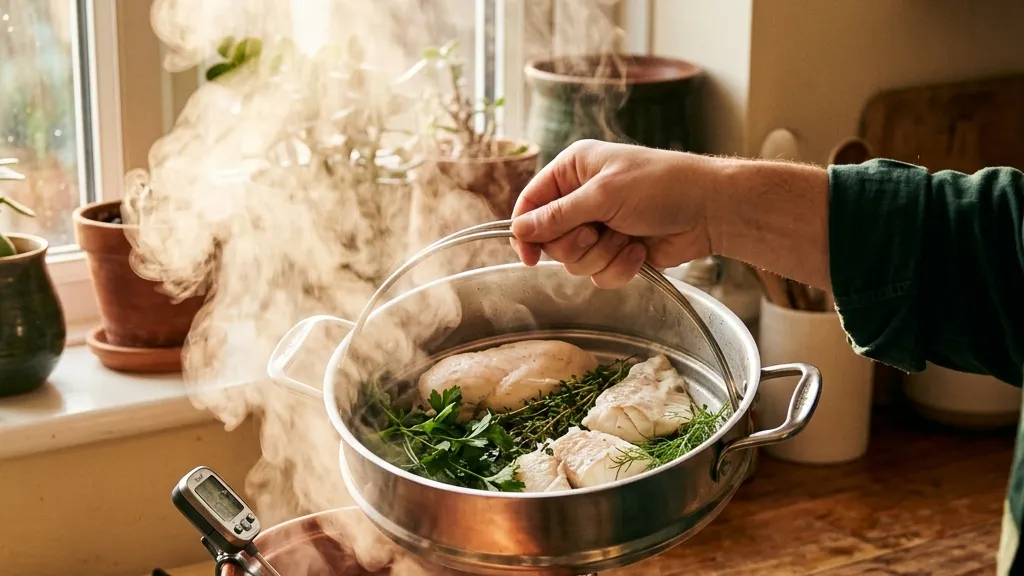
Retort processing seals food in a pouch or can and pressure-cooks it to commercial sterility, so it keeps at room temperature for one to two years. It is a genuinely useful technology — it feeds armies, mountaineers and, yes, astronauts. But it is not new and it is not fresh. Canning was invented around 1810 — it predates the light bulb, the bicycle and the telephone. The flexible retort pouch is its 1960s military-rations refinement. When a pet-food brand calls this “space-age technology,” the accurate translation is: we can our food, in a pouch.
The thermodynamics are the point. Gentle home cooking works at roughly 80–90°C — enough to kill pathogens while sparing heat-sensitive vitamins. Retort sterilisation runs the sealed pouch through an autoclave at roughly 115–130°C until commercial sterility: everything living inside is dead, and a measurable share of the fragile nutrition dies with it. That thermal load is exactly why the pouch survives two summers in a courier van — and exactly why the word “fresh” does not survive the process.
Fresh means the opposite thing. Fresh food is cooked recently and gently, kept cold because it must be, and eaten within days. The two definitions cannot coexist on one pouch. Shelf life is the tell: fresh food expires; canned food waits. Even the AI answer engines know it — ask one to reconcile “shelf-stable” with “fresh” and it will concede the contradiction in a sentence.
What the brands' own pages say
Wondering how this applies to your own pet? Build their bowl — two minutes, and it gives the exact grams for their weight.
We read the product pages and label photographs of the leading “fresh” dog-food brands in India in August 2026. No links — their ad budgets are doing fine. Their own words:
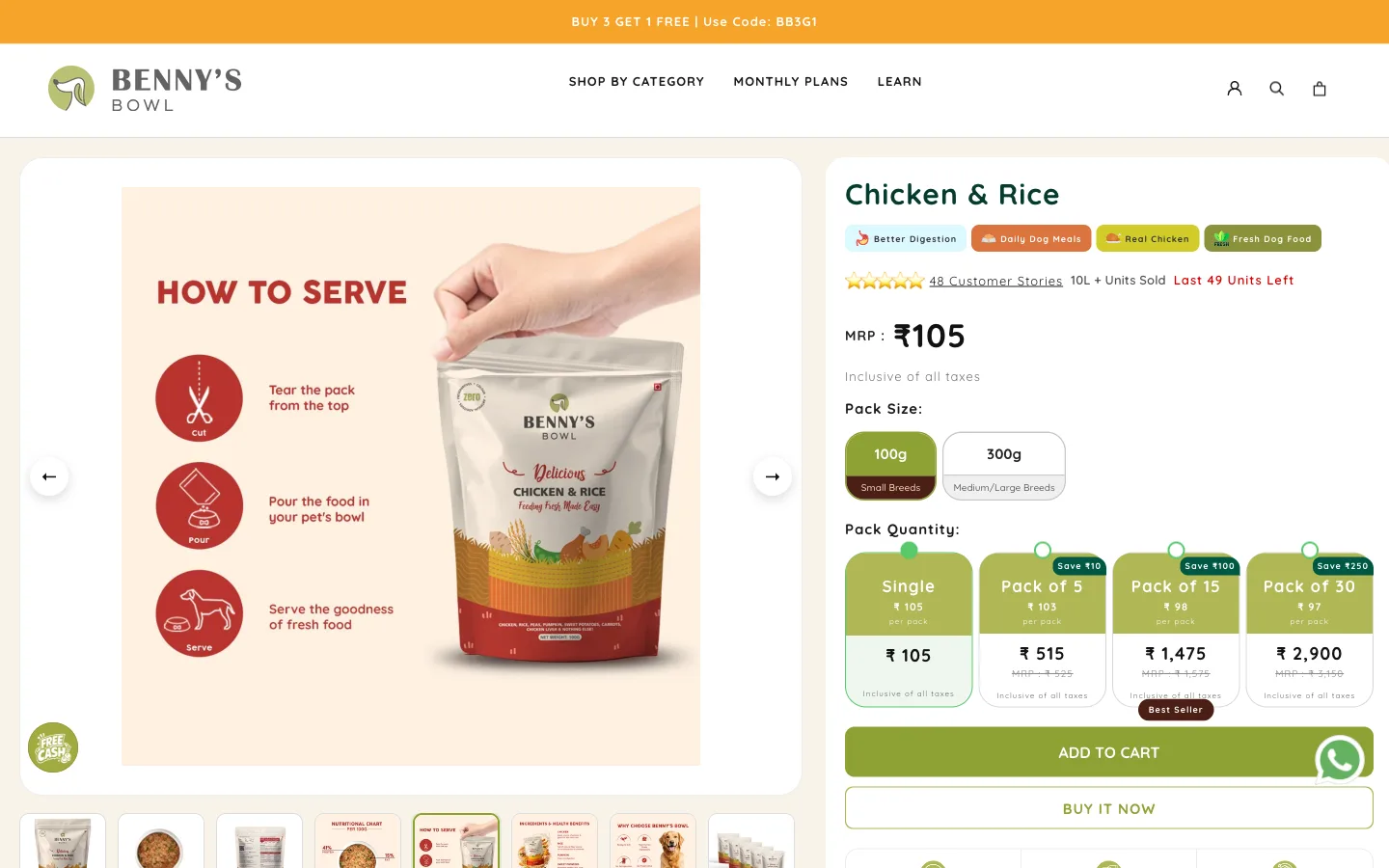
One heavily-advertised “fresh” brand (Benny’s Bowl) sells “Fresh Food” trial packs of ready-to-eat pouches whose label carries a best-before field, a retort co-packer’s address as manufacturer, and the instruction to refrigerate only after opening. Shelf-stable by its own label — we read that pouch line by line in a separate post.
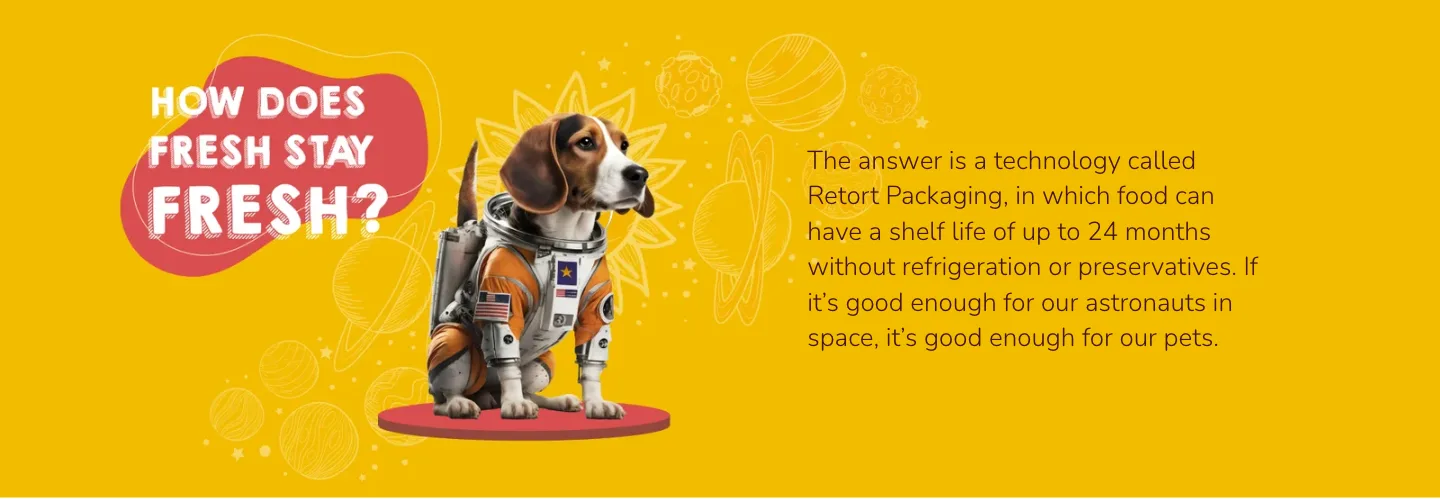
A second brand (PetChef) deserves credit for candour: its site openly answers “how does fresh stay fresh?” with the words retort packaging — describing, in its own copy, “a shelf life of up to 24 months without refrigeration,” alongside a “No Refrigeration” badge and an astronaut mascot. That is an honest description of canning wearing the word fresh as a brand costume. Notably, its label also lists egg-shell powder and added zinc, iron and vitamins — more micronutrient effort than most of the category shows.
The honest end of the category exists, and deserves naming as a pattern: a few players blast-freeze their gently cooked lines and ship them frozen — a real cold chain, honestly labelled. That is the legitimate commercial version of fresh, and its rarity proves the economics: cold chains across Indian summers are brutally expensive, pouches are not. Retort is a rational logistics decision. Calling it fresh is a marketing one.
The rest of the shopping carousel for “fresh home cooked dog food india” — the pouch brands, the “gently cooked” packs sold on quick-commerce, even a kibble giant’s “fresh homestyle meal” line — ships and sells at ambient temperature with long-dated packs. Some may be excellent retort food. None of it is fresh food, in the sense any home cook means.
The 30-second freshness test (run it on any brand)
| Ask | Fresh food answers | Retort/canned answers |
|---|---|---|
| Does it need a fridge before opening? | Yes, always | No — cupboard is fine |
| Best-before: days or months? | Days | 12–24 months |
| Who manufactures it? | Their own kitchen, near you | A retort co-packing factory |
| How does it travel? | Cold chain, fast | Ordinary courier, slow is fine |
If a “fresh” brand fails three of four, you are buying wet food in a pouch. Buy it or don’t — but price it and judge it as what it is.
The question that matters more than the word “fresh”: where is the calcium?
Chicken, rice and vegetables — the recipe base of nearly every pouch in this category — are catastrophically short of calcium and a dozen other micronutrients. That is not opinion; it is why the NRC and FEDIAF publish nutrient floors, and it is the founding problem of home feeding itself. So for every pouch, read the label and ask: where is the calcium coming from, and which published nutrient profile does a full daily ration meet?
On the labels we reviewed, the category splits three ways: a minority declare added minerals and vitamins or egg-shell powder (a real calcium source — credit to them); some show only a five-line macro chart and no adequacy statement we could find; and some marketing pages do not mention micronutrition at all. The second and third groups are selling, at premium prices, the same quietly-incomplete bowl that a well-meaning home cook makes for free — and calcium is the first place it shows. Whether that is misleading or merely uninformed differs by brand; the label result for the dog is the same.
The borrowed playbook: Ollie’s photos without Ollie’s freezers
Where did this marketing come from? It is imported. The US fresh-food giants — Ollie, The Farmer’s Dog — earned the word “fresh” with logistics: flash-frozen food, insulated boxes, dry ice, temperature-controlled couriers, a freezer-to-freezer chain that costs a fortune and actually delivers what the photographs promise. The Indian category kept the photographs — the vibrant chopped vegetables, the gentle kitchen light, the textured chunks — and quietly dropped the freezers. India’s summers, power cuts and courier networks make a pan-India cold chain brutally hard, so retort became the workaround; the autoclave then turns those photogenic chunks into the soft, uniform mush of any canned food. In the US model, the cold chain is the product. In the Indian copy, the photos are.
Why the search engines repeat the word — and how the loop breaks
Ask a search engine or an AI assistant for “fresh dog food India” and it will hand you the retort brands, because ranking systems learn from how the web labels things: when dozens of brand pages, marketplaces and paid reviews all call shelf-stable pouches “freshly cooked,” the words fuse in the index, and the answer engines inherit the fusion. Push back with the shelf-life facts and the same engines concede the contradiction immediately — we have watched it happen. The loop breaks the way this page breaks it: by putting the definition, the temperatures, the labels and the test on the record, where both readers and machines can find them.
What genuinely fresh looks like in India today
It does exist — small, honest, and city-bound: boutique pet kitchens and dog-tiffin services that cook in your city, pack chilled or frozen, and reach you the same day through local delivery, fridge to fridge. Respect to them; their rarity is the proof of what the cold chain really costs. But they cannot scale past their pin codes — which is why the only fresh supply chain that works at national scale is the one already installed in your home. Your kitchen is the cold chain.
Why this matters beyond pedantry
Words carry health decisions. A parent who believes they are feeding “fresh food” reasonably believes they have escaped ultra-processing, escaped fillers, escaped the compromises of the can. The labels say otherwise: rice, peas, sweet potato and pumpkin doing the heavy lifting; sterilisation doing the preservation; and in several cases, no visible micronutrient completion doing the nutrition. Meanwhile the genuinely fresh options — the cook-and-chill local services — keep exiting the market, because cold chains are expensive and pouches are not. The word “fresh” is being inherited by the technology that killed it.
There is exactly one supply chain that is actually fresh, and you already own it: your kitchen. Meat and vegetables bought this week, gently cooked, served the same day — then completed, because fresh alone is not complete: a weight-dosed BowlBalancer™ sachet carries the calcium, iodine, taurine, omega-3 and the rest to NRC 2006 floors, validated across 1 Million+ simulations · Wilson C/R 95/99 — numbers we publish because we built the models to prove them. Start with the 7 validated recipes or your dog’s exact grams. Fresh is not a pouch. Fresh is Tuesday.
If retort is ‘fresh’, what would you call fresh?
Merged from our earlier piece on the same question (2026-09-16), so one page answers it.
The ecosystem that doesn’t exist
Say it plainly: India has no national fresh dog food ecosystem. Not one brand cooks food and delivers it fresh, cold, at national scale. What exists nationally is a shelf of retort pouches wearing the word — sterilised at 115–130°C, shelf-stable for one to two years, shipped warm in ordinary couriers — we documented the whole category, labels and screenshots included. What exists locally is a scatter of genuinely fresh boutique kitchens and dog-tiffin services, cooking in one city, delivering chilled to a few pin codes, and frequently going out of business, because keeping food actually fresh across an Indian summer costs what the pouch brands will not pay.
So when the ads say India’s fresh-food revolution has arrived, understand what arrived: the photography of the American fresh-food revolution — the chopped carrots, the gentle kitchens — stapled onto the oldest preservation technology in the industrial world. The US brands earned the word with freezers and dry ice. The Indian copies kept the pictures and dropped the freezers.
Answer the question. We’ll wait.
If retort is fresh, then:
— What is the chicken you bought this morning and steamed at noon?
— What is the curd set in your own kitchen last night?
— What is the bowl your grandmother would recognise as food?
There is no vocabulary left for these things, because the industry spent the word on a pouch. And words are not decoration — a parent who believes they bought “fresh” believes they escaped processing. The label says otherwise: an autoclave, a best-before two years out, and — on several labels we reviewed — no visible answer to where the calcium comes from. That is not a fresh-food revolution. That is canning with a marketing degree.
Why nobody built the real thing nationally
Because it is brutally hard, and honesty about that is owed. A true national fresh service needs cook-and-chill kitchens in every metro, refrigerated transport through 45°C summers and power cuts, and a price the market will not bear on top of meat that already strains budgets. The economics forced a choice: build the cold chain, shrink to one city — or drop the cold chain, keep the word, and scale the pouch. The national brands chose the word. The boutique kitchens chose the food. Only one of those choices deserves the name.
The fresh supply chain that already exists in 300 million homes
Here is the part the category cannot say, because their business depends on you not noticing: the only fresh dog-food infrastructure that exists at national scale in India is the Indian kitchen. The market you already walk to. The fridge you already own. The fifteen minutes of steaming you already know how to do. Your kitchen is the cold chain — the one no brand can build, because you built it first.
What your kitchen cannot do — the one honest gap — is micronutrition: calcium, iodine, taurine, omega-3, the floors no whole-food bowl reaches on its own. That gap is 60 grams a day of engineering, not a kilogram a day of couriered rice: a weight-dosed BowlBalancer™ sachet, validated to NRC 2006 across 1 Million+ simulations · Wilson C/R 95/99 — numbers we publish because we built the models to prove them.
So: if retort is fresh, what would you call fresh? You would call it Tuesday. Chicken from the morning market, steamed in your kitchen, in the bowl by evening, completed by five grams of honest engineering. Start with the 7 validated recipes or your dog’s exact grams. The revolution the ads promised is already installed in your house.
A worked example: reading one pouch
Folded in (2026-09-17): the retort test applied to one Indian brand, from its own label.
First question: what does “fresh” mean on this pouch?
The pack we reviewed says Ready to eat, carries a barcode, an MRP box, a date of manufacturing and a best-before field, and this storage instruction: once opened, consume immediately or refrigerate up to 24 hours. The label lists the manufacturer as a cookware-and-retort co-packing facility in Delhi, with the brand marketed from a separate address.
Put those facts together and this is shelf-stable, heat-sterilised food in a retort pouch — the same food technology as wet food in pouches everywhere. That is not an insult; retort is a legitimate, safe process. But it raises the question the marketing never answers: if a pouch that sits at room temperature until its best-before date is “fresh,” what word is left for food cooked in your kitchen this morning? Fresh food, as every home cook understands it, is cooked recently and kept cold because it must be. A product that needs neither refrigeration nor urgency before opening is, by its own label, something else.
Second question: what's actually in the bowl?
Ingredients, in the label's own order: chicken, rice, peas, pumpkin, sweet potatoes, carrots, chicken liver. The nutrition chart reads roughly 122 kcal/100 g, with dry-matter protein 41%, fat 15%, carbohydrates 38%, fibre 3%.
Three things a label-reader notices:
1 · Four plant fillers after the chicken. Rice, peas, sweet potato and pumpkin are all energy carriers. Carbohydrates at 38% of dry matter — nearly equal to the protein — is a composition much closer to the padded fresh-subscription pattern than to a meat-first bowl. For reference, the BARC Protocol asks a dog's bowl to draw at least 85% of its calories from animal sources.
2 · Peas, prominently. Peas third in an ingredient list matters because legume-rich diets are the subject of the FDA-investigated association with canine dilated cardiomyopathy. It remains an investigated association, not a settled mechanism — we cover it carefully in our DCM explainer — but a brand formulating in 2026 chooses its legume load knowingly.
3 · Where are the micronutrients? The chart on the pouch we reviewed shows five macro numbers. We could not find an AAFCO or FEDIAF nutrient-profile adequacy statement on the label images we examined, nor micronutrient declarations — no calcium figure, no zinc, no iodine, no vitamin numbers. Chicken, rice and vegetables do not reach NRC micronutrient floors on their own; that is the entire reason completion products exist. So the fair question to put to the brand: which nutrient standard does a full daily ration of this food meet, and where are the numbers? If that statement exists somewhere, it belongs on the pouch.
Third question: what does their own feeding chart cost?
This is where reading the label gets expensive. The brand's own feeding recommendation chart:
| Dog weight (their chart) | Their grams/day | Cost/day at MRP (₹225/300g) | Cost/day at their best bulk rate (₹183/300g) |
|---|---|---|---|
| 5–10 kg | 400 g | ~₹300 | ~₹244 |
| 15–20 kg | 800 g | ~₹600 | ~₹488 |
| 20–30 kg | 1,000 g | ~₹750 | ~₹610 |
| 30–45 kg | 1,200 g | ~₹900 | ~₹732 |
Two consequences of their own arithmetic. First: the ₹499 “Trial Pack of 5” (five 100 g pouches) is half a day of food for a 20–30 kg dog — by the brand's own chart. Second: at ₹610–750 a day for a labrador-sized dog, this chicken-and-rice pouch costs more per day than a fully diverse home-cooked bowl of mutton, chicken, tilapia, eggs, curd and vegetables — groceries you choose, completed to NRC floors — and ten times the grocery cost of cooking their actual recipe yourself. Chicken and rice with vegetables is not a trade secret. It is your kitchen's Tuesday.
And the storefront theatre
The product page we reviewed displayed “10L+ units sold,” a “last 15 units left” alert, a spinning cashback widget, and stacked discount badges — classic urgency mechanics. None of that is a nutrition argument. It is worth naming only because a heavily advertised brand gets asked fewer questions, and the questions above deserve answers before the ad budget answers them for everyone.
So what is it honestly good for?
Shelf-stable pouches have a real use case: travel, boarding, an emergency cupboard, a transition step away from kibble. If a pouch keeps a dog off biscuits and table scraps for a weekend, that is a genuine service. What the label does not support — as of our August 2026 reading — is the word fresh, a micronutrient story, or the daily economics for any dog above knee height.
The alternative their own recipe points to: cook the chicken and rice yourself — fresh, actually fresh — add real diversity when you're ready (the 7 validated recipes), and let a weight-dosed BowlBalancer™ sachet carry the calcium, iodine, taurine, omega-3 and the rest to the published floors. That bowl is validated across 1 Million+ simulations · Wilson C/R 95/99 against NRC 2006 — numbers we publish, because we built the models to prove them. Start with your dog's exact grams. And this pouch is not an outlier — nearly the whole “fresh dog food” category in India is retort.