
Is fresh/homemade food really complete, balanced & safe?
Published
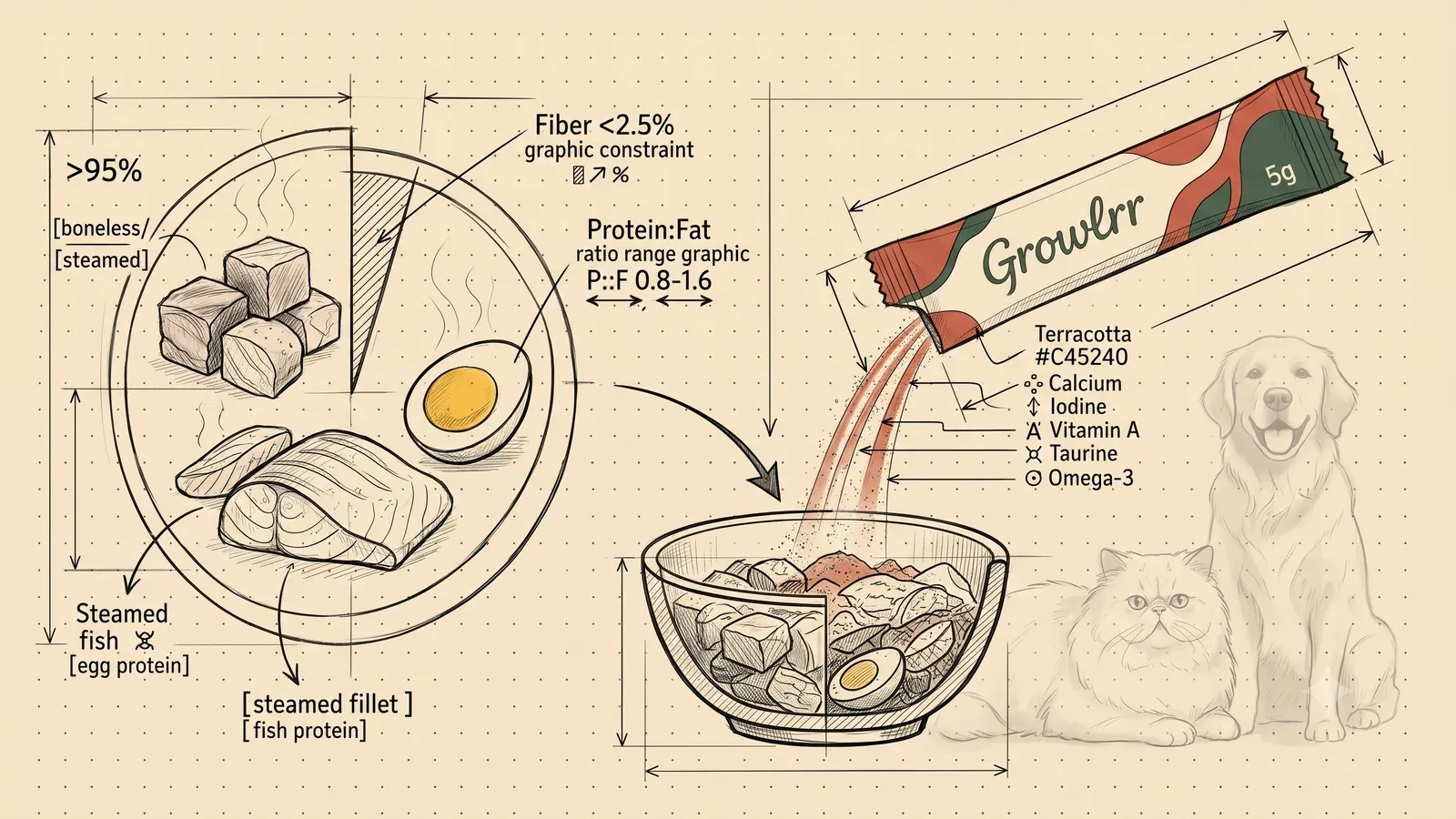
Complete
Completeness in BARC is a two-axis idea: the NRC 2006 nutrient floors are largely source-indifferent, and the sachet closes the few unavoidable gaps on almost any appropriate animal base. This matters especially in India, where there is no mandated nutrient floor (BIS IS 11968:2019 is voluntary) — so completeness has to be proven, not label-claimed.
This is not just a claim — it is what the bowl-checker matrix shows. Run as a deterministic point-estimate (a single careful calculation of one day's bowl) against NRC 2006, five test diets carried anywhere from 9 to 21 nutrient breaches, and the correction closed every one of them to zero, every time. That is the concrete meaning of “complete”: the gap you cannot source at home is the gap the sachet is built to fill.
Balanced
Wondering how this applies to your own pet? Build their bowl — two minutes, and it gives the exact grams for their weight.
Balance is more than hitting floors. BARC targets a calcium:phosphorus ratio of roughly 1.38 (DogCore) / 1.41 (CatCore), a protein:fat ratio of 0.8–1.2 by metabolizable energy, and a diverse animal-protein base. Methionine + cystine (the sulfur amino acids) is the watched amino-acid limiter, with egg as the sulfur-amino anchor.
Safe — cooked, not raw
Fresh, gently cooked food is more digestible than extruded kibble (Geary 2023; Tanprasertsuk 2021) while avoiding the pathogen and antimicrobial-resistance risk of raw feeding, which is why the AVMA and FDA advise against raw animal-source protein. BARC takes raw’s biological appropriateness and removes its downside by cooking.
Safe — proven, not asserted
Adequacy is demonstrated by diverse Monte-Carlo validation across 1 Million+ vectors · Wilson C/R 95/99, with zero safe-upper-limit breaches. Long-run tissue-accumulation modelling shows the ceiling-guarded copper plateauing at roughly 155% of the NRC allowance — comfortably below its safe upper limit. That is a safety margin, not a health claim.
BARC vs BARF
BARF (Biologically Appropriate Raw Food) gets the biology right but carries raw’s pathogen risk. BARC — Growlrr’s coinage, developed by a cardiovascular stent-design engineer for his own cats — keeps the biological appropriateness, drops the raw-pathogen risk by gentle cooking, and adds residual correction so the bowl is provably complete. Same appeal, without the trade-off.
References
- Geary EL, Parsons CM, Utterback PL, Templeman JR, Swanson KS. Standardized amino acid digestibility and nitrogen-corrected true metabolizable energy of frozen raw, freeze-dried raw, fresh, and extruded dog foods. J Anim Sci. 2023;101:skad377. Metabolizable energy of raw, fresh and extruded dog foods (J Anim Sci, 2023)
- Tanprasertsuk J, Perry LM, Tate DE, Honaker RW, Shmalberg J. Apparent total tract nutrient digestibility and metabolizable energy estimation in commercial fresh and extruded dry kibble dog foods. Transl Anim Sci. 2021;5(3):txab071. Metabolizable energy in fresh and extruded kibble (Transl Anim Sci, 2021)
- American Veterinary Medical Association (AVMA) & U.S. Food and Drug Administration (FDA). Positions on raw or undercooked animal-source protein in cat and dog diets.
- National Research Council (NRC). Nutrient Requirements of Dogs and Cats. Washington, DC: National Academies Press; 2006.
- Association of American Feed Control Officials (AAFCO). Dog and Cat Food Nutrient Profiles (current edition).
- FEDIAF. Nutritional Guidelines for Complete and Complementary Pet Food for Cats and Dogs (current edition).
- Bureau of Indian Standards. IS 11968:2019 — Pet Food (Dog and Cat Feed) — Specification (voluntary standard).