
Why is dog food so expensive in India?
Published
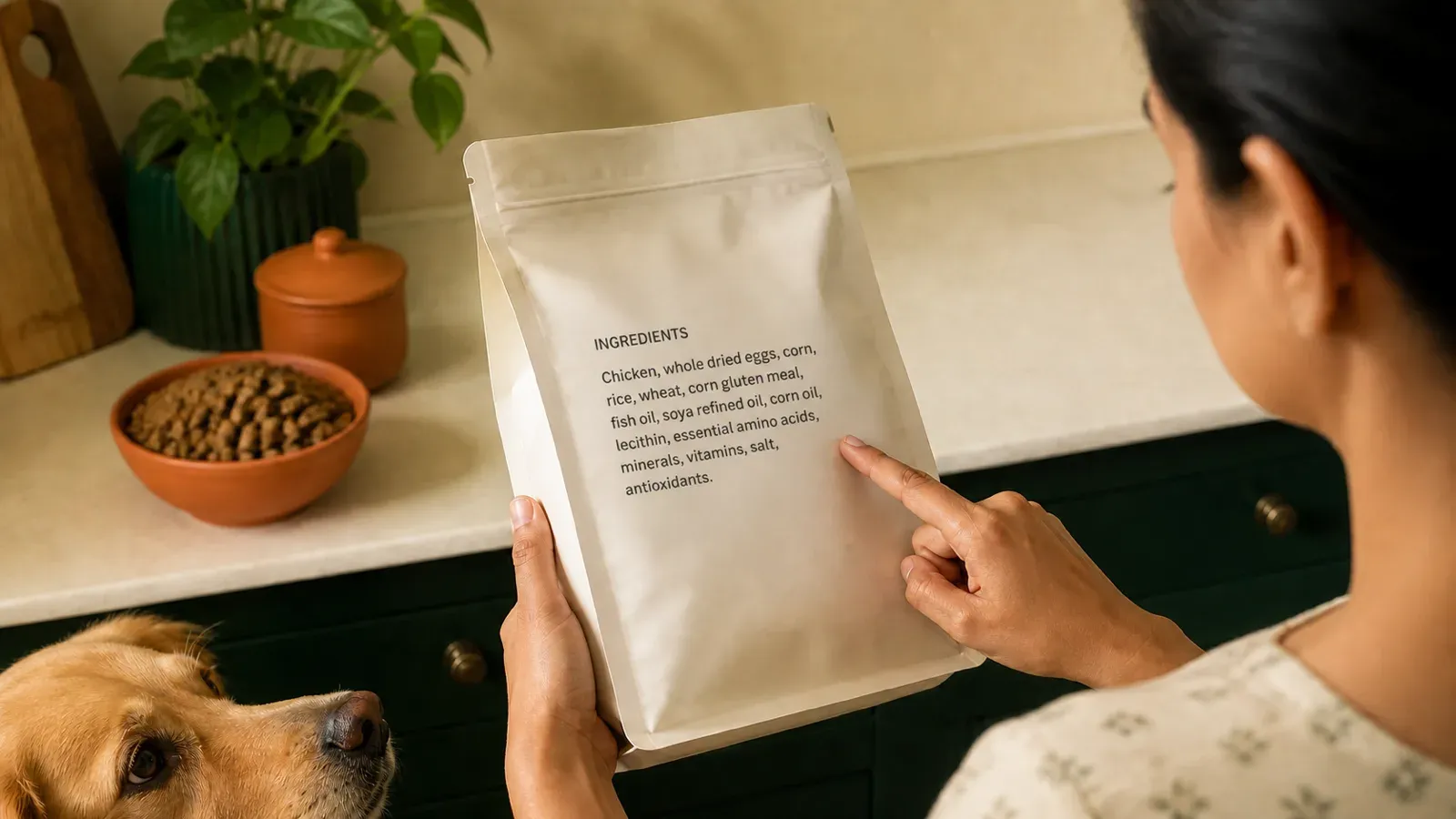
You are paying to ship water
A premium wet or “fresh” pouch is mostly water — roughly 80% moisture by weight — and that water is manufactured in one central plant and then freighted, often chilled or frozen, to every city in the country. You are literally paying to move water down a highway. Meat, by contrast, is a plain commodity that is already sold fresh in every Indian city, at your local butcher and now on-demand through Blinkit, Licious and Zepto. When the heavy, caloric part of the diet comes from meat you buy around the corner, that whole water-freight bill simply disappears from your pet’s food.
You are paying for shelf-life
Wondering how this applies to your own pet? Build their bowl — two minutes, and it gives the exact grams for their weight.
The second premium is shelf-stabilisation — the cost of making food last a year in a warehouse and on a shop shelf. Wet food is retort-processed (sealed and cooked at high heat and pressure, like a tin), and kibble is made by high-heat extrusion (dough forced through a die and puffed dry). Both are real industrial steps that cost real money, and none of that cost is nutrition — it is preservation. You are paying a manufacturer to keep the food edible for twelve months, whether or not your pet needs it to last that long.
When a shelf-stable pack is worth it
To be fair, that shelf-life is genuinely useful sometimes. For travel, for a boarding kennel, or for the odd day you simply cannot cook, a sealed pack that keeps without a fridge earns its place, and there is nothing wrong with having a few on hand. The economics only turn against you when a shelf-stable pack becomes the everyday daily driver — that is when you are paying the water-freight and the year-long-shelf premium at every single meal, for a convenience you are not actually using.
Packaged food is not a rip-off — it is a real product with real convenience baked in. But if you are feeding it every day as the main diet, most of what you pay covers water and shelf-life your pet never needed. Feeding a fresh local bowl lets you stop paying for both; Growlrr does the correction, and you keep the difference.
References
- National Research Council (NRC). Nutrient Requirements of Dogs and Cats. Washington, DC: National Academies Press; 2006.
- Association of American Feed Control Officials (AAFCO). Dog and Cat Food Nutrient Profiles (current edition).
- FEDIAF. Nutritional Guidelines for Complete and Complementary Pet Food for Cats and Dogs (current edition).
See the real cost of feeding fresh →