
Can I feed kibble and fresh food together?
Published · 6 min read
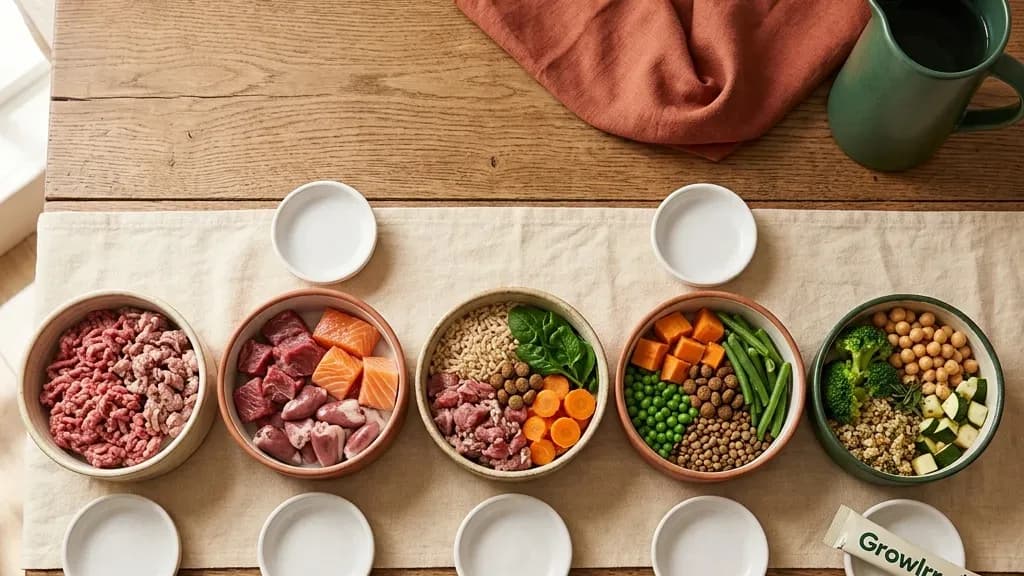
This is far and away the most common thing people write to us about. It usually arrives in one of three shapes: “can I do fresh in the evening and kibble in the morning?”, “I travel a lot, what then?”, or the honest one, “I cannot cook every single day.”
All three deserve a straight answer, and the three answers are different. If you are still deciding between the options rather than combining them, wet versus dry versus fresh and the five ways of home feeding and where each falls down are the places to start.
The rule, first, because it removes all the arithmetic
The sachet goes with the home-cooked bowl. No bowl, no sachet.
That is the whole operating instruction, and it is safe in both directions. A commercial meal is already complete — or at least complete in the sense the label means — so it needs no correction and gets none. A home-cooked meal gets its calculated dose. If there is commercial food in the same bowl and it is more than a garnish, treat it as a commercial meal and skip the sachet.
And if you skip one? Nothing. There is no catching up to do. The dose is built around what your animal habitually eats rather than what is in any single bowl, and micronutrient stores buffer over days and weeks, not meals. A missed dose on Tuesday is not a debt you repay on Wednesday.
Why we will not give you a split
Wondering how this applies to your own pet? Build their bowl — two minutes, and it gives the exact grams for their weight.
Here is the part that surprises people, because it sounds like we are being difficult.
A “complete and balanced” label tells you that a food meets published minimum standards. It does not tell you what that food actually delivers above those minima. It does not tell you which chemical forms the nutrients are in, or how well they are absorbed out of that particular matrix — a label is a floor, not a description. And pet food in India sits outside FSSAI, with BIS IS 11968 not enforced as a binding specification regime, so nobody independently verifies the declaration either — which is a longer story than it sounds.
Notice what that argument is not. It is not that mixing is dangerous. Two nutritionally complete systems mixed in any proportion still clear requirement, and the headroom up to safe upper limits is generally wide. Nobody is going to come to harm because they fed half a bowl of kibble.
It is that we would be stating a figure we cannot stand behind. We would rather tell you we cannot work it out than work it out badly, and that is the same position we take on custom diets and on everything else where the honest answer is “we do not know.”
Where commercial food genuinely belongs
1. As the thing you transition off
Moving from kibble to a fresh bowl is a change to the gut microbiome, not just a change of menu. Do it over 7–10 days for a dog and 2–3 weeks for a cat: replace about a quarter of the commercial portion with the fresh bowl every three days, and raise the sachet count as the fresh fraction grows.
Loose stools during the change are usual and they settle. If they do not, step back to the previous ratio and hold there longer before moving on. Nobody is in a hurry.
The important thing about a transition is that it ends. That is exactly what distinguishes it from mixed feeding.
2. As an occasional substitution
Travel. A hospital stay. A flood. A power cut. A day you simply cannot face cooking. A commercial meal is not a problem — feed it, skip the sachet, pick up where you left off.
We describe this as an event rather than a percentage, and that is deliberate. The moment you put a number on it — “up to 30% commercial is fine” — it stops being an exception and becomes a permanent arrangement, which is the thing we just said we cannot dose for. An event is what it actually is: a substitution, for a reason, for a period, after which normal service resumes.
“But I really cannot cook every day”
This is the real objection hiding behind most mixed-feeding questions, and it is a completely fair one. The answer still is not a split — it is batch cooking.
Cook for the week in one afternoon. Portion it while the meat is fresh. Freeze it flat in sealed pouches. Thaw tomorrow’s portion tonight, reheat it, serve warm, and add the sachet to the bowl at the table. Cooking becomes a weekly job instead of a daily one, and it is how almost everyone who feeds fresh for years ends up working.
We have written the whole weekly rhythm out here — the buying, the portioning, the freezing, the equipment that pays for itself inside a year, and the one rule about never mixing the sachet into the batch.
And the thing we will not do
A permanent half-and-half is a perfectly reasonable thing to want. We are still not going to publish a dose for it. The builder is designed for a home-cooked bowl, and we are not going to invent a number for the other half of a diet we cannot see.
You are free to feed your animal however you judge best — that is genuinely not our call. What we will not do is sell you a correction for a bowl it does not correct.
The full policy, stated formally, is here. And if you want to know where your current bowl actually stands before you change anything, the free bowl checker will tell you, whether or not you ever buy from us.
Related reading
- Batch cooking: making fresh feeding a weekly job
- Do I have to follow your feeding chart exactly?
- Make your own treats: heart in the air fryer, broth in the pressure cooker
- Why a cat cannot skip meals
- Ready-to-eat fresh dog food, examined
- Is Pedigree good for dogs?
- What homemade pet food actually costs per day in India
- The mixed feeding policy, stated formally
- Check the bowl you feed now, free
- My pet refuses the sachet — what to do
- My cat won’t eat — what to do, and what not to do