
Batch cooking: how to make fresh feeding a weekly job instead of a daily one
One organised afternoon a week, some equipment that pays for itself, and you stop thinking about dinner every evening.
Short answer
Can I batch cook and freeze fresh food for my dog or cat?
Yes — cook or portion for the week, freeze flat in sealed pouches, thaw the night before and reheat on the day. The one rule is that the correction sachet goes into the warm bowl at serving, never into the batch: it is a dry unit, and blended into wet food and held for a week the least stable vitamins begin to go.
What it depends on
- Whether you freeze raw or freeze cooked — both work, and the animal eats cooked food either way.
- Freezer space, which is what makes bulk meat buying possible, and bulk buying is where the money is saved.
- Your own week. This is the advanced path; if you are starting out, cook daily first and get a feel for portions.
Who this is for
Not beginners. If you are starting out, cook daily for a few weeks and get a feel for your animal’s portions first. There is no substitute for watching them eat.
This page is for people who have settled into fresh feeding and want to stop thinking about it every evening. It is how most people who feed fresh for years end up doing it.
The weekly cycle
Buy for the week
One grocery run. Chicken, mutton, fish, eggs, vegetables — whatever your bowl specifies. Bulk is where most of the money is saved: a whole bird or a full cut of mutton costs materially less per kilogram than daily small purchases.
Portion per meal, while it is fresh
Weigh out each meal now, not later from a frozen block. Portioning once, accurately, is what makes the rest of the week mindless.
Freeze it raw or freeze it cooked — both work
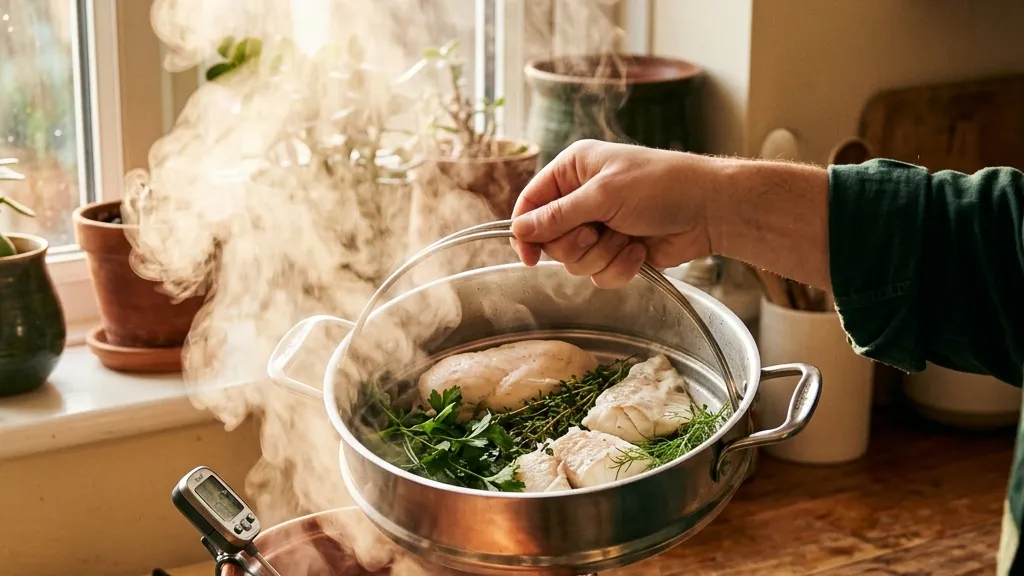
Some weeks there is time to cook the whole lot, cool it and bag it. Other weeks there is not, and portioning raw into small pouches takes twenty minutes. Our founder does both depending on the week. The animal eats cooked food either way; the only question is whether you cook now or on the day.
Vacuum seal and freeze flat
A vacuum sealer removes the air, which is what causes freezer burn and lets stored fat go rancid. Freeze flat and fast — thin packets freeze quicker, thaw quicker and stack better.
Thaw the night before
Move tomorrow’s pouch to the fridge. Never thaw on the counter, and never refreeze a thawed portion.
The daily step, and the one rule that matters
Take the day’s measured portion. Thaw it. Cook it, or reheat it if you cooked before freezing. Serve warm.
Add the Growlrr sachet to the warm bowl, at the table, fresh, every time.
Never into the batch. Never before freezing.
This is the rule we would ask you to follow above all others here, and the reason is simple. The sachet is a dry unit. Blended into wet food and held for a week — frozen or refrigerated — the vitamins that are least stable begin to go, thiamine and vitamin C first, and the oils sit in contact with moisture and protein for far longer than they were designed to.
Added to a warm bowl at serving, none of that happens. It takes four seconds, and it is the difference between the dose you paid for and an unknown fraction of it.
It also keeps your dosing flexible. Mixed into a batch, the dose is locked in for the week. Added at the bowl, you can change it the moment your animal’s weight or activity does.
Equipment, and what it pays back
| Item | Indicative | What it does |
|---|---|---|
| Vacuum sealer | from around ₹1,200 | Removes the air, which is what causes freezer burn and lets stored fat go rancid. The highest-return purchase here by a distance — it is the difference between a month of good storage and freezer burn in a fortnight. |
| Chest freezer | from around ₹10,000 | Unlocks buying meat in bulk, which is where the savings actually are. Pays for itself in discounts and in not running to the butcher. |
| Air fryer | under around ₹10,000 | Treats, in batches. Heart in eight minutes, cooled and frozen. |
| Pressure cooker | under around ₹10,000 | Bone broth. Two to three hours under pressure beats anything sold in a jar. |
These are one-time purchases that replace a recurring spend. The money currently leaking out as shop-bought treats and convenience food buys the equipment inside a year, and then keeps paying. Our founder runs both the freezer and the air fryer for his own cats.
Let your animal find its own rhythm
The chart gives you a starting point. Your animal will not read it.
Over the first few weeks you will notice their actual pattern, and it will not be the chart’s. Some eat everything the moment it lands. Some return to the bowl four times across the day, the way they would return to a kill. Some eat less than the chart says and hold perfect condition. Some eat more. Some are consistent to the gram and some are entirely idiosyncratic — more on Tuesday, less on Wednesday, for no reason you will ever discover.
All of that is normal. Watch, record what you see, and let them settle into their own pace. The portion is a starting estimate, not a target they have failed to hit.
What is worth paying attention to is change — a sudden drop or jump in appetite, a shift in how they approach food, weight moving in either direction over weeks. That is when you call your vet. Not when the bowl comes back with twenty grams left in it.
Food is half of it
Nourishment is not only what goes in the bowl. Steady, age-appropriate and breed-appropriate activity does as much for longevity as the ingredients do — and a few calories either side of the estimate are easily burnt off by an animal that moves properly.
This is also why we would rather you did not agonise over precision. A dog that walks and runs has a wide tolerance. A dog that does not has a narrow one, and no amount of formulation fixes that.
Treats, and making your own
For cats, treats are a novelty. For dogs, they are a necessity — behavioural training does not work without them. Two things to hold on to: they are calories, and they come out of the day’s budget; and make them work for it, because a treat given for nothing teaches nothing.
Shop-bought treats are the slowest and least visible drain in pet ownership, and the easiest to replace.
Hearts, in the air fryer
A batch of chicken or mutton heart, eight minutes, cooled and frozen. Thaw a handful as you need them. Heart is muscle, not organ — high in taurine, and animals will do a great deal for it. One batch lasts weeks.
Bone broth, in the pressure cooker
Bones, feet and necks, two to three hours under pressure, and you have better broth than anything sold in a jar. Cool, skim the fat, freeze in cubes. A spoonful over a bowl is a reward in itself, and useful for an animal that is off its food.
Strain the broth and discard the solids. We do not feed bones — cooked bone, pressure-softened or not, is not something we put in a bowl. The broth is the point; the bones are the means.
Between the air fryer and the pressure cooker you have replaced a recurring cost with equipment you own, and you know exactly what is in what your animal is being rewarded with.
Batch cooking is also the answer to “I cannot cook every day, can I just feed kibble for half the week?” — which is a different question with a different answer. See our mixed feeding policy, and what you can change in the bowl.