
Homemade cat food missing nutrients: 11 even in the best all-meat bowl
Published · 4 min read
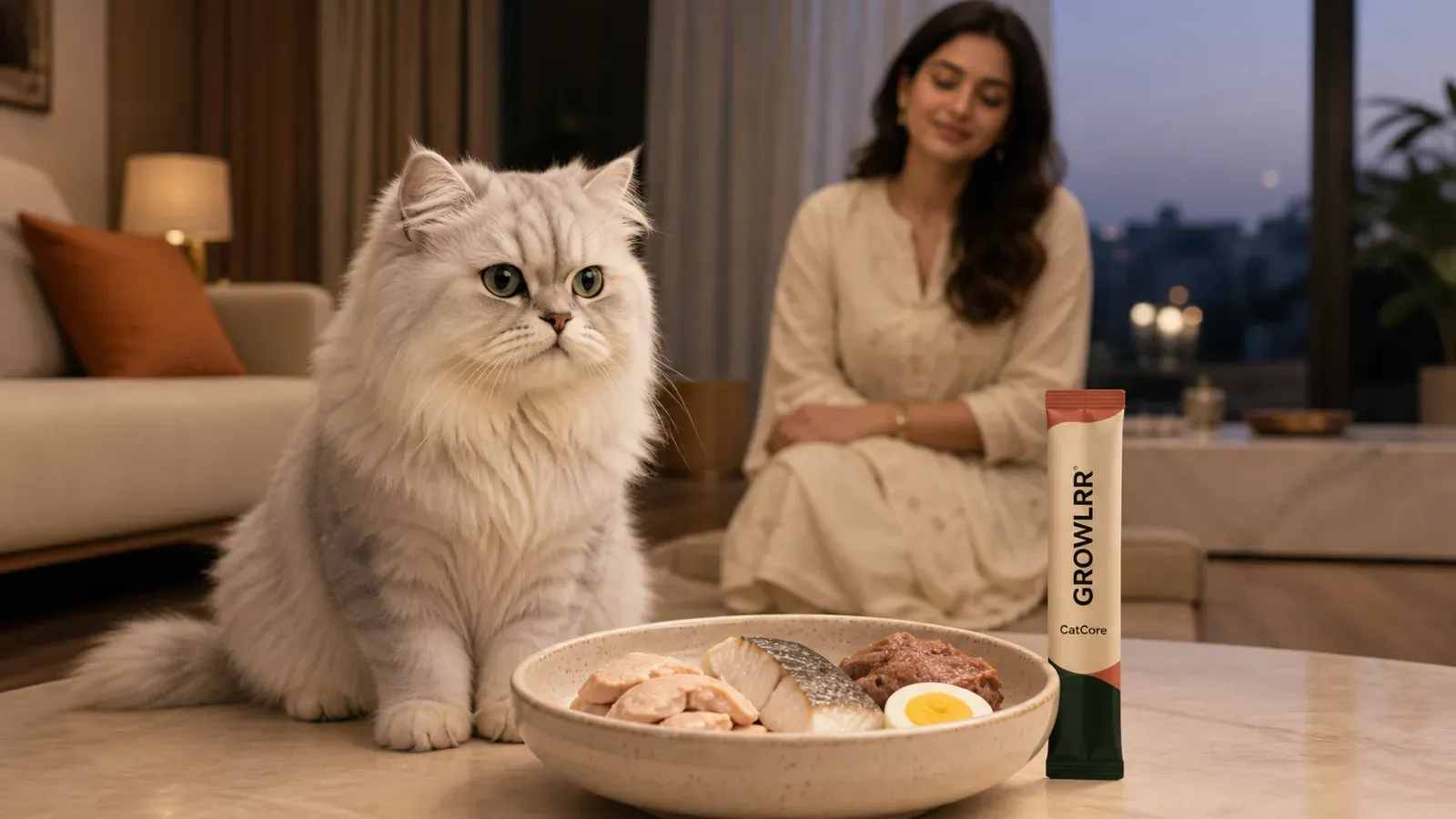
This is the cat half of our five-bowl audit for dogs. It looks the same from a distance — the same checker, the same nutrient standard — and it is not the same study, for a reason that is itself the main finding.
Why there are three cat bowls, not five
The dog study started from an all-meat bowl and stripped the meat out step by step — chicken-mix, no meat, no veg, no tofu — the way a home diet really drifts. For a cat that axis ends at the first step. A cat needs at least 95% of its daily energy from animal food. A bowl built on rice, dal or tofu is not a cat diet with a few gaps; it is not a cat diet. So the cat study measures the two bowls a cat actually eats at home, and one rice-stretched bowl marked plainly as a diagnostic — to show what a little filler does, not as something to feed.
The three bowls
| Cat bowl (4 kg adult, fed to need) | Animal energy | Below the floor, food alone | With the sachets |
|---|---|---|---|
| Standard all-meat — mutton, chicken, fish, egg | 100% | 11 | 0 |
| Typical home bowl — chicken and egg | 100% | 14 | 0 |
| Rice-stretched — chicken, egg, rice (diagnostic only) | 72.5% | 15 | 0 |
Each bowl was scaled to the cat's energy need before it was scored, so a bowl is never marked down simply for being too small. The checker reports a nutrient as short when the bowl delivers less than 90% of the NRC 2006 amount for that much energy.
Which nutrients are missing in every homemade cat bowl?
Wondering how this applies to your own pet? Build their bowl — two minutes, and it gives the exact grams for their weight.
- Calcium — 0% to 1%. Muscle meat carries almost none. Without bone or a measured source, the calcium-to-phosphorus balance is upside down.
- Thiamine (vitamin B1) — 0%. Cooking destroys most of what little meat holds, and cats need more of it than dogs do.
- Vitamin E — 0%. Lean cooked meat and egg supply almost none.
- Iodine at about a quarter of the need, folate at a third to a half, choline at about two thirds, and manganese near zero in the meat bowls.
- Iron and copper short even in the varied all-meat bowl, and further short in the others.
- Taurine at 28–56%. This is the one that matters most for cats: they cannot make enough of it, and a long shortfall damages the heart and the eyes. Cooking and draining lose it too.
The chicken-and-egg bowl adds four more — chloride, zinc, vitamin B12 and the omega-3 fats EPA and DHA — because a single meat carries a narrower spread than a mixed one. The rice-stretched bowl loses ground on almost everything, which is what dilution means.
What Growlrr adds to a homemade cat bowl
Growlrr CatCore™ sachets are stirred into the bowl you cook, weight-dosed at 4–8 a day for a cat, split across meals. In this audit they took all three bowls to zero breaches. To size your cat’s bowl and dose, build your pet’s bowl.
Dogs and cats, side by side
| Dogs | Cats | |
|---|---|---|
| Home bowls modelled | five, from all-meat to no meat | three — only one is a real cat diet |
| Best home bowl, nutrients below the floor | the all-meat bowl | the all-meat bowl: 11 |
| Fails in every bowl | thiamine, vitamin E, iodine, calcium-to-phosphorus | calcium, thiamine, vitamin E, iodine, iron, copper, manganese, folate, choline, taurine |
| Can the bowl drift toward plants? | yes, and every step adds gaps | no — a cat needs at least 95% of its energy from animal food |
| With the sachets | zero breaches in every bowl | zero breaches in every bowl |
The short version: a cat's home bowl has less room to go wrong in one direction — it must stay meat — and more ways to go wrong in another, because cats need more of several nutrients per calorie than dogs and make less of their own. In both species the gaps are the same kind of thing: not a missing food, but nutrients that ordinary meat, egg and vegetables do not carry in the amounts the animal needs.
How this was measured, and what it is not
A single careful calculation of one day’s bowl for a 4 kg adult cat, run on 4 November 2026 with the checker’s cat floors aligned to our nutrient reference (that alignment raised the taurine floor and stopped plant vitamin A being credited to cats, which cannot use it). It is a deterministic point estimate — not the Monte-Carlo simulation we use to validate the sachets themselves — and it scores a modelled bowl, not your kitchen.
How does your cat’s bowl do?
Enter what you feed and see the same breakdown for your own cat: check the bowl you feed today. It is free and takes a minute. Then build a balanced bowl for your cat.