
New puppy · Start here

You just got a puppy. Let’s feed them right from day one.

Congratulations — and welcome to the one decision that shapes the next fifteen years: how you feed. This isn’t about “puppy food” as a separate baby product. It’s about starting a complete feeding routine from the beginning— a real, fresh, meat-based bowl your puppy grows up on and carries into adulthood. Here is how to get it right.

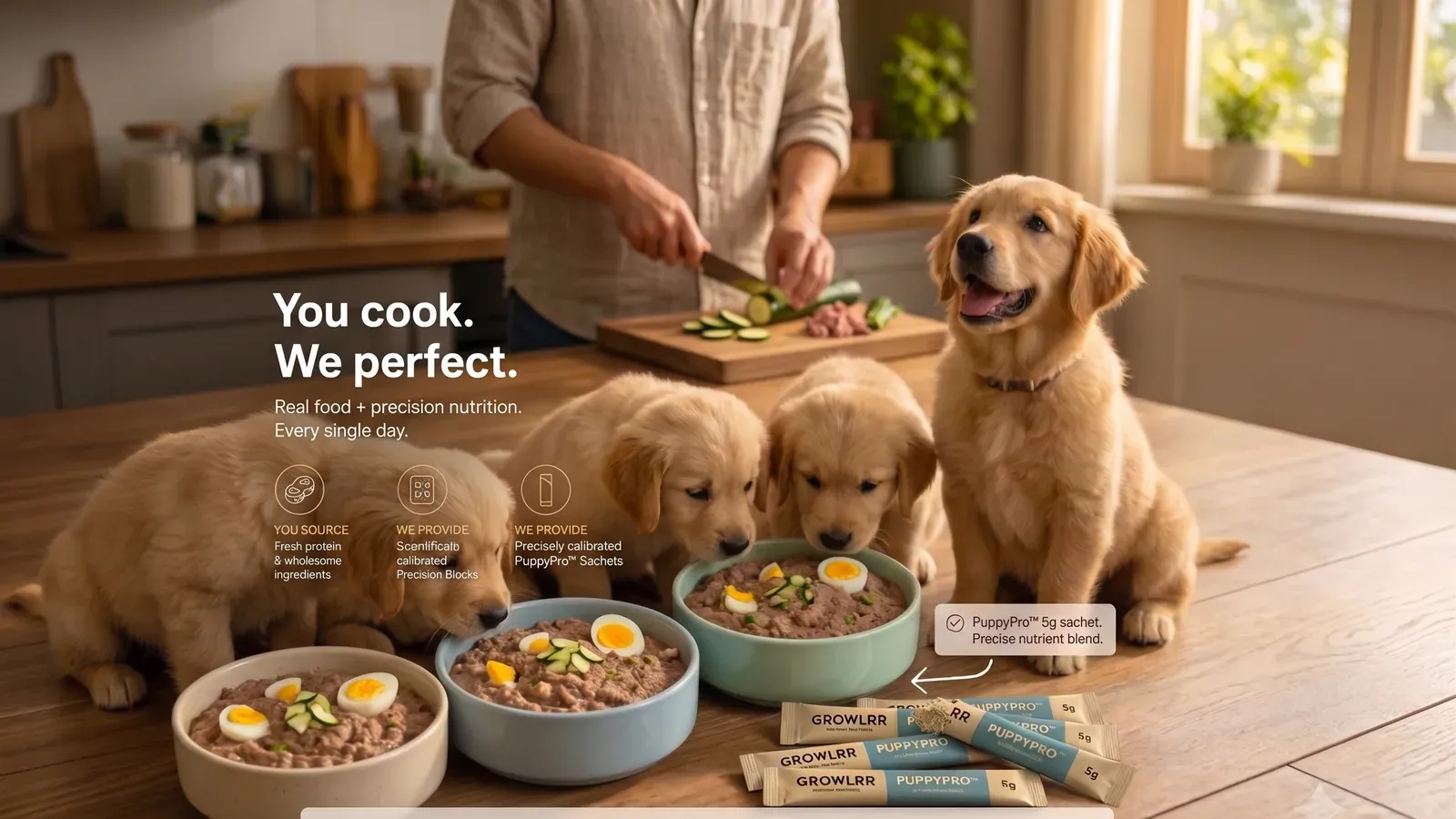
Golden Retriever puppies eating fresh home-cooked bowls completed with PuppyPro 5 g sachets — you cook, we perfect

New to growth feeding? The rules puppies and kittens share are in the new-arrival starter.

Short answer

What should I feed a new puppy in India?

Feed a new puppy a fresh, meat-based bowl — chicken and mutton or goat, lean fish like tilapia, egg, a little curd and veg — sized to its growth stage. A puppy builds its whole skeleton in year one, so it needs more calcium, phosphorus, protein and DHA than an adult; one 5 g Growlrr BowlBalancer™ PuppyPro™ sachet completes the bowl to the FEDIAF 2024 / NRC growth floors. Start the routine now and step down to adult maintenance around 12 months.

What it depends on

  • Breed size — large and giant breeds grow slower and longer (to 18–24 months) and need calcium held inside a two-sided window for developmental-orthopedic safety.
  • Age within growth — energy and dose peak through the middle of the first year, then taper toward the adult hand-off.
  • What is in the bowl — a varied meat, egg, fish, curd and veg bowl balances more easily than a plain chicken-and-rice one.
  • Body weight — the daily amount scales with how big the puppy is and how big it will become.

Common questions

What should I feed a new puppy in India?

A fresh, meat-based home bowl — chicken and mutton or goat, lean fish like tilapia, egg, and a little curd and veg — kept plain (no onion, garlic, salt or masala) and sized to your puppy’s growth stage. Because a puppy needs more calcium, phosphorus, protein and DHA than an adult, complete the bowl with one 5 g Growlrr BowlBalancer™ PuppyPro™ sachet dosed to the stage, which corrects it to the FEDIAF 2024 / NRC growth floors.

How is feeding a puppy different from feeding an adult dog?

A puppy builds its whole skeleton in its first year, so its calcium, phosphorus and protein needs run well above adult maintenance, and it needs DHA-forward omega-3 for brain and eye development. For large and giant breeds, getting calcium right matters even more — too much drives developmental bone problems — so calcium is held inside a two-sided window (3.0–4.0 g per 1000 kcal) and you must not add bone, eggshell or any calcium supplement on top.

When do I switch a puppy to adult food?

Feed the growth formula (PuppyPro™) through the growth window, then step down to adult maintenance (DogCore™) at around 12 months for small and medium breeds, and 18–24 months for large and giant breeds whose growth is slower and more extended.

Is home-cooked food safe for a puppy?

Yes, when it is complete. Fresh home food is excellent for a growing puppy, but a plain meat or meat-and-rice bowl is not complete on its own — it is short on the exact minerals and vitamins growth demands most. That is why the bowl is sized to the stage and completed with a weight-and-stage dose, rather than fed as plain meat.

What to feed — and why a puppy is not a small adult

Anchor the bowl in animal protein: balanced chicken and mutton or goat, with lean fish like tilapia (a lean protein that helps balance the bowl’s protein-to-fat ratio), egg, and a little curd and veg. Keep it plain — no onion or garlic (both toxic to dogs), no masala, no extra salt. Fresh, simple and varied is the goal, just as it will be when your puppy is grown.

The difference is in the amounts. Puppies build their whole skeleton in their first year, so their calcium, phosphorus and protein needs run well above adult maintenance, and they need DHA-forward omega-3 for brain and eye development. For large and giant breeds, getting calcium right matters even more, because too much drives developmental bone problems — which is why the growth formula holds calcium inside a two-sided window and you must not add bone, eggshell or any calcium supplement on top.

A plain meat bowl, on its own, misses exactly the nutrients growth demands most. That is the gap PuppyPro™fills: a 5-gram precision food-balancer that completes your puppy’s fresh bowl to the FEDIAF 2024 / NRC growth floors. You cook the food; the sachet closes the gaps. The full dosing chart by age and the daily-bowl grams live on the growth page.

Size it, and reserve your first pack

Pick your puppy’s breed size and stage. We work out the sachets per day and a ~30-day pack — the start of the routine, editable any time. Groceries not included — you buy them fresh, locally.

Reserve a pack

5 g sachets. Beagle-class 15 kg reference; one PuppyPro SKU covers early + late growth, only the count changes.

2
sachets/day
60
sachets · ~30-day pack
PuppyPro™5 g sachet
Per pack1,650
Per sachet27.5 / 5 g sachet

Groceries not included — you buy them fresh, locally.

Review & consent on the next screen · Editable any time

What happens after growth

The routine you start now doesn’t restart when your puppy grows up — it continues. Feed PuppyPro™ through the growth window, then step down to DogCore™adult maintenance at around 12 months (18–24 months for large and giant breeds). Same fresh bowl, same one-sachet habit — just re-dosed for an adult body. That is the whole idea: a complete feeding routine your dog keeps for life.

Not sure what “complete” even means, or want to see it before you commit? Read what complete and balanced means, sort the whole feeding decision at the feeding hub, or check any bowl with the tool.

Got a kitten instead? Start a new kitten’s routine →