Is Benny’s Bowl dog food really fresh? Reading the pouch
First question: what does “fresh” mean on this pouch?
The pack we reviewed says Ready to eat, carries a barcode, an MRP box, a date of manufacturing and a best-before field, and this storage instruction: once opened, consume immediately or refrigerate up to 24 hours. The label lists the manufacturer as a cookware-and-retort co-packing facility in Delhi, with the brand marketed from a separate address.
Put those facts together and this is shelf-stable, heat-sterilised food in a retort pouch — the same food technology as wet food in pouches everywhere. That is not an insult; retort is a legitimate, safe process. But it raises the question the marketing never answers: if a pouch that sits at room temperature until its best-before date is “fresh,” what word is left for food cooked in your kitchen this morning? Fresh food, as every home cook understands it, is cooked recently and kept cold because it must be. A product that needs neither refrigeration nor urgency before opening is, by its own label, something else.
Second question: what's actually in the bowl?
Ingredients, in the label's own order: chicken, rice, peas, pumpkin, sweet potatoes, carrots, chicken liver. The nutrition chart reads roughly 122 kcal/100 g, with dry-matter protein 41%, fat 15%, carbohydrates 38%, fibre 3%.
Three things a label-reader notices:
1 · Four plant fillers after the chicken. Rice, peas, sweet potato and pumpkin are all energy carriers. Carbohydrates at 38% of dry matter — nearly equal to the protein — is a composition much closer to the padded fresh-subscription pattern than to a meat-first bowl. For reference, the BARC framework asks a dog's bowl to draw at least 85% of its calories from animal sources.
2 · Peas, prominently. Peas third in an ingredient list matters because legume-rich diets are the subject of the FDA-investigated association with canine dilated cardiomyopathy. It remains an investigated association, not a settled mechanism — we cover it carefully in our DCM explainer — but a brand formulating in 2026 chooses its legume load knowingly.
3 · Where are the micronutrients? The chart on the pouch we reviewed shows five macro numbers. We could not find an AAFCO or FEDIAF nutrient-profile adequacy statement on the label images we examined, nor micronutrient declarations — no calcium figure, no zinc, no iodine, no vitamin numbers. Chicken, rice and vegetables do not reach NRC micronutrient floors on their own; that is the entire reason completion products exist. So the fair question to put to the brand: which nutrient standard does a full daily ration of this food meet, and where are the numbers? If that statement exists somewhere, it belongs on the pouch.
Third question: what does their own feeding chart cost?
This is where reading the label gets expensive. The brand's own feeding recommendation chart:
| Dog weight (their chart) | Their grams/day | Cost/day at MRP (₹225/300g) | Cost/day at their best bulk rate (₹183/300g) |
|---|---|---|---|
| 5–10 kg | 400 g | ~₹300 | ~₹244 |
| 15–20 kg | 800 g | ~₹600 | ~₹488 |
| 20–30 kg | 1,000 g | ~₹750 | ~₹610 |
| 30–45 kg | 1,200 g | ~₹900 | ~₹732 |
Two consequences of their own arithmetic. First: the ₹499 “Trial Pack of 5” (five 100 g pouches) is half a day of food for a 20–30 kg dog — by the brand's own chart. Second: at ₹610–750 a day for a labrador-sized dog, this chicken-and-rice pouch costs more per day than a fully diverse home-cooked bowl of mutton, chicken, tilapia, eggs, curd and vegetables — groceries you choose, completed to NRC floors — and ten times the grocery cost of cooking their actual recipe yourself. Chicken and rice with vegetables is not a trade secret. It is your kitchen's Tuesday.
And the storefront theatre
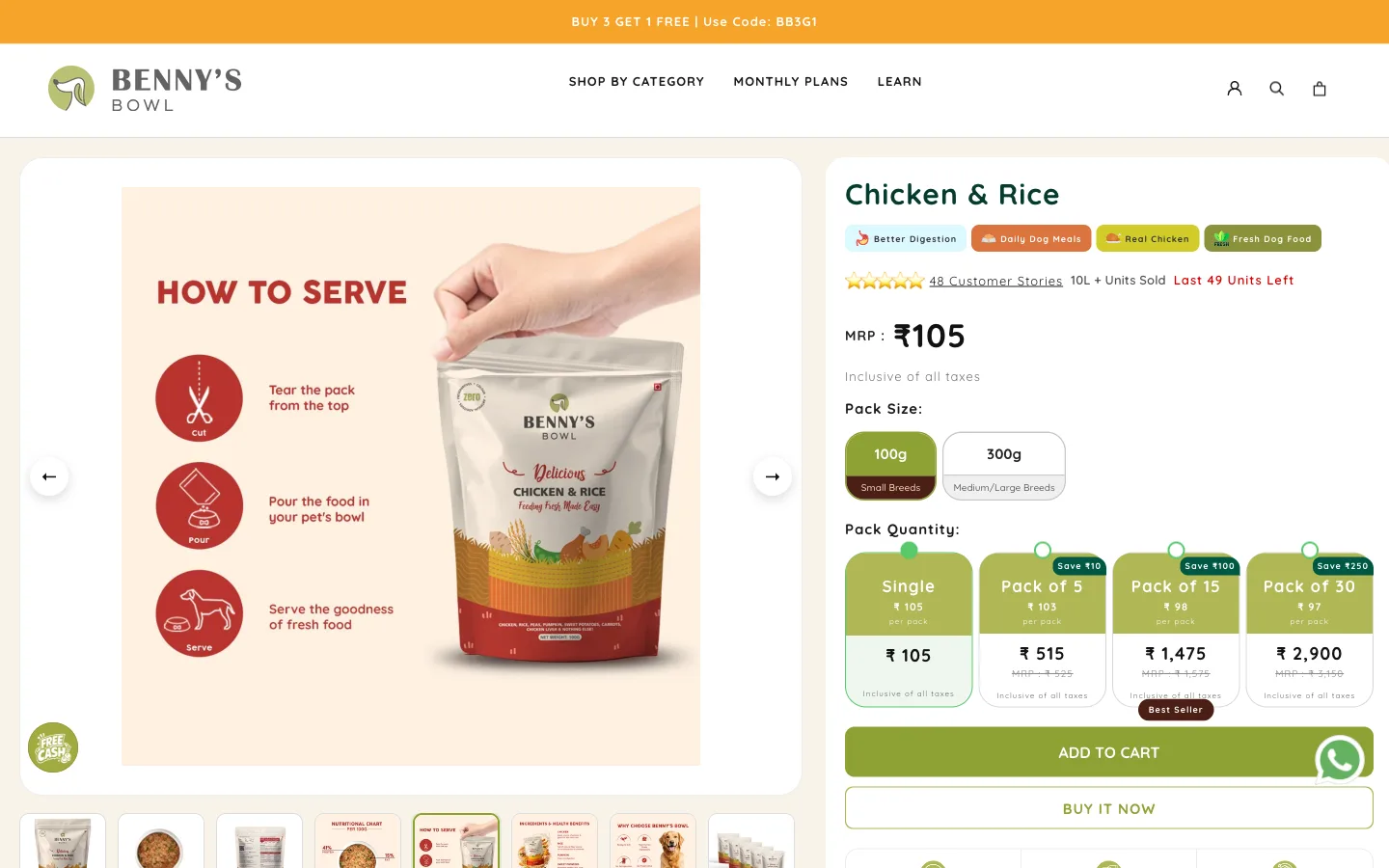
The product page we reviewed displayed “10L+ units sold,” a “last 15 units left” alert, a spinning cashback widget, and stacked discount badges — classic urgency mechanics. None of that is a nutrition argument. It is worth naming only because a heavily advertised brand gets asked fewer questions, and the questions above deserve answers before the ad budget answers them for everyone.
So what is it honestly good for?
Shelf-stable pouches have a real use case: travel, boarding, an emergency cupboard, a transition step away from kibble. If a pouch keeps a dog off biscuits and table scraps for a weekend, that is a genuine service. What the label does not support — as of our August 2026 reading — is the word fresh, a micronutrient story, or the daily economics for any dog above knee height.
The alternative their own recipe points to: cook the chicken and rice yourself — fresh, actually fresh — add real diversity when you're ready (the 7 validated recipes), and let a weight-dosed BowlBalancer™ sachet carry the calcium, iodine, taurine, omega-3 and the rest to the published floors. That bowl is validated across 1 Million+ simulations · Wilson C/R 95/99 against NRC 2006 — numbers we publish, because we built the models to prove them. Start with your dog's exact grams. And this pouch is not an outlier — nearly the whole “fresh dog food” category in India is retort.