
A homemade dog food plan for a 20 kg adult dog, worked end to end
Every question we ask, the answer given, and the exact daily plan that comes back.
Our bowl builder is a form, so nothing inside it can be read from outside. This page is the same nine questions and the same answer, written out for one animal: Bruno, a 4-year-old intact dog of 20 kg, in normal condition, fed a home-cooked bowl.
Every figure below is computed by the same engine the builder runs — not transcribed. The screenshots are captures of the live builder answering exactly these answers. There is a worked cat example too, or you can run it for your own animal.
Short answer
What does Growlrr recommend for a 20 kg adult dog?
A 20 kg active adult dog in normal condition needs 1,000 kcal a day: 890 g of cooked boneless chicken, mutton, tilapia, curd, mixed vegetables and egg across 3 meals, plus 6 × 10 g DogCore™ sachets. Without the sachets, 11 of the 28 nutrients we track — thiamine, EPA + DHA, calcium and vitamin E worst — land under the daily allowance on the day the bowl is cooked.
What it depends on
- Body weight — it sets the calorie target and reads the whole-sachet dose off a ladder.
- Neutering, body condition, activity and the temperature they live in — these four move the calorie target, and therefore the grocery grams.
- Life stage and health — growth, pregnancy and animals under veterinary treatment are routed away from this product, not quietly fed by it.
Common questions
Can I order it in India, and what does it cost for a 20 kg dog?
We ship within India only, and dispatch has not opened yet — the first boxes go out from 15 December 2026. Today you can hold one for ₹1, which is refundable and comes off the final bill. One 10 g sachet is ₹55; Bruno takes 6 a day, so the correction is about ₹330 a day — roughly ₹9,900 a month. The Starter Box is ₹1,299 all-in and holds 42 sachets, about 7 days at this dose. Groceries are not included: you buy those locally, and they run about ₹464 a day for this bowl at Chennai app-delivery rates.
Is it validated for cooked boneless chicken, and can I include fish and rice — or must the recipe be exact?
The recipe does not have to be exact, and that is the point of the product. We validate against a published diet — cooked, boneless chicken and mutton, farmed fish (tilapia) and egg, with curd and a mixed-vegetable share — and the proportions inside it can be swapped freely. Chicken on its own is the worst case we test against, not a diet we recommend: it is the floor the correction still has to clear. Rice is a different matter. It is not in the diet we validate, and it is not dangerous, but it is calories carrying almost none of the nutrients the plan is counting on — so a bowl padded with rice is a diluted bowl against the same sachet dose. Keep the fresh bowl as specified and feed rice, if you want to, as a small extra rather than a substitute for part of it.
What is the full recipe and the exact daily dose for a 20 kg adult dog?
Bruno's target is 1,000 kcal a day. That is 890 g of fresh food split across 3 meals — chicken mince 161 g, mutton mince 137 g, fish (tilapia) 132 g, curd (dahi) 150 g, rainbow veg mix 310 g, egg (whole, cooked) 3 — plus 6 × 10 g DogCore™ sachets, two per meal, stirred through the food. Cooked, boneless, no salt, no onion and no garlic. The dose is read off body weight alone, so it does not move when the proportions in the bowl do.
What is the evidence that it is adequate — lab analyses, feeding trials, a nutrient profile?
Adequacy here is substantiated by formulation against NRC 2006, cross-checked against AAFCO and FEDIAF, which is a recognised route for a complementary feed. Because the base bowl is cooked by the owner rather than by us, a single recipe would not represent what people actually feed — so the formulation was set against over a million simulated bowls spanning the permitted input space, each evaluated against the requirements and the safe upper limits. For this bowl, 11 of the 28 nutrients we track land under the daily allowance without the correction and all 28 are met with it, none above a safe upper limit. What that does not establish is digestibility, bioavailability or long-term biological outcome. We have not run an AAFCO feeding trial and do not present one, and we hold no batch analyses for product that has not been manufactured yet. The full position, including why that protocol does not fit this product, is on our scientific basis and validation page.
Who manufactures it, and how is batch consistency controlled?
Growlrr Foods Pvt Ltd is the marketer. Manufacture is contracted to an Indian facility, which holds the FSSAI licence for its own premises; the arrangement is not signed yet, so we do not name it. The batch-release programme is defined and applies from the first commercial batch: ingredient specifications and supplier documentation, analytical verification against specification including heavy metals, microbiology and assay, blend-uniformity testing across multiple sampling points using a low-inclusion marker element, batch documentation and traceability, and stability testing. None of it has been executed yet, because nothing has been made yet, and we will not claim records we do not hold.
Is it safe to feed every day long term, and what if some commercial food stays in the bowl?
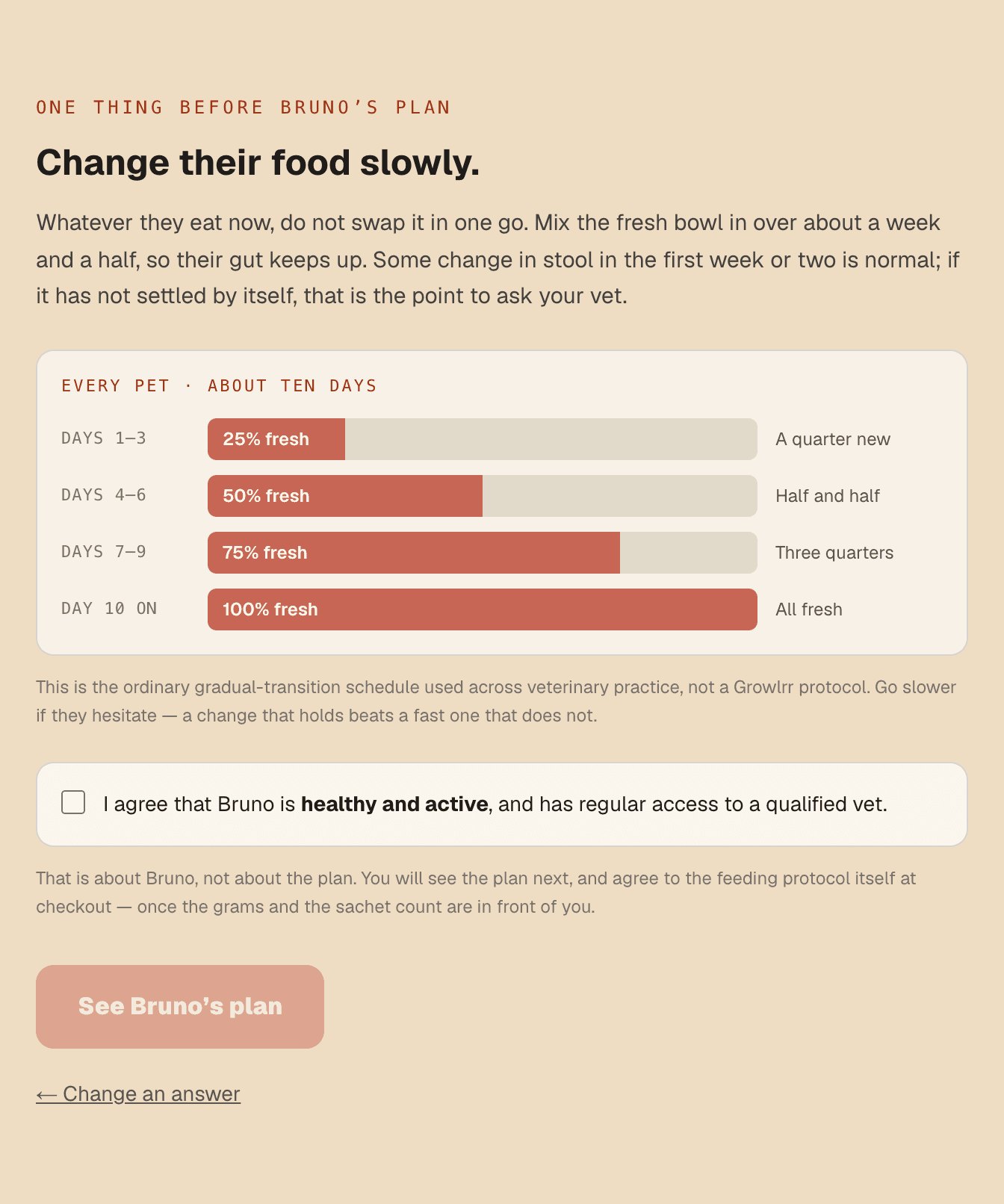
It is built for exactly that — daily maintenance feeding of a healthy adult dog, which is why the formulation is set against requirements and safe upper limits at the same time rather than against requirements alone. It is not for animals under a year, pregnant or nursing animals, or animals on prescription food or under active veterinary treatment; the builder stops and says so rather than handing those cases a plan. On mixing: the dose is computed for a day that is entirely the fresh bowl. While you are switching over, move across gradually — a quarter fresh for about three days, then half, then three quarters, then all fresh from around day ten — and feed the sachet count that matches the fresh share rather than the full dose. A complete commercial food is already fortified, so feeding a full correction alongside a large share of it is stacking two corrections; that is not a diet we have modelled, and it is worth a word with your vet before settling into it permanently.
The nine questions, in order
The builder asks nine, one per screen, and shows the plan on the tenth. Five of them move numbers — body weight, and the four lifestyle answers. The rest route the animal or set up a later question. Nothing is asked that does not change something.
1. What's your dog's name?
So the plan comes back with their name on it, not "your pet".
Nothing in the arithmetic depends on it. It is here because a plan addressed to a named animal gets read, and one addressed to "your pet" does not.
Bruno’s answerBruno
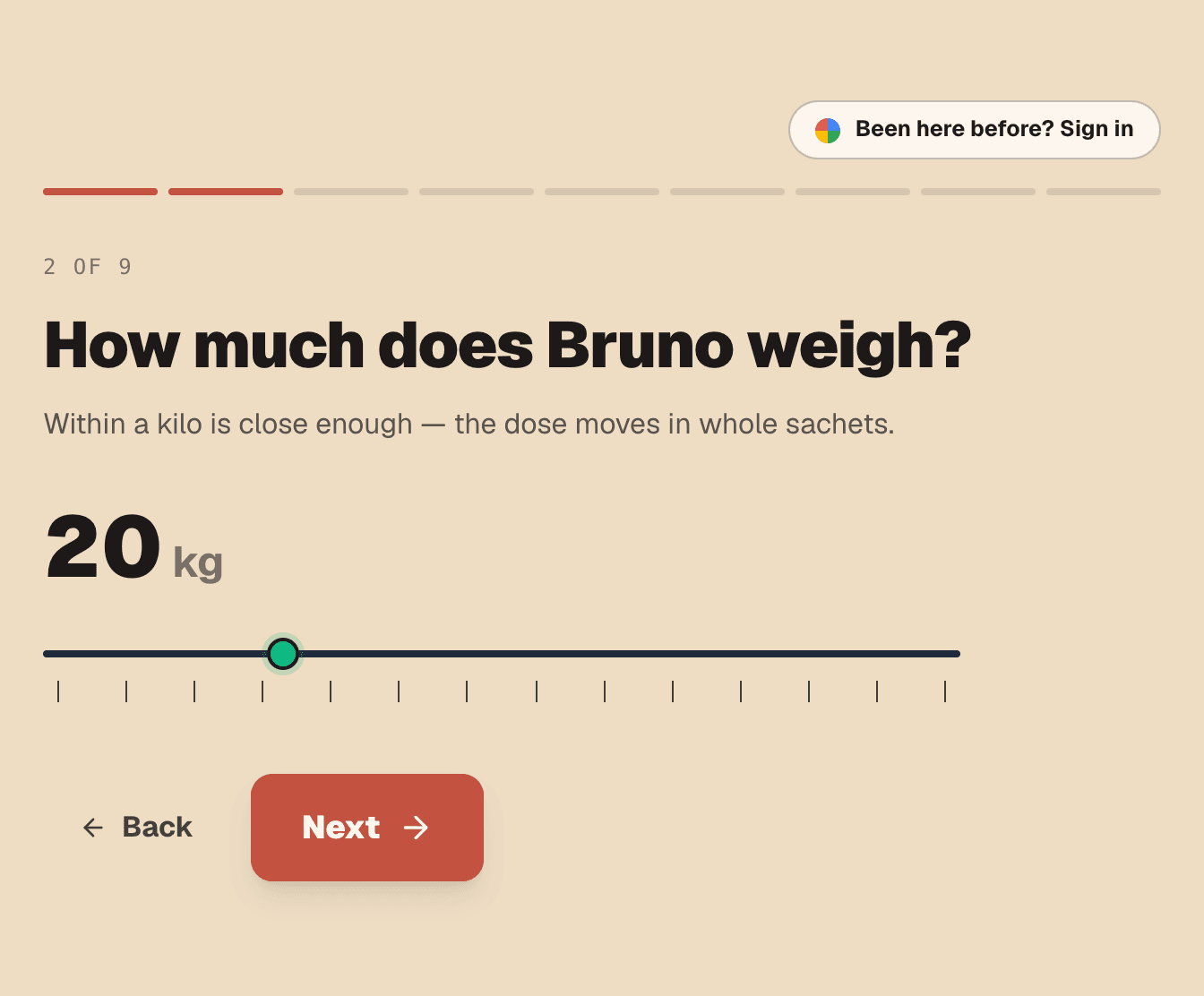
2. How much does Bruno weigh?
Within a kilo is close enough — the dose moves in whole sachets.
Body weight sets both halves of the plan: resting energy scales as a power of it, and the sachet dose is a whole-sachet ladder read straight off it. It is the only answer that changes how much correction Bruno gets.
Bruno’s answer20 kg
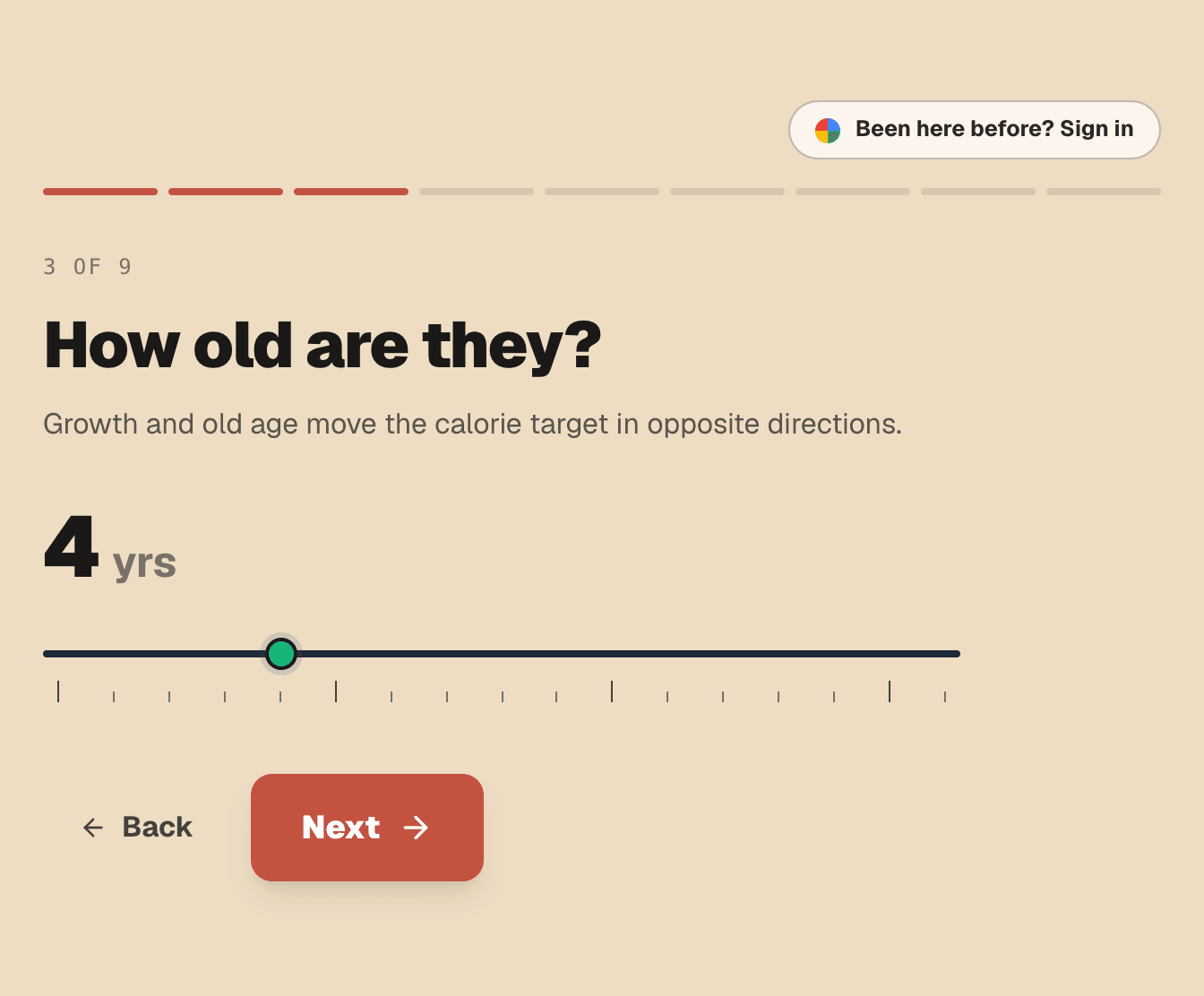
3. How old are they?
Growth and old age move the calorie target in opposite directions.
Adult maintenance is what this product is for. An animal under a year is routed to the growth formulation instead, and from eight years we ask the owner to confirm the animal is well and seeing a vet — the age itself changes no number.
Bruno’s answer4 years
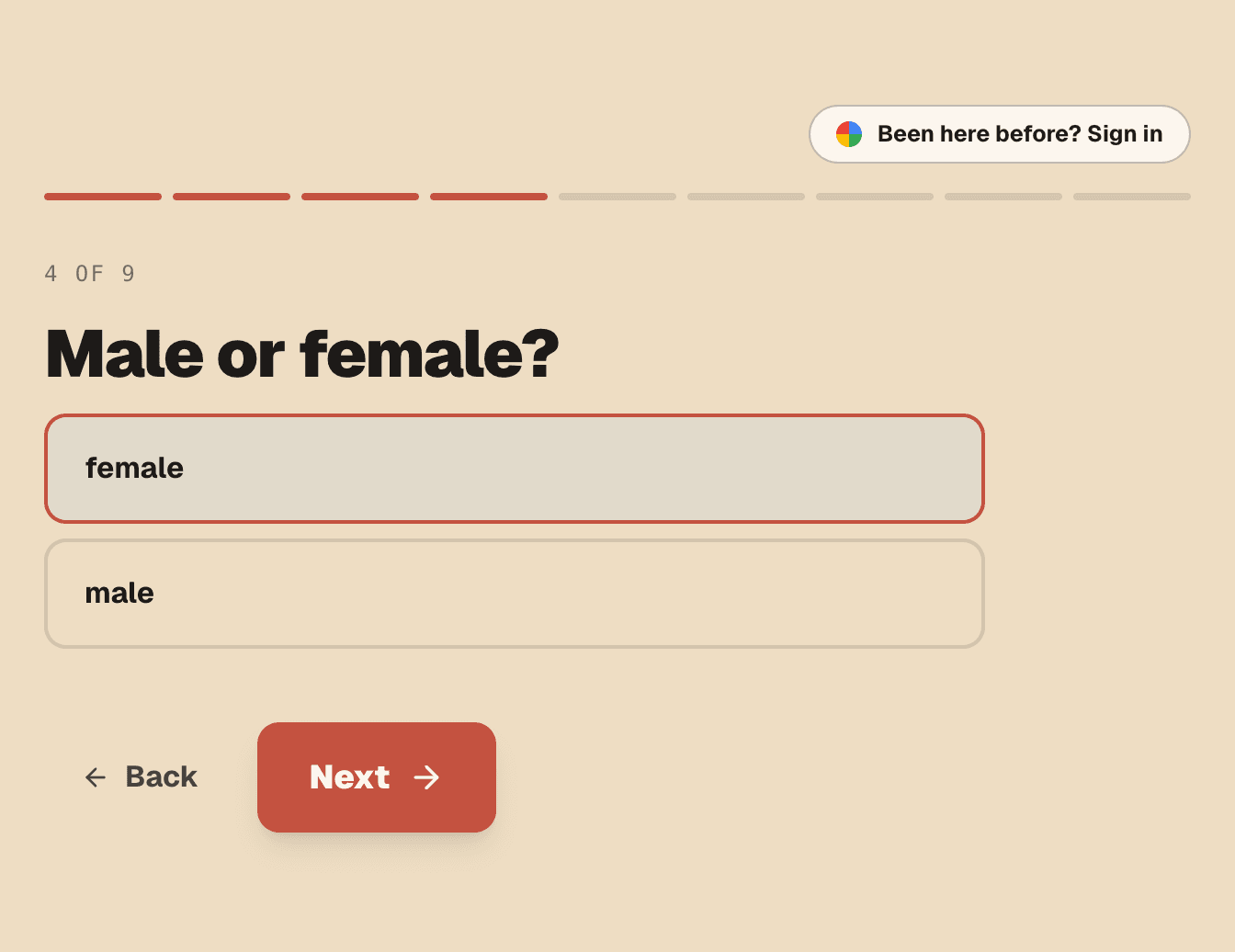
4. Male or female?
On its own it changes nothing. It pairs with the next question, because the energy effect belongs to neutering, not to sex.
Bruno’s answerfemale
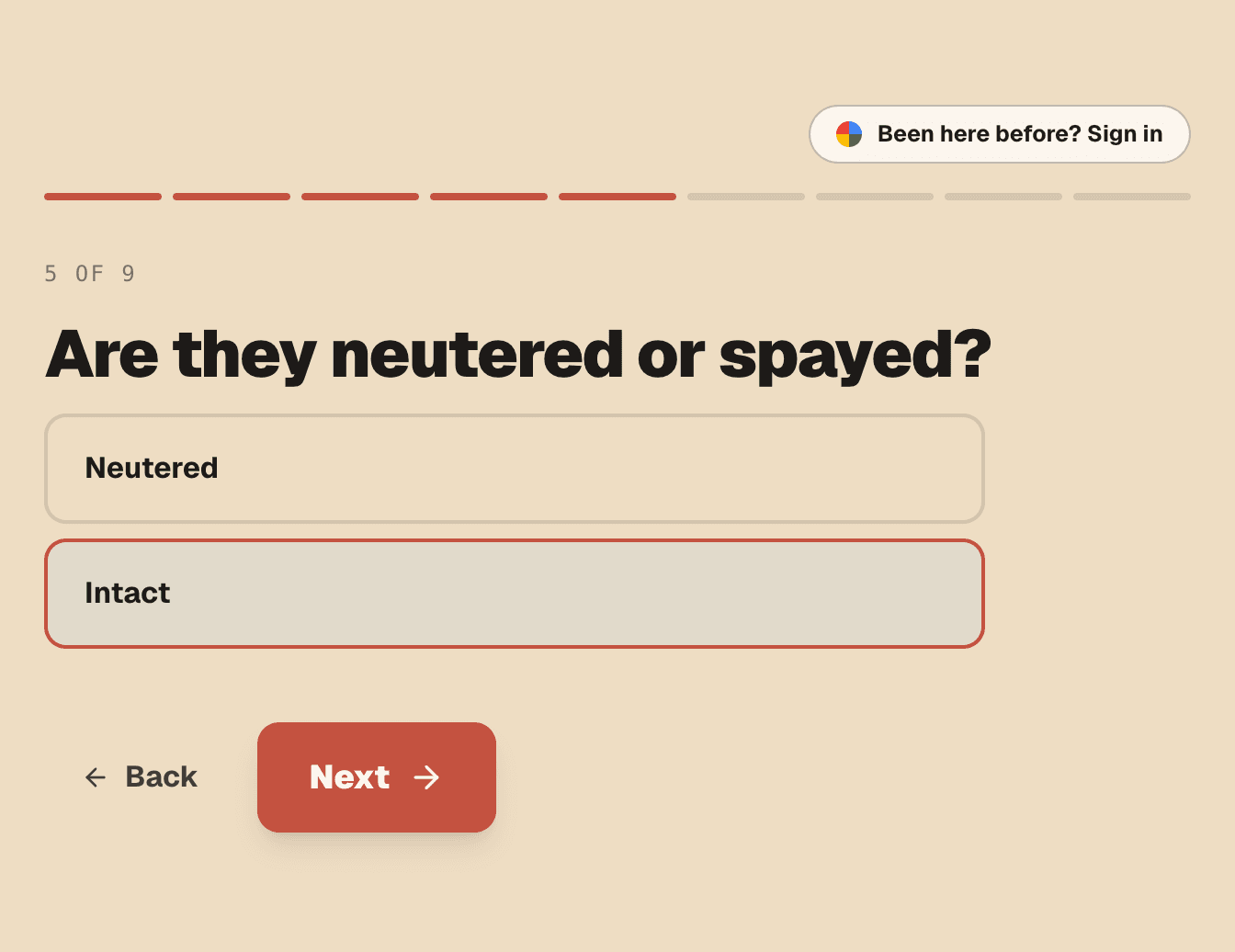
5. Are they neutered or spayed?
A neutered animal needs measurably less energy for the same body weight, so this moves the calorie target and therefore the grocery grams.
Bruno’s answerIntact
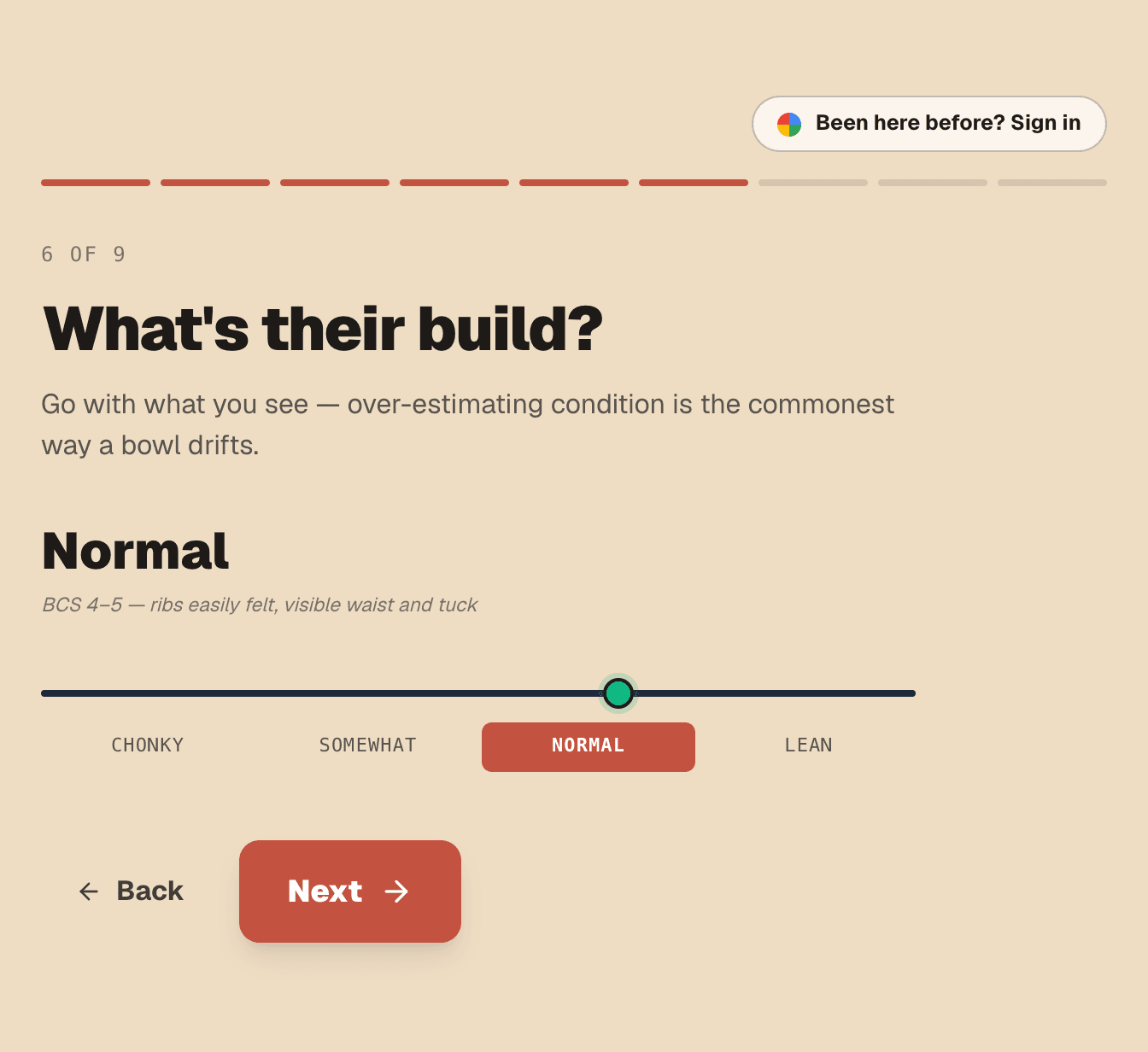
6. What's their build?
Go with what you see — over-estimating condition is the commonest way a bowl drifts.
Body condition moves the calorie target and, at the extremes, triggers a guardrail: an overweight animal reported as athletic is refused rather than quietly fed.
Bruno’s answerNormal
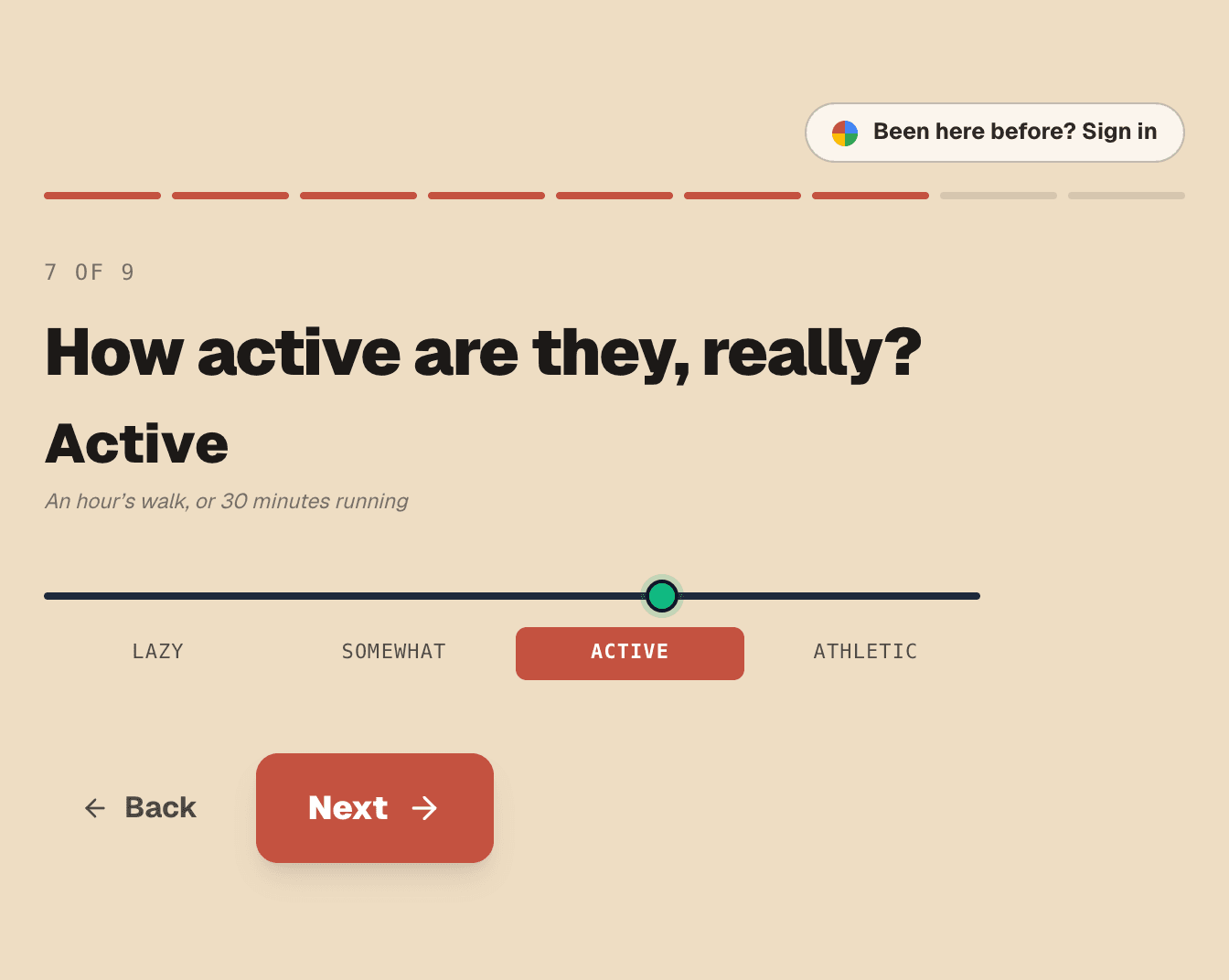
7. How active are they, really?
The largest single adjustment to the calorie target. Active means an hour’s walk, or 30 minutes running.
Bruno’s answerActive
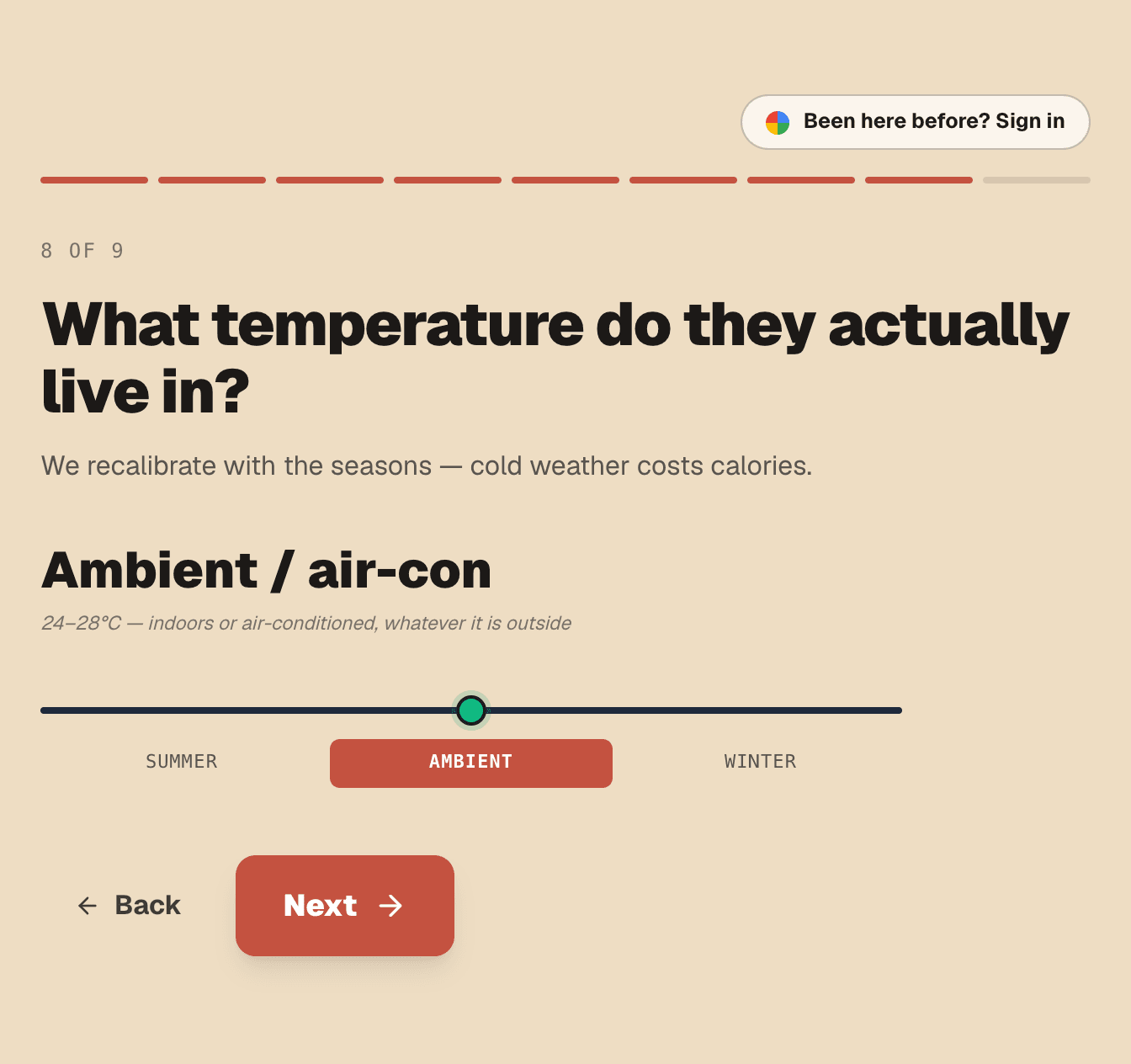
8. What temperature do they actually live in?
We recalibrate with the seasons — cold weather costs calories.
Keeping warm costs energy. An animal living in an Indian summer and one living through a hill winter do not eat the same amount.
Bruno’s answerAmbient / air-con
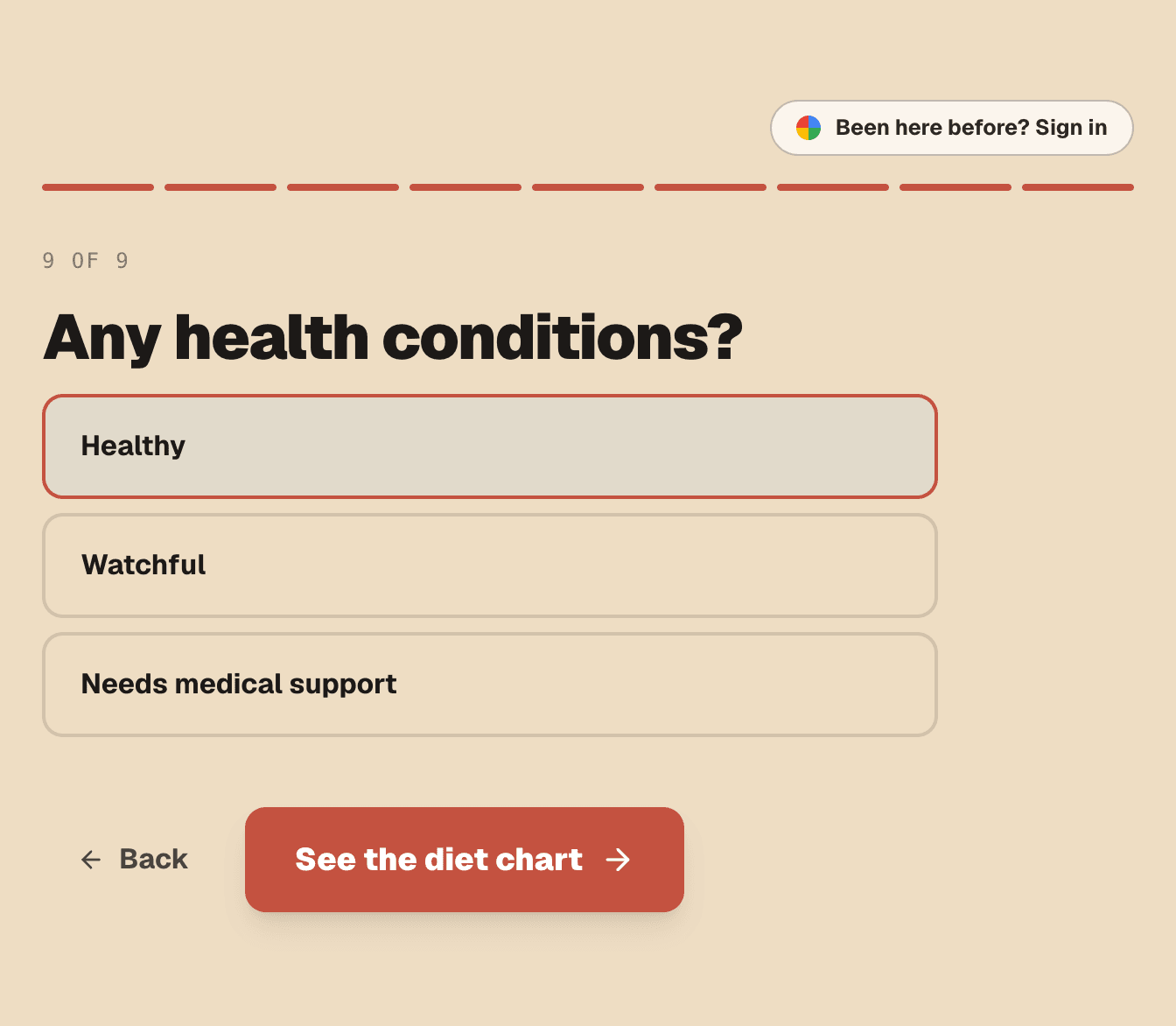
9. Any health conditions?
Growlrr is maintenance nutrition for a healthy adult animal, not treatment. "Needs medical support" stops the builder on this card and says so, rather than handing out a plan that could cut across a vet's protocol.
Bruno’s answerHealthy
Change their food slowly.
Not a question — the transition schedule, shown before the plan. A quarter fresh for three days, half, three quarters, then all fresh from day ten. Ordinary veterinary practice, not a Growlrr protocol.
Bruno’s answerAcknowledged
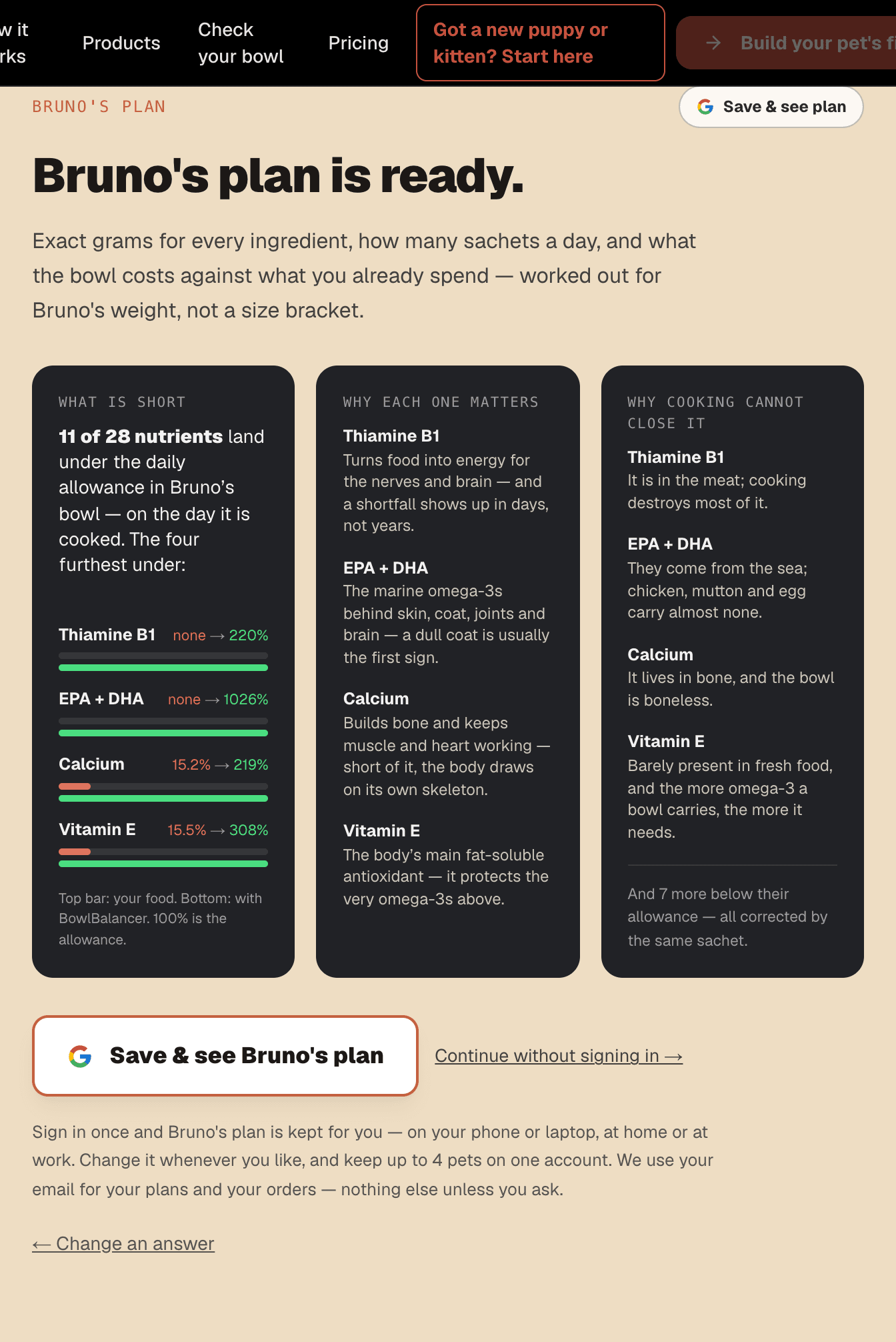
Bruno's plan is ready.
What is short, why each one matters, and why cooking cannot close it — shown before any sign-in. Signing in saves the plan and unlocks the full 28-nutrient report; "continue without signing in" goes straight on to the plan.
Bruno’s answer11 of 28 nutrients short
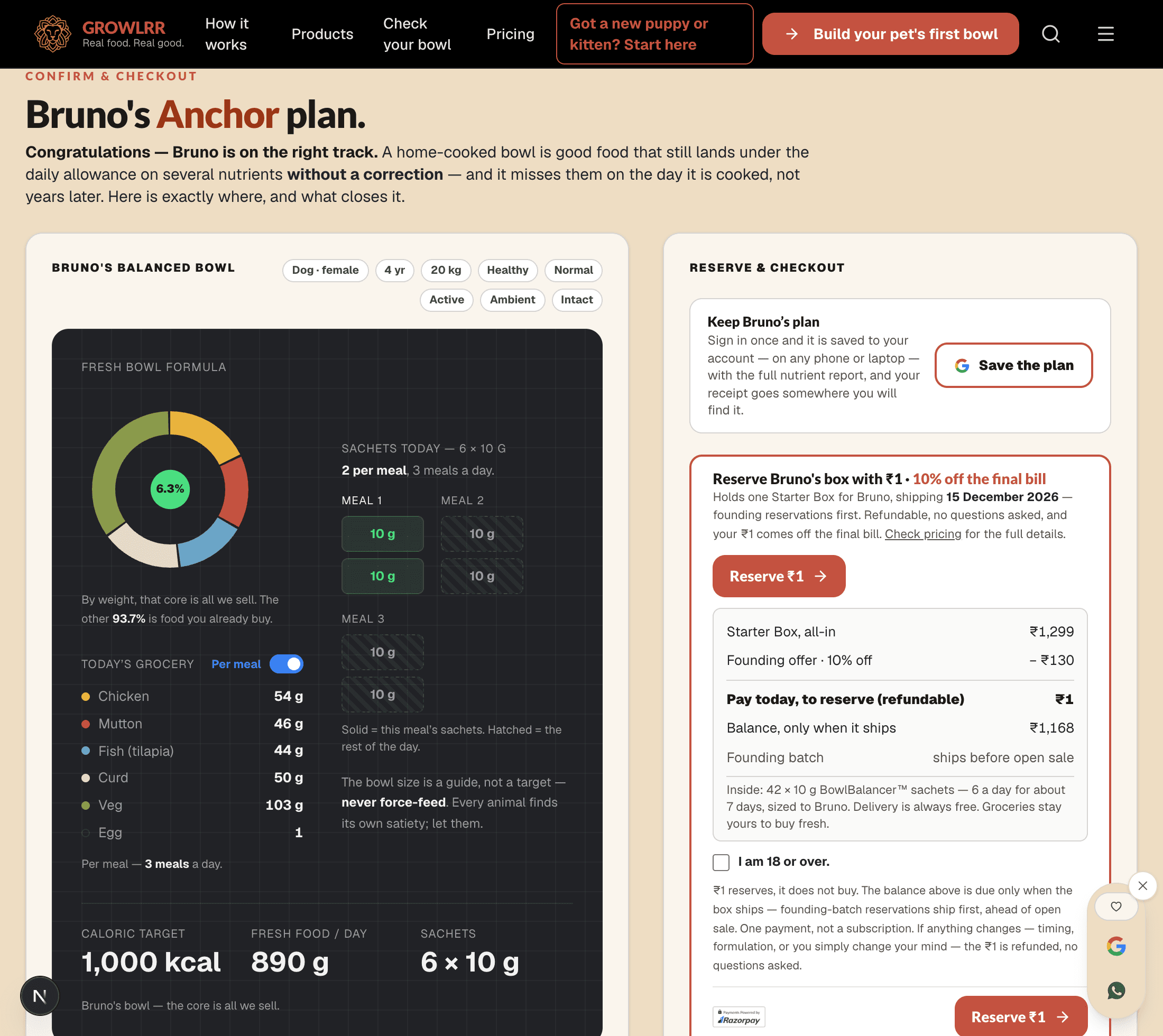
Bruno's plan, and the checkout.
The grams, the sachet count laid out meal by meal, the bill, and the ₹1 reservation. This is the last screen before payment.
Bruno’s answer6 × 10 g a day
Bruno’s plan
Bruno needs 1,000 kcal a day — resting energy for 20 kg, multiplied by 1.50 for intact, normal build, active and ambient / air-con. That comes to 890 g of fresh food across 3 meals, corrected by 6 × 10 g sachets a day — two per meal.
What goes in the bowl
| Ingredient | Per day | Per meal (×3) |
|---|---|---|
| Chicken mince | 161 g | 54 g |
| Mutton mince | 137 g | 46 g |
| Fish (tilapia) | 132 g | 44 g |
| Curd (dahi) | 150 g | 50 g |
| Rainbow veg mix | 310 g | 103 g |
| Egg (whole, cooked) | 3 | 1.0 |
| Growlrr DogCore™ sachets | 6 × 10 g | 2 × 10 g |
Cooked, boneless, no salt and no onion or garlic. The groceries are yours to buy locally — they are not in the order. Proportions can be swapped inside the published rules; the sachet count does not change, because it is set by body weight, not by what is in the bowl.
What that bowl is short of, and what closes it
Cooked well and fed exactly as above, 11 of the 28 nutrients we check land under the daily allowance — on the day it is cooked, not years later. With the sachets, all 28 are met and none lands above a safe upper limit. The four that start furthest below:
Turns food into energy for the nerves and brain — and a shortfall shows up in days, not years.
Missing becauseIt is in the meat; cooking destroys most of it.
The marine omega-3s behind skin, coat, joints and brain — a dull coat is usually the first sign.
Missing becauseThey come from the sea; chicken, mutton and egg carry almost none.
Builds bone and keeps muscle and heart working — short of it, the body draws on its own skeleton.
Missing becauseIt lives in bone, and the bowl is boneless.
The body’s main fat-soluble antioxidant — it protects the very omega-3s above.
Missing becauseBarely present in fresh food, and the more omega-3 a bowl carries, the more it needs.
Allowances are the NRC 2006 recommended allowances, cross-checked against FEDIAF. How the formulation is substantiated, and what that substantiation does and does not establish, is set out on the scientific basis and validation page.
What Bruno’s day costs
Two numbers, kept apart on purpose: the groceries you buy anyway, and the part we charge for. Grocery rates are a real Chennai app-delivery basket, so they are a guide rather than your bill.
One 10 g sachet is ₹55. The Starter Box is ₹1,299 all-in and holds 42 × 10 g sachets — 6 a day, which is Bruno’s first 7 days. It is not a 7-day course: this is everyday food, you carry on at the same 6 a day, and you reorder when the box runs low. The box is a flat price and its contents are sized to the animal, so a bigger animal gets more sachets rather than a bigger bill. Today you can hold one for ₹1, refundable; the founding discount takes ₹130 off and the balance of ₹1,168 falls due only when it ships, from 15 December 2026. Full terms on pricing.
Your animal is not Bruno
Every number above moves with body weight, and most of them move with the four lifestyle answers too. Run the same nine questions for your own dog and the plan comes back in under two minutes, free, before anything is bought.